

Biden embraces a Trump policy in backing Arab-Israeli deals

1 / 2
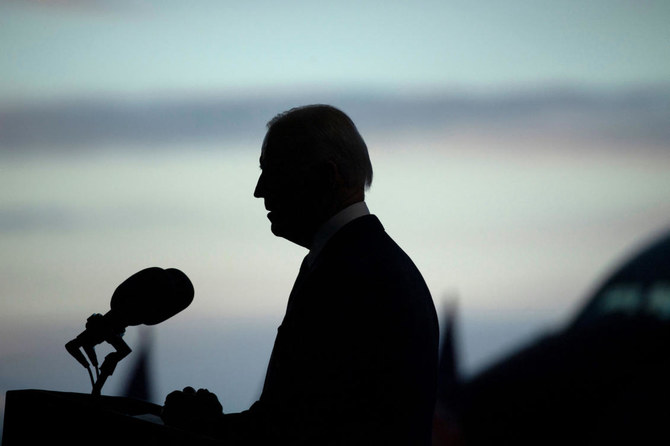
The Biden administration saw significant prospects of several other Arab governments signing accords soothing and normalizing relations with Israel. (File/AFP)
2 / 2
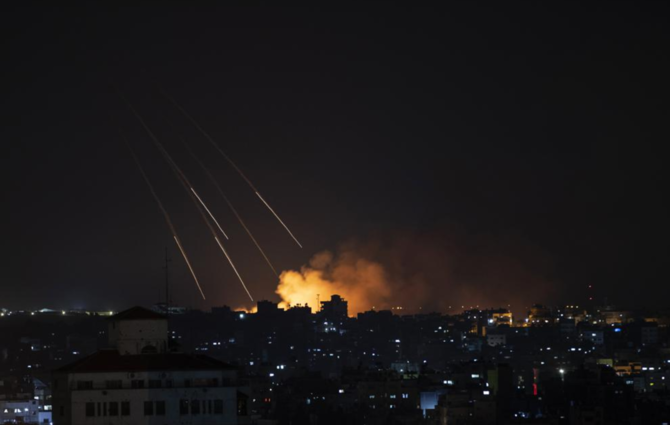
Smoke rises following Israeli missile strikes on Gaza City, May 13, 2021. (File/AP)
Short Url
Updated 10 June 2021
Follow

Biden embraces a Trump policy in backing Arab-Israeli deals

  • The Trump administration put US clout and incentives into landing pacts by four Arab states last year
  • The 11-day war between Israel and Hamas militants last month has complicated US-backed diplomacy

The Biden administration is laying the groundwork for a renewed push to encourage more Arab countries to sign accords with Israel and working to strengthen existing deals after last month’s devastating war in the Gaza Strip interrupted those diplomatic efforts.

The embrace of the so-called Abraham Accords is a rare carryover of a signature Trump administration policy by president Joe Biden and other democrats.

The Trump administration put US clout and incentives into landing the country-by-country pacts by four Arab states last year, easing enmity and isolation for the Jewish state in the Middle East that had dated back to Israel’s 1948 founding. The Biden administration saw significant prospects of several other Arab governments signing accords soothing and normalizing relations with Israel. US officials have declined to publicly identify the countries they regard as promising prospects.

Sudan, which signed a general declaration of peaceful intent but has not yet signed on to diplomatic relations with Israel, had been a prospect. Oman, which has a policy of non-interference that allows it to be a broker across the

Middle East’s fault lines, long has been seen by Westerners as a likely contender.

But the 11-day war between Israel and Gaza’s Hamas militant rulers last month has complicated US-backed diplomacy for new Abraham accords.

The fighting “has strengthened the conviction of opponents of normalization” with Israel, activist Doura Gambo said in Sudan. Sudanese were already divided over their government’s agreement last year to become one of the four Arab states signing accords. In Sudan’s case, the Trump administration offered financial relief from US sanctions.

Last month’s bloodshed, which killed 254 Palestinians — including 66 children and at least 22 members of one family — resonated deeply with the Arab public, including in the other countries that had signed accords with Israel: the United Arab Emirates, Bahrain and Morocco. Thirteen people died in Israel, including two children and one soldier.

The Biden administration is considering appointing a former US ambassador to Israel, Dan Shapiro, to a Mideast role that would marshal and potentially expand the country-by-country accords between Israel and Mideast governments.

Two people familiar with the matter confirmed Shapiro was being considered for the job, as first reported by The Washington Post. They spoke on condition of anonymity because they were not authorized to comment publicly.

US officials also are working to encourage more business, education and other ties among the four Arab states and Israel. They hope visible success there will also promote the bilateral accords in the region, at the same time the US works to advance resolution of the Israel-Palestinian conflict.

Last year, the United Arab Emirates became the first Arab country in over two decades to establish ties with Israel, after Egypt and Jordan in 1979 and 1994, respectively. It was a move that bypassed the Palestinians, who saw it as betrayal.

The Abraham Accords include a general declaration of support for peaceful relations in the Middle East among Jews, Muslims and Christians, all followers of religions linked to the patriarch Abraham. The Trump administration saw the accords partly as paving a path toward full ties with Israel, including in security and intelligence cooperation to counter common rivals, such as Iran.

The deals former president Donald Trump struck were “an important achievement, one that not only we support, but one we’d like to build on,” US secretary of state Antony Blinken told the House Foreign Affairs Committee this week.

In addition, “we’re looking at countries that may want to join in and, and take part and begin to normalize their own relations with Israel. That, too, has been very much part of conversations I’ve had with, with several of my counterparts,” Blinken added.

Opponents of these deals, however, argue that they undermine Arab consensus around only recognizing Israel when it resumes serious peace talks with the Palestinians that lead to tangible concessions.

“These agreements were never about the peace process,” said Marwan Muasher, a former foreign minister of Jordan, who charges that Israeli Prime Minister Benjamin Netanyahu saw the accords as an alternative to peace-making with the Palestinians.

“Were they helpful to the peace process? No, they were not,” Muasher said. “They gave Israel the false impression that it can forge peace agreements with Arab states as a substitute for coming to terms with the Palestinians.”

Supporters of the country-by-country accords say isolating Israel failed to overcome decades of stalemate on Palestinians’ demand for their own state with its capital in East Jerusalem.

“As many ways as the Biden administration will depart from Trump policy in the region, there will be places where it sees an interest in continuity,” said democratic sen. Chris Murphy of Connecticut, who spoke to officials in Oman on a trip immediately before last month’s Gaza war erupted.

Before any new efforts on the accords move forward, big political and pragmatic developments need to fall into place in the region. Eyes are on Israel at the moment to see how a possible new coalition government led by a new prime minister may affect Israeli-Palestinian relations, especially in the aftermath of the Gaza war.

The Knesset is set to vote on Sunday on whether to confirm the new government and end Prime Minister Benjamin Netanyahu’s 12-year rule. If it does, Yamina party leader Naftali Bennett will become prime minister. Bennett opposes Palestinian statehood.

The accords signed by the four Arab nations so far seem solidly in place despite the strain of last month’s war. So too do the big incentives that the Trump administration threw in to help close the deals, such as US recognition of the disputed territory of Western Sahara for Morocco.

In the UAE, a Gulf financial hub that has been the most enthusiastic about establishing ties with Israel, Emirati political analyst Abdulkhaleq Abdulla said the government is gauging public sentiment, but can also control the street and sometimes defy whatever public opposition there is.

“The UAE have taken this decision. They knew exactly where they are and knew the risk, and they are not going back on it,” he said.


War powers resolution fails in Senate as 2 Republicans bow to Trump pressure

Updated 15 January 2026
Follow

War powers resolution fails in Senate as 2 Republicans bow to Trump pressure

WASHINGTON: Senate Republicans voted to dismiss a war powers resolution Wednesday that would have limited President Donald Trump’s ability to conduct further attacks on Venezuela after two GOP senators reversed course on supporting the legislation.
Trump put intense pressure on five Republican senators who joined with Democrats to advance the resolution last week and ultimately prevailed in heading off passage of the legislation. Two of the Republicans — Sens. Josh Hawley of Missouri and Todd Young of Indiana — flipped under the pressure.
Vice President JD Vance had to break the 50-50 deadlock in the Senate on a Republican motion to dismiss the bill.
The outcome of the high-profile vote demonstrated how Trump still has command over much of the Republican conference, yet the razor-thin vote tally also showed the growing concern on Capitol Hill over the president’s aggressive foreign policy ambitions.
Democrats forced the debate after US troops captured Venezuelan leader Nicolás Maduro in a surprise nighttime raid earlier this month
“Here we have one of the most successful attacks ever and they find a way to be against it. It’s pretty amazing. And it’s a shame,” Trump said at a speech in Michigan Tuesday. He also hurled insults at several of the Republicans who advanced the legislation, calling Sen. Rand Paul of Kentucky a “stone cold loser” and Sens. Lisa Murkowski of Alaska and Susan Collins of Maine “disasters.” Those three Republicans stuck to their support for the legislation.
Trump’s latest comments followed earlier phone calls with the senators, which they described as terse. The president’s fury underscored how the war powers vote had taken on new political significance as Trump also threatens military action to accomplish his goal of possessing Greenland.
The legislation, even if it had cleared the Senate, had virtually no chance of becoming law because it would eventually need to be signed by Trump himself. But it represented both a test of GOP loyalty to the president and a marker for how much leeway the Republican-controlled Senate is willing to give Trump to use the military abroad. Republican angst over his recent foreign policy moves — especially threats of using military force to seize Greenland from a NATO ally — is still running high in Congress.
Two Republicans reconsider
Hawley, who helped advance the war powers resolution last week, said Trump’s message during a phone call was that the legislation “really ties my hands.” The senator said he had a follow-up phone call with Secretary of State Marco Rubio Monday and was told “point blank, we’re not going to do ground troops.”
The senator added that he also received assurances that the Trump administration will follow constitutional requirements if it becomes necessary to deploy troops again to the South American country.
“We’re getting along very well with Venezuela,” Trump told reporters at a ceremony for the signing of an unrelated bill Wednesday.
As senators went to the floor for the vote Wednesday evening, Young also told reporters he was no longer in support. He said that he had extensive conversations with Rubio and received assurances that the secretary of state will appear at a public hearing before the Senate Foreign Relations Committee.
Young also shared a letter from Rubio that stated the president will “seek congressional authorization in advance (circumstances permitting)” if he engaged in “major military operations” in Venezuela.
The senators also said his efforts were also instrumental in pushing the administration to release Wednesday a 22-page Justice Department memo laying out the legal justification for the snatch-and-grab operation against Maduro.
That memo, which was heavily redacted, indicates that the administration, for now, has no plans to ramp up military operations in Venezuela.
“We were assured that there is no contingency plan to engage in any substantial and sustained operation that would amount to a constitutional war,” according to the memo signed by Assistant Attorney General Elliot Gaiser.
Trump’s shifting rationale for military intervention
Trump has used a series of legal arguments for his campaign against Maduro.
As he built up a naval force in the Caribbean and destroyed vessels that were allegedly carrying drugs from Venezuela, the Trump administration tapped wartime powers under the global war on terror by designating drug cartels as terrorist organizations.
The administration has claimed the capture of Maduro himself was actually a law enforcement operation, essentially to extradite the Venezuelan president to stand trial for charges in the US that were filed in 2020.
Paul criticized the administration for first describing its military build-up in Caribbean as a counternarcotics operation but now floating Venezuela’s vast oil reserves as a reason for maintaining pressure.
“The bait and switch has already happened,” he said.
Trump’s foreign policy worries Congress
Lawmakers, including a significant number of Republicans, have been alarmed by Trump’s recent foreign policy talk. In recent weeks, he has pledged that the US will “run” Venezuela for years to come, threatened military action to take possession of Greenland and told Iranians protesting their government that ” help is on its way.”
Senior Republicans have tried to massage the relationship between Trump and Denmark, a NATO ally that holds Greenland as a semi-autonomous territory. But Danish officials emerged from a meeting with Vance and Rubio Wednesday saying a “fundamental disagreement” over Greenland remains.
“What happened tonight is a roadmap to another endless war,” Senate Democratic leader Chuck Schumer said at a news conference following the vote.
More than half of US adults believe President Donald Trump has “gone too far” in using the US military to intervene in other countries, according to a new AP-NORC poll.
House Democrats have also filed a similar war powers resolution and can force a vote on it as soon as next week.
How Republican leaders dismissed the bill

Last week’s procedural vote on the war powers resolution was supposed to set up hours of debate and a vote on final passage. But Republican leaders began searching for a way to defuse the conflict between their members and Trump as well as move on quickly to other business.
Once Hawley and Young changed their support for the bill, Republicans were able to successfully challenge whether it was appropriate when the Trump administration has said US troops are not currently deployed in Venezuela.
“We’re not currently conducting military operations there,” said Senate Majority Leader John Thune in a floor speech. “But Democrats are taking up this bill because their anti-Trump hysteria knows no bounds.”
Democratic Sen. Tim Kaine, who has brought a series of war powers resolutions this year, accused Republicans of burying a debate about the merits of an ongoing campaign of attacks and threats against Venezuela.
“If this cause and if this legal basis were so righteous, the administration and its supporters would not be afraid to have this debate before the public and the United States Senate,” he said in a floor speech.