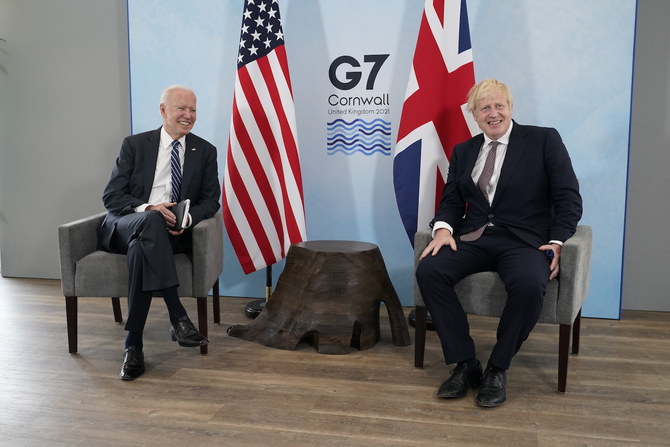
CARBIS BAY, England: US President Joe Biden and British Prime Minister Boris Johnson looked back on illustrious wartime predecessors as they met ahead of a Group of Seven summit in England.
At their first meeting in the seaside resort of Carbis Bay, the two leaders inspected documents Thursday related to the Atlantic Charter, a declaration signed by British Prime Minister Winston Churchill and US President Franklin D. Roosevelt in August 1941 setting out common goals for the world after World War II. Those goals included freer trade, disarmament and the right to self-determination of all people.
Johnson noted that the charter laid the foundation for the United Nations and NATO. “Yeah, I know,” Biden said.
At their meeting, the two leaders plan to sign what they’re calling a new Atlantic Charter, pledging to “defend the principles, values, and institutions of democracy and open societies.”
The original charter is often cited as a cornerstone of the trans-Atlantic “special relationship.”
Johnson’s predecessor, Theresa May, gave a copy of the charter to Donald Trump in 2019 as part of efforts to charm the volatile then-president. It had little success; Trump publicly disparaged May and derided international bodies such as the UN.

Biden, Johnson seek to sign new Atlantic charter
https://arab.news/bn54g
Biden, Johnson seek to sign new Atlantic charter
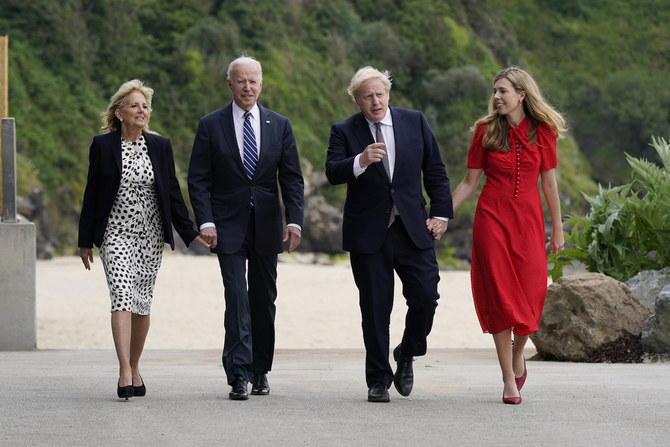
- At their meeting, the two leaders plan to sign what they’re calling a new Atlantic Charter
- The charter pledges to “defend the principles, values, and institutions of democracy and open societies”
Ethiopia’s prime minister accuses Eritrea of mass killings during Tigray war
- Landlocked Ethiopia says that Eritrea is arming rebel groups, while Eritrea says Ethiopia’s aspiration is to gain access to a seaport
- Ethiopia lost sovereign access to the Red Sea when Eritrea seceded in 1993 after decades of guerrilla warfare
ADDIS ABABA: Ethiopia’s government Tuesday for the first time acknowledged the involvement of troops from neighboring Eritrea in the war in the Tigray region that ended in 2022, accusing them of mass killings, amid reports of renewed fighting in the region.
Ethiopian Prime Minister Abiy Ahmed, while addressing parliament Tuesday, accused Eritrean troops fighting alongside Ethiopian forces of mass killings in the war, during which more than 400,000 people are estimated to have died.
Eritrean and Ethiopian troops fought against regional forces in the northern Tigray region in a war that ended in 2022 with the signing of a peace agreement.
Eritrea’s Information Minister Yemane Gebremeskel told The Associated Press that Ahmed’s comments were “cheap and despicable lies” and did not merit a response.
Both nations have been accusing each other of provoking a potential civil war, with landlocked Ethiopia saying that Eritrea is arming and funding rebel groups, while Eritrea says Ethiopia’s aspiration is to gain access to a seaport.
“The rift did not begin with the Red Sea issue, as many people think,” Ahmed told parliamentarians. “It started in the first round of the war in Tigray, when the Eritrean army followed us into Shire and began demolishing houses, massacred our youth in Axum, looted factories in Adwa, and uprooted our factories.”
“The Red Sea and Ethiopia cannot remain separated forever,” he added.
Ethiopia lost sovereign access to the Red Sea when Eritrea seceded in 1993 after decades of guerrilla warfare.
Gebremeskel said the prime minister has only recently changed his tune in his push for access to the Red Sea.
Ahmed “and his top military brass were profusely showering praises and State Medals on the Eritrea army and its senior officers. … But when he later developed the delusional malaise of ‘sovereignty access to the sea’ and an agenda of war against Eritrea, he began to sing to a different chorus,” he said.
Eritrea and Ethiopia initially made peace after Abiy came to power in 2018, with Abiy winning a Nobel Peace Prize for his efforts toward reconciliation.
In June, Eritrea accused Ethiopia of having a “long-brewing war agenda” aimed at seizing its Red Sea ports. Ethiopia recently said that Eritrea was “actively preparing to wage war against it.”
Analysts say an alliance between Eritrea and regional forces in the troubled Tigray region may be forming, as fighting has been reported in recent weeks. Flights by the national carrier to the region were canceled last week over the renewed clashes.


