

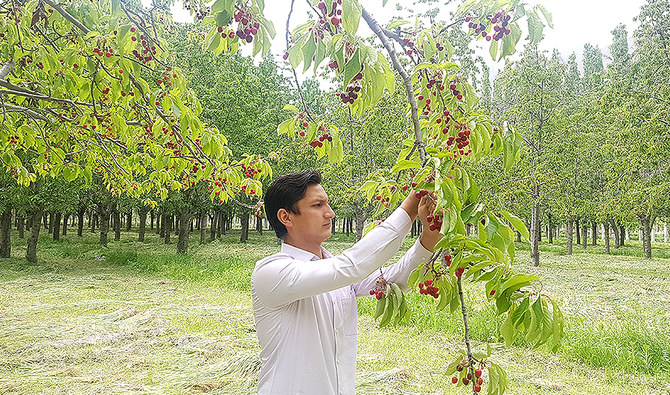

Khaplu, Ghanche: Cherry farmers in Pakistan’s northern region of Gilgit-Baltistan, whose businesses were upended by the COVID-19 pandemic last year, are hopeful their trade will thrive this harvest season as coronavirus restrictions, especially on travel, are lifted across the country.
The picturesque mountainous Gilgit-Baltistan, with its mild to cold climate, is the top producer of the fruit in the region with 6,000 metric tons of cherries – equivalent to the weight of 146 aeroplanes – harvested in 2020, according to Ghulamullah Saqib, deputy director of Gilgit-Baltistan’s agriculture department. Around Rs600 million ($3.8 million) in revenue is earned by the industry each year, he said.
But a COVID-19 ban on tourism and transport services disrupted supply chains and led to labor redundancy and up to 50 percent in revenue losses last year, leaving few takers for the prized fruit from the region.
Farmers are hopeful this year will be better.
“Thank God!” Muhammad Hussain, a Nagar-based farmer, said. “Now there is no ban on tourism and transport this year. We are very hopeful for this year, that all of our products will reach the market without any difficulties.”
Hazif ur Rehman, project director of the Khashal Cherry Farm in Gilgit-Baltistan’s easternmost district of Ghanche, said farmers had managed to sell only 50 percent of their produce in the last harvest cycle, which lasts from May to July.
“Before the pandemic, we exported 800-1,000 tons of cherries to Gulf countries, including the UAE and Kuwait,” Rehman said. “We were badly affected by the pandemic as we had to reduce the labor force from 70 to 15 [percent] due to a ban on tourism and transport services last year.”
“But with the tourism sector reopening we hope to sell all the produce this year,” the farmer added.
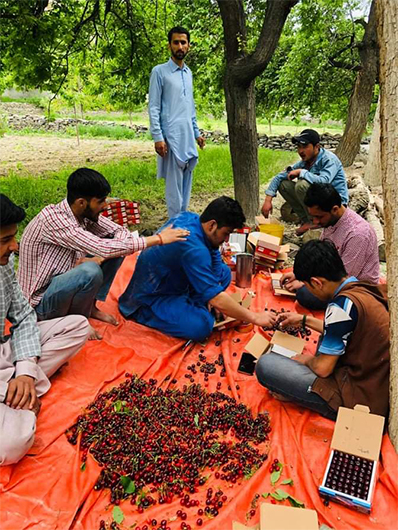
Workers pack cherries at a farm in Nagar district of Gilgit-Baltitsan, Pakistan, on May June 4, 2021 (Photo courtesy: social media)
Another cherry farmer, Mir Wazir Mir from Ghizer, said Pakistan’s anti-virus measures early last year, including a restriction on interstate travel, had affected several businesses in the tourism and agricultural sectors, and rendered nearly 80 percent of Gilgit-Baltistan’s labor force redundant. Arab News could not independently verify the figure for unemployment from the agriculture department.
Mir also said he had to cut by half the cost price of cherries since the pandemic began last February.
“Before the COVID-19 outbreak, I would sell more than 60 tons of cherries to several parts of the country, including Islamabad and Lahore, at Rs150 per kg,” he said. “Now, I sell them for Rs 60 per kg after demand dropped due to the pandemic … I was unable to sell even two or three tons in the market, with tons of cherries wasted.”
Mir said he hoped things would return to “normal” this year.
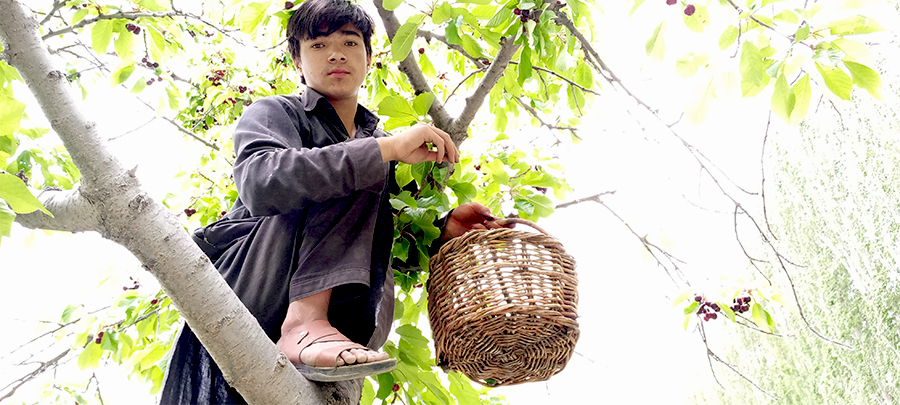
A teenager poses for a photograph on a tree of cherry at Khashal Cherry Farm in district Ghanche of Gilgit-Baltitsan, Pakistan, on May 20, 2021 (AN photo by Nisar Ali)
The local agriculture department did not have figures for this year’s harvest and said data would be available after July, when harvesting ended.
But officials said they were confident the business would thrive once again, and the government would support farmers in ramping up production and creating jobs.
“COVID-19 has not only affected cherry farmers but other sectors too, and we are well aware of farmers’ grievances,” Muhammad Iqbal, an officer at Gilgit-Baltistan’s agriculture department, told Arab News.

A farmer poses for a photograph in front of stocks of cherries in Ghizer district of Gilgit-Baltistan, Pakistan, on June 4, 2021 (Courtesy: Mir Wazir Mir).
Iqbal cited several initiatives undertaken by the department to facilitate farmers, such as providing free cherry trees and distributing 150,000 saplings under the nationwide Ten Billion Tree Tsunami program launched by Prime Minister Imran Khan in 2018. The prestigious five-year tree-planting initiative aims to counter extreme weather conditions in Pakistan that scientists link to climate change.
“We will leave no stone unturned,” Iqbal said, “to help cherry farmers this year and do our level best to provide training and technical support.”


