

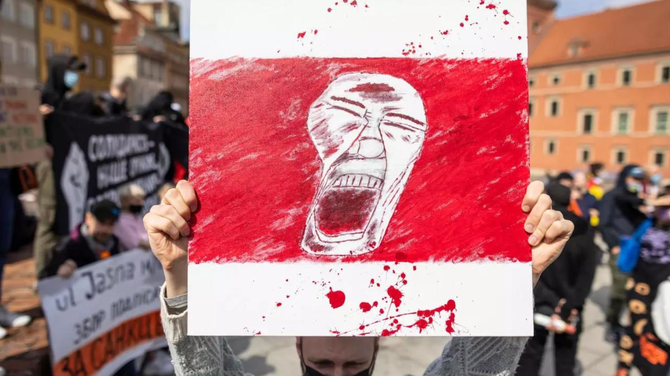

Prague: Not long after Belarus diverted an international flight, forced it to land in Minsk and then arrested activist journalist Roman Protasevich on board, an online campaign to discredit him began.
Stories alleging that Protasevich had ties with neo-Nazis appeared initially in Russian-language media and quickly spread in dozens of languages.
Photos of young men doing Nazi salutes or wearing SS insignia began to pop up on social media, falsely claiming to show Protasevich in his younger years in what experts called a disinformation campaign similar to others against Kremlin critics.
AFP tracked down the man in the Nazi salute photo.
Konstantin Akhromenko, a young Belarusian, confirmed his identity and said the picture was taken “10-12 years ago.”
“We were never Nazis. We took such photos just for laughs, because the Belarusian state propaganda called us Nazis,” he told AFP.
Similarly, the man in the SS helmet turned out to be not Protasevich but Eduard Lobov, a former Belarusian political prisoner who became a volunteer fighter in eastern Ukraine.
Many posts focused on the fact that Protasevich, by his own admission, spent some time with Ukrainian paramilitary units in eastern Ukraine after Russia annexed the Crimean peninsula in 2014.
Labelling him a “terrorist” and “extremist,” they said that he fought with the Azov battalion, some of whose soldiers have been known to harbor white supremacist and neo-Nazi views.
Protasevich’s family, colleagues and even some Azov fighters insist that he was in Ukraine only as a journalist, albeit embedded with Ukrainian forces battling the Russia-backed separatists.
Some online claims about Protasevich contain photos of a young man in a military uniform and AFP has been unable to verify if it is in fact him.
In some of the pictures that bear a resemblance to him, the young man is wearing a military uniform; in others he is brandishing a Kalashnikov rifle and smiling for the camera.
Often he is surrounded by soldiers wearing the insignia of the Azov battalion, a volunteer unit formed in the wake of Russia’s annexation of Crimea.
Vladyslav Sobolevsky, the chief of staff of the Azov battalion in 2014-2017, said that Protasevich had joined as a journalist to “help Ukraine, and in the future to help his own country.”
“His views were: Lukashenko must leave. Belarus should be free,” Sobolevsky said, referring to President Alexander Lukashenko, who has ruled Belarus since 1994.
Likewise, Protasevich’s father Dmitry, who lives in Poland, has said that Roman never actively fought as a soldier.
“My son is and was a journalist. He was in Donbas as a journalist doing his job,” he said.
This was confirmed by both Azov commander Andriy Biletsky and by the battalion spokeswoman Anastasya Rymar, both of whom said that Protasevich followed the unit only to report on the action and did not take an active part in the fighting.
The 26-year-old often mentioned his time in Ukraine in interviews, and there is a video of him being treated for a battle wound.
But he always maintained he was there to document the fighting rather than fight himself.
Euvsdisinfo.eu, a project of the European Union’s foreign service set up to combat Russian disinformation, said there was a deliberate attempt at Protasevich’s online “denigration.”
An article on the project’s website compared these “disinformation efforts” to those seen against Kremlin critics such as anti-corruption campaigner Alexei Navalny.
Russia is a key ally for Lukashenko, who has jailed hundreds of opponents following mass protests that erupted after his disputed re-election last year.
Such mixing of facts, falsehoods and unfounded or unprovable allegations “bears all the signs of typical Kremlin propaganda,” said Jakub Kalensky, a senior fellow at the Atlantic Council, a Washington-based think tank.
“The goal is not to convince the public about one version of the event, but to present many different versions, muddy the waters and bury the facts under a thick layer of lies,” Kalensky told AFP.


