

Blinken: Tehran could build a nuclear bomb ‘in a matter of weeks’

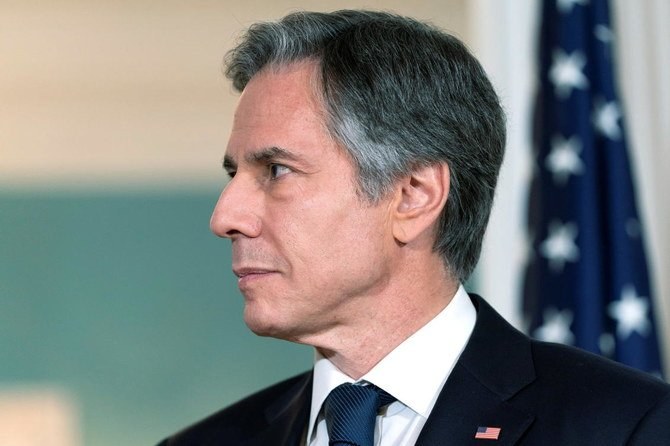
(FILES) In this file photo US Secretary of State Antony Blinken looks on as he meets with Israel’s Defense Minister Benny Gantz, on June 3, 2021, at the State Department in Washington, DC. (AFP)
Short Url
Updated 08 June 2021
Follow

Blinken: Tehran could build a nuclear bomb ‘in a matter of weeks’

  • It remains unclear whether Iran is prepared to do what it needs to do come back into compliance, Blinken told lawmakers
  • The fifth round of talks ended on June 2 and diplomats have said a sixth may begin on Thursday

JEDDAH: Iran could have a nuclear weapon in “a matter of weeks” unless it curbs its enrichment of fissile uranium, the US warned on Monday.

And the head of the UN’s nuclear watchdog said it was “becoming increasingly difficult” to extend a temporary arrangement for inspections of Iran’s nuclear facilities, as Tehran and world powers try to salvage the 2015 Joint Comprehensive Plan of Action (JCPOA).

The JCPOA restricted Iran’s nuclear program in return for relief from international sanctions. It has been dead in the water since 2018, when the US withdrew. President Donald Trump reimposed sanctions, and Tehran began refusing to comply with the agreement’s limits on its uranium enrichment.

“It remains unclear whether Iran is willing and prepared to do what it needs to do come back into compliance,” US Secretary of State Antony Blinken said on Monday. “Meanwhile, its program is galloping forward. The longer this goes on, the more the breakout time gets down. It’s now down, by public reports, to a few months at best. And if this continues, it will get down to a matter of weeks.”

The US and Iran began indirect talks in Vienna in April to see if both could resume compliance with the JCPOA.

The fifth round of talks ended on June 2 and diplomats have said a sixth may begin on Thursday. That would leave only eight days to rescue the deal before Iran’s presidential election on June 18, which is expected to bring in new a hard-line leader. 

US allies in the Gulf are also concerned that the talks are only about Iran’s nuclear program, and fail to address Tehran’s ballistic missile development and its regional meddling through proxy militias in Iraq, Yemen and elsewhere.

In February, Tehran suspended some inspections of its nuclear sites by the International Atomic Energy Agency (IAEA). The agency struck a temporary three-month deal allowing it to continue with a reduced level of access. In late May the arrangement was extended until June 24, but  time was now “very short,” IAEA chief Rafael Grossi said on Monday.

“I can see this space narrowing down,” he said. “I hope we are not going to see our ... inspection capacities curtailed any more. We cannot limit and continue to curtail the ability of the inspectors to inspect and at the same time pretend that there is trust.

“This is where everything you do with any country is interconnected. For me the road to trust goes through information, clarification, inspections and full transparency.

“We have a country that has a very developed and ambitious nuclear program which is enriching at very high levels ... very close to weapons grade.”


Asia rings in 2026 and Australia is defiant after its worst mass shooting

Updated 4 sec ago
Follow

Asia rings in 2026 and Australia is defiant after its worst mass shooting

  • Australia holds defiant celebrations after its worst mass shooting in nearly 30 years
  • Hong Kong holds a subdued event after a deadly fire in tower blocks
MELBOURNE, Australia: Auckland was the first major city to ring in 2026 with a fireworks display launched from New Zealand’s tallest structure, Sky Tower, followed by a defiant celebration in Australia in the aftermath of its worst mass shooting.
South Pacific countries were the first to bid farewell to 2025. Clocks stuck midnight in Auckland 18 hours before the famous ball drop in New York’s Times Square. The five-minute display involved 3,500 fireworks.

Defiant celebration in Australia after worst mass shooting

Australia’s east coast welcomed 2026 two hours after New Zealand. In Sydney, the country’s largest city, celebrations were held under the pall of Australia’s worst mass shooting in almost 30 years. Two gunmen targeted a Hannukah celebration at Bondi Beach on Dec. 14, killing 15 and wounding 40.
A heavy police presence monitored the thousands who thronged to the waterfront to watch a fireworks show centered on the Sydney Harbor Bridge. Many officers openly carried rapid-fire rifles, a first for the annual event.
An hour before midnight, the massacre victims were commemorated with a minute of silence while images of a menorah were projected on the bridge pylons. The crowd was invited to show solidarity with Australia’s Jewish community.
New South Wales Premier Chris Minns urged Sydney residents not to stay away through fear, saying extremists would interpret smaller crowds at New Year’s Eve festivities as a victory.
“We have to show defiance in the face of this terrible crime and say that we’re not going to be cowered by this kind of terrorism,” he said.

Indonesia and Hong Kong hold subdued events

In Indonesia, one of Australia’s nearest neighbors, cities scaled back festivities as a gesture of solidarity with communities devastated by floods and landslides that struck parts of Sumatra island a month ago, claiming more than 1,100 lives.
The capital, Jakarta, was not ringing in 2026 with its usual fanfare, choosing subdued celebrations with a program centered on prayers for victims, city Gov. Pramono Anung said last week.
Makassar Mayor Munafri Arifuddin urged residents of one of Indonesia’s largest cities to forgo parties, calling for prayer and reflection. “Empathy and restraint are more meaningful than fireworks and crowds,” he said.
Concerts and fireworks on Indonesia’s tourist island of Bali were canceled and replaced with a cultural arts event featuring traditional dances.
Hong Kong, too, was ringing in 2026 without the usual spectacle in the sky over iconic Victoria Harbor, after a massive fire in November killed at least 161 people.
The facades of eight landmarks were turning into giant countdown clocks presenting a three-minute light show at midnight.
Many parts of Asia welcome the new year by observing age-old traditions.
In Japan, crowds were gathering at a Buddhist temple in Tokyo for a bell striking at midnight. In the South Korean capital, Seoul, a bell tolling and countdown ceremony were being held at the Bosingak Pavilion.

Berliners celebrate in snowfall

Tourists and Berliners alike marked the end of 2025 by enjoying snowfall, taking selfies and making snowmen in front of the German capital’s cathedral and the iconic Brandenburg Gate. The Berlin TV Tower was nearly invisible thanks to the falling flakes and fog.
Quieter celebrations in Greece and Cyprus
Greece and Cyprus were ringing in 2026 by turning down the volume, replacing traditional fireworks with low-noise pyrotechnics, light shows and drone displays in capital cities. Low-noise fireworks avoid the explosive bursts that generate the loud cracks of traditional displays.
Officials in the countries said the change is intended to make celebrations more welcoming for children and pets, particularly animals sensitive to loud noise.

Additional security in New York City

Police in New York City will have additional anti-terrorism measures at the Times Square ball drop, with “mobile screening teams” in search of suspicious activity. It is not in response to a specific threat, according to NYPD Commissioner Jessica Tisch.
After the ball drops in Times Square, it will rise once again, sparking in red, white and blue, to mark the country’s upcoming 250th birthday celebration. It will be one of several patriotic flourishes throughout the night, organizers said.
Zohran Mamdani will take office as mayor at the start of 2026. Two swearing-in ceremonies are planned, starting with a private ceremonial event around midnight in an old subway station.