

Taliban vow not to harm former Afghan interpreters after US troops’ exit

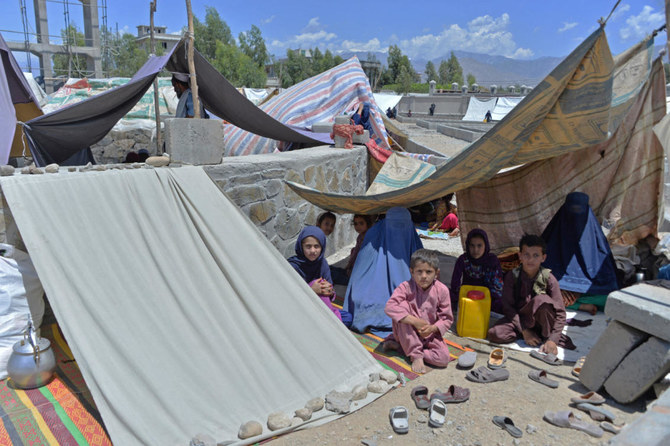
Afghan families who have been displaced due to fighting between Taliban and Afghan forces, take temporary shelter at a market in Mihtarlam, the capital of Laghman Province.(File/AFP)
Short Url
Updated 08 June 2021
Follow

Taliban vow not to harm former Afghan interpreters after US troops’ exit

  • Several translators have said in recent weeks that they fear for their lives once US withdraws from Afghanistan

KABUL: The Taliban pledged on Monday not to target Afghans who worked with US-led foreign troops in the past after several said in recent weeks that they fear retribution from the group once Washington ends its nearly 20-year occupation of Afghanistan.

In a statement released on Monday, the Taliban called on interpreters to “return to their normal lives and … serve their country,” adding that “they shall not be in any danger” on the group’s part.

For several weeks, Afghan interpreters said they were likely to be assassinated by militant groups for assisting American troops during their decades-long fight against the Taliban, which has labeled most as “traitors and collaborators.”

Washington was heavily reliant on the language skills and cultural knowledge of local translators — with many well-versed in English, Dari and Pashtu — to interpret conversations.


The translators’ fears increased manifold following an announcement by US President Joe Biden to withdraw the remaining 3,500 troops from the country by Sept. 11 — the 20th anniversary of the attacks on the Twin Towers in New York.

Since 2014, nonprofit organization No One Left Behind has cataloged more than 300 cases in which the Taliban and other terrorist groups have killed interpreters or family members — many of whom were waiting for visas to the US — while a 2014 report by International Refugee Assistance Project, a nonprofit based in New York City, estimated that an Afghan interpreter was being killed every 36 hours.

The Taliban said it considered “such Afghans as foes” for working in the “ranks of our enemies.”

“But when they abandon enemy ranks and opt to live as ordinary Afghans in their homeland, they should not remain fearful and should continue living a serene life in their own country,” the statement said.

The reactions prompted US-led coalition nations such as the UK, Australia, and Germany to accelerate the Special Immigration Visas (SIV) allotment process for former Afghan interpreters and their families.

Aimed at supporting Afghans who came under threat for their work with the US military and other entities, the SIV program involves a lengthy application process with an average waiting time of three years.

It has faced delays since last year due to disruptions caused by the pandemic.

According to the US State Department, nearly 13,000 SIVs have been granted to Afghan nationals since 2014. Recently, Washington vowed to provide SIVs to 18,000 Afghan translators and their families, as several await their fate.

“If they are using danger as an excuse to bolster their fake asylum case abroad, then that is their problem,” the Taliban said.

With hopes waning for the success of US-sponsored talks between the Taliban and President Ashraf Ghani’s government to end Afghanistan’s protracted conflict, some local and foreign officials believe that the Taliban will try to regain power by force.

Since the US began withdrawing its troops on May 1, the Taliban have made territorial gains in several regions across the country either through violent strikes or after national forces surrendered to the group.

The militants have taken control of at least 10 districts in recent weeks and captured the district of Shahrak in the central Ghor province overnight.

Interior Ministry Spokesman Tariq Arian confirmed the reports to Arab News but reiterated that the government “withdrew the troops to prevent casualties among civilians” in the area.

Experts say the Taliban’s statement was aimed at assuaging fears.

“Afghanistan is facing an uncertain future given that talks have yielded no fruit. People are concerned about their future, and those who can afford to are leaving,” Taj Mohammed, a Kabul-based analyst, told Arab News.

“The Taliban want to reassure outsiders and others who worked for foreign forces that they will not be attacked. All sides have their stories here. But I do not know how convincing the Taliban assurance will be for the translators,” he added.


Trump warns Maduro against playing ‘tough’ as US escalates pressure campaign on Venezuela

Updated 23 December 2025
Follow

Trump warns Maduro against playing ‘tough’ as US escalates pressure campaign on Venezuela

  • Venezuelan President Nicolas Maduro on Monday fired back at Donald Trump, who has ordered US naval forces to blockade the South American country's oil wealth, saying the US president would be "better off" focusing on domestic issues rather than threatenin
  • The Defense Department, under Trump’s orders, continues its campaign of attacks on smaller vessels in the Caribbean and eastern Pacific Ocean that it alleges are carrying drugs to the United States and beyond

WEST PALM BEACH, Florida: President Donald Trump on Monday delivered a new warning to Venezuelan President Nicolás Maduro as the US Coast Guard steps up efforts to interdict oil tankers in the Caribbean Sea as part of the Republican administration’s escalating pressure campaign on the government in Caracas.
Trump was surrounded by his top national security aides, Secretary of State Marco Rubio and Defense Secretary Pete Hegseth, as he suggested that he remains ready to further escalate his four-month pressure campaign on the Maduro government, which began with the stated purpose of stemming the flow of illegal drugs from the South American nation but has developed into something more amorphous.
“If he wants to do something, if he plays tough, it’ll be the last time he’ll ever be able to play tough,” Trump said of Maduro as he took a break from his Florida holiday vacation to announce plans for the Navy to build a new, large warship.
Trump levied his latest threat as the US Coast Guard on Monday continued for a second day to chase a sanctioned oil tanker that the Trump administration describes as part of a “dark fleet” Venezuela is using to evade US sanctions. The tanker, according to the White House, is flying under a false flag and is under a US judicial seizure order.
“It’s moving along and we’ll end up getting it,” Trump said.
It is the third tanker pursued by the Coast Guard, which on Saturday seized a Panama-flagged vessel called Centuries that US officials said was part of the Venezuelan shadow fleet.
The Coast Guard, with assistance from the Navy, seized a sanctioned tanker called Skipper on Dec. 10, also part of the shadow fleet of tankers that the US says operates on the fringes of the law to move sanctioned cargo. That ship was registered in Panama.
Trump, after that first seizure, said the US would carry out a “blockade” of Venezuela. Trump has repeatedly said that Maduro’s days in power are numbered.
Last week, Trump demanded that Venezuela return assets that it seized from US oil companies years ago, justifying anew his announcement of a blockade against sanctioned oil tankers traveling to or from the South American country.
Homeland Security Secretary Kristi Noem, whose agency oversees the Coast Guard, said in a Monday appearance on “Fox & Friends” that the targeting of tankers is intended to send “a message around the world that the illegal activity that Maduro is participating in cannot stand, he needs to be gone, and that we will stand up for our people.”
Russian diplomats evacuate families from Caracas
Meanwhile, Russia’s Foreign Ministry started evacuating the families of diplomats from Venezuela, according to a European intelligence official speaking on condition of anonymity to discuss sensitive information.
The official told The Associated Press the evacuations include women and children and began on Friday, adding that Russian Foreign Ministry officials are assessing the situation in Venezuela in “very grim tones.” The ministry said in an X posting that it was not evacuating the embassy but did not address queries about whether it was evacuating the families of diplomats.
Venezuela’s Foreign Minister Yván Gil on Monday said he spoke by phone with his Russian counterpart, Sergey Lavrov, who he said expressed Russia’s support for Venezuela against Trump’s declared blockade of sanctioned oil tankers.
“We reviewed the aggressions and flagrant violations of international law that have been committed in the Caribbean: attacks against vessels and extrajudicial executions, and the unlawful acts of piracy carried out by the United States government,” Gil said in a statement.
The scene on a Venezuelan beach near a refinery
While US forces targeted the vessels in international waters over the weekend, a tanker that’s considered part of the shadow fleet was spotted moving between Venezuelan refineries, including one about three hours west of the capital, Caracas.
The tanker remained at the refinery in El Palito through Sunday, when families went to the town’s beach to relax with children now on break from school.
Music played on loudspeakers as people swam and surfed with the tanker in the background. Families and groups of teenagers enjoyed themselves, but Manuel Salazar, who has parked cars at the beach for more than three decades, noticed differences from years past, when the country’s oil-dependent economy was in better shape and the energy industry produced at least double the current 1 million barrels per day.
“Up to nine or 10 tankers would wait out there in the bay. One would leave, another would come in,” Salazar, 68, said. “Now, look, one.”
The tanker in El Palito has been identified by Transparencia Venezuela, an independent watchdog promoting government accountability, to be part of the shadow fleet.
Area residents on Sunday recalled when tankers would sound their horns at midnight New Year’s Eve, while some would even send up fireworks to celebrate the holiday.
“Before, during vacations, they’d have barbecues; now all you see is bread with bologna,” Salazar said of Venezuelan families spending the holiday at the beach next to the refinery. “Things are expensive. Food prices keep going up and up every day.”
Venezuela’s ruling party-controlled National Assembly on Monday gave initial approval to a measure that would criminalize a broad range of activities that could be linked to the seizure of oil tankers.
Lawmaker Giuseppe Alessandrello, who introduced the bill, said people could be fined and imprisoned for up to 20 years for promoting, requesting, supporting, financing or participating in “acts of piracy, blockades or other international illegal acts against” commercial entities operating with the South American country.
The Defense Department, under Trump’s orders, continues its campaign of attacks on smaller vessels in the Caribbean and eastern Pacific Ocean that it alleges are carrying drugs to the United States and beyond.
At least 104 people have been killed in 28 known strikes since early September. The strikes have faced scrutiny from US lawmakers and human rights activists, who say the administration has offered scant evidence that its targets are indeed drug smugglers and that the fatal strikes amount to extrajudicial killings.