

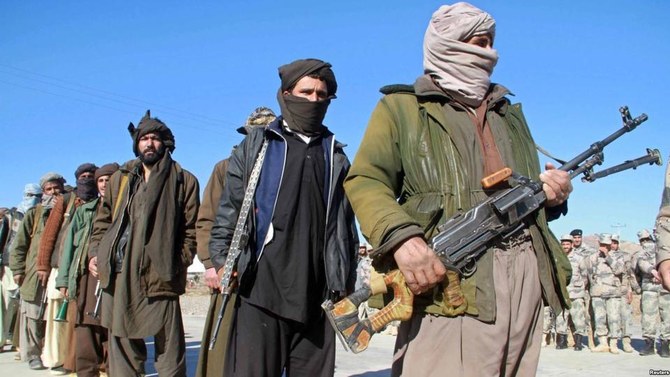

KABUL: Afghan Taliban fighters have captured four more districts from government forces in the past 24 hours amid an escalation in fighting across the country.
It comes after the US began withdrawing its remaining troops from the war-torn state more than a month ago, officials said on Saturday.
The Do Aab district in eastern Nuristan, one of the 34 provinces of Afghanistan, was seized by the Taliban overnight, while Shinkai in southern Zabul, Deh Yak in adjacent Ghazni and Gizab in neighboring Daikundi province were overtaken on Friday.
“The security forces were under Taliban siege for a month in Do Aab. There were more than 300 of them who handed over their weapons to the Taliban and withdrew from their areas as part of a deal,” Ismail Aikan, a lawmaker from Nuristan province, told Arab News.
He added that the Taliban were “now advancing” toward the Noragam region and Do Aab, a strategic district linking Nuristan with the Panjshir province — long seen as an invincible and rugged region that troops belonging to the former Soviet Union and Taliban previously failed to capture.
A lawmaker from Zabul province in southern Afghanistan lamented the loss of the area to the Taliban, who “captured it without any resistance” after overrunning a key army base in Shahjoy, another district of Zabul.
“The troops abandoned their region. The Taliban have stepped up pressure on the government,” Hamidullah Tokhi told Arab News.
“There have been complaints about shortage of troops, lack of equipment and frustration among forces who are forced to leave the areas and just rescue their lives,” he added.
However, the government said that forces had “made a tactical retreat from Do Aab district.”
Interior ministry spokesman Tariq Arian also confirmed the “evacuation of troops from Deh Yak” district in Ghazni province, but refused to share details about Shinkai and other districts.
The Taliban have carried out a string of attacks near vulnerable provincial capitals across Afghanistan since May 1, when the withdrawal process for the nearly 3,000 US-led foreign troops began.
It has resulted in an uptick in violence, which analysts say is a sign that the group is assessing the government’s capacity to safeguard the country once the withdrawal process is completed on Sept. 11.
Shafiq Haqpal, a Kabul-based analyst, listed the “halt of air support of foreign forces to the Afghan government, since the drawdown of US forces, lack of coordination among government leaders and weakness in delivering equipment to battle zones on time” as key reasons behind the Taliban’s advances.
“At the same time, the government says it has pulled up troops from some populated areas to avoid civilian casualties,” he told Arab News, adding the Taliban wanted to “show their might and seek concessions on the negotiations” when the stalled intra-Afghan peace talks resume in Doha, Qatar.
Since last month, at least four other districts have also fallen to the Taliban, two of them close to the capital city, Kabul, in the Maidan Wardak province.
Earlier, the Taliban claimed that “hundreds of government soldiers have defected to the group,” in the captured districts in one month alone.
The Taliban were unavailable for comment when contacted by Arab News on Saturday.
The seizure of the districts follows media reports of hundreds of civilians, government forces and Taliban being killed in recent days, while “thousands of non-combatants have been forced to leave their homes.”
On Friday night, government forces were accused of “mistakenly” killing a local commander and 12 of his men in an air raid in the Kohistan district, according to Abdul Wali Niazi, a lawmaker from Badakhshan.
“The government, instead of targeting the enemies, mistakenly killed the commander and his men. Eight others were badly wounded in the incident,” Niazi told Arab News.
Media reports said the attack was carried out by the defense ministry, which refused to comment on the matter when contacted by Arab News on Saturday.
Friday’s airstrike comes a day after a group of civilians lost their lives in a separate attack by the army in the southern Helmand province after they reportedly “looted” an army base seized by the Taliban on Wednesday.
Mirwasi Khadem, a lawmaker from Helmand, told Arab News that “based on local sources, almost 100 civilians were killed and wounded” in the air raid in the Yakh Chal area of Helmand’s Nahre Saraj district.
The defense ministry refused to comment on the exact death toll among civilians but expressed “regret” over “a number of locals who, with the Taliban, had entered the base and looted military equipment, and were also killed and wounded in the attack.”
Civilian casualties caused by both Afghan and US-led foreign troops hunting for insurgents have been one of the main reasons for the Afghan population’s dwindling support for the government and defense forces.
Although the UN has linked several civilian casualties to militant attacks in recent years, it has also reported a spike in civilian deaths due to air raids and operations carried out by government and foreign troops.
In its annual Afghanistan Protection of Civilians in Armed Conflict report released in February, the UN’s human rights agency and its assistance mission in the country said that there was a “disturbing spike” in civilian deaths, with 3,035 fatalities and 5,785 injuries registered in 2020.


