Asia-Pacific trade ministers mull pandemic, recovery

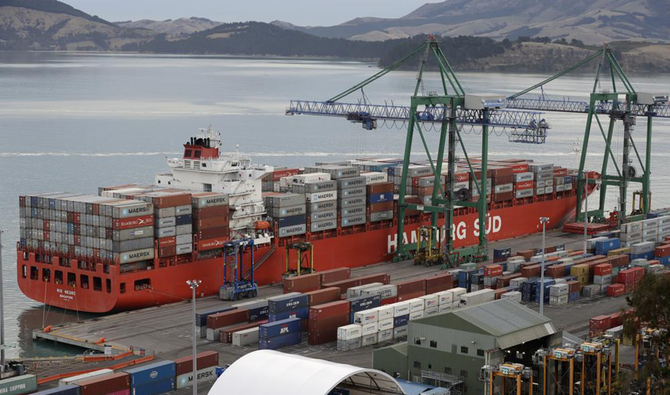
In this June 3, 2020, file photo, containers are loaded onto a ship for export at Lyttelton Port near Christchurch, New Zealand. (AP)
Short Url
Updated 05 June 2021
Follow

Asia-Pacific trade ministers mull pandemic, recovery

  • The trade ministers attending Saturday’s meeting conferred with business leaders on Friday on ways to better manage the health and economic crisis brought on by the pandemic

BANGKOK: Trade ministers from the Pacific Rim were discussing ways to build back better from the pandemic in an online meeting Saturday hosted by New Zealand.

The Asia-Pacific Economic Cooperation forum has long focused on dismantling trade barriers. The meeting of its trade ministers was convened virtually, given the travel restrictions prevailing in the region as coronavirus outbreaks flare in many countries still struggling to obtain and deploy enough COVID-19 vaccines.

On the agenda was a statement on aiding the movement of essential goods needed to fight the pandemic, in line with global trade rules that have been strained in recent years, especially during the administration of President Donald Trump who favored striking trade deals with individual countries.

The trade ministers attending Saturday’s meeting conferred with business leaders on Friday on ways to better manage the health and economic crisis brought on by the pandemic.

“We must ensure that trade plays a role in combatting the worst, continuing effects of COVID-19 through open and unrestricted trade in vaccines, essential medical supplies and associated products,” said Rachel Taulelei, chair of the APEC Business Advisory Council.

In many countries in the Asia-Pacific region, the share of people vaccinated so far is in the low single digits. That includes places like Thailand and Taiwan that initially managed to avoid initial massive outbreaks but now are contending with their worst flare-ups.

APEC members Japan, South Korea and New Zealand are ranked among the worst among all developed nations in vaccinating their people for COVID-19, below many developing countries such as Brazil and India. Australia is also performing comparatively poorly.

This week, President Joe Biden announced the US will swiftly donate an initial allotment of 25 million doses of surplus vaccine overseas through the UN-backed COVAX program, promising infusions for Asia, South and Central America, Africa and others.

That would be a substantial and immediate boost to the lagging COVAX effort, which to date has shared just 76 million doses with needy countries.

While some countries at times have limited exports of vaccines, chemicals needed to make them or of protective equipment such as surgical masks, it’s unclear whether tariffs and other trade barriers have been the main problem since countries like Japan and New Zealand imposed onerous approval requirements that have slowed inoculations.

The average tariff on vaccines is a low 0.8 percent, according to the APEC Secretariat. But duties on some other products can be as high as 30 percent for some countries.

While the average tariff on vaccines is very low within APEC (only 0.8 percent), tariffs are much higher for several goods that are very important in the vaccine supply chain.


Apparel Group expands Saudi presence with 25 new brands 

Updated 7 sec ago
Follow

Apparel Group expands Saudi presence with 25 new brands 

RIYADH: Apparel Group is seeking to strengthen its presence in the Saudi market through digital commerce expansion, adding 25 new brands to its portfolio, and plans to grow its store network by 200 outlets this year to reach a total of 1,000, CEO Neeraj Teckchandani told Al-Eqtisadiah.

He noted that Saudi Arabia has been one of the group’s key markets since entering in 2007, currently operating more than 800 stores across the Kingdom. He added that the group’s current expansion plans include opening over 200 new stores this year, following 150 openings last year, with expectations that Saudi Arabia will become the group’s largest market in terms of footprint and revenue share in the coming period. 

Teckchandani added that the group continues to invest in e-commerce through its digital platform, SixFeet, launched in 2016, which contributed 10 percent of total group sales, noting that plans are underway to gradually increase this share in 2026 through technology investments and enhanced digital shopping experiences. 

The group is also preparing to launch a unified SuperApp this year, integrating its loyalty program, the SixFeet platform, and all digital assets into a single application to accelerate e-commerce growth, improve customer experience, and increase operational efficiency. 

New fashion and restaurant brands 

The CEO said the new brands added to the group’s portfolio cover fashion, footwear, restaurants, and entertainment, including Footasylum, FitFlop, and Clarins, as well as Bobbi Brown, Wagamama, Ivy Asia, and Punjab Grill. 

He noted that some brands have already opened in Saudi Arabia, with further expansion planned this year and next. 

85 brands under the group 

Apparel Group manages 85 global brands and over 2,500 stores across Saudi Arabia, the UAE, Bahrain, Qatar, and Oman. 

The company has also expanded strategically into India, South Africa, Singapore, and Indonesia, as well as Thailand, Malaysia, and Egypt. 

Its portfolio includes internationally renowned fashion, footwear, and lifestyle brands such as Tommy Hilfiger, Charles & Keith, Skechers, Aldo, Crocs, Calvin Klein and Aéropostale. The group also operates food and lifestyle brands including Tim Hortons, Jamie’s Italian, and Cold Stone Creamery, alongside beauty labels such as Inglot and Rituals. R&B, its in-house label, is currently the fastest-growing brand in the region. 

Securing locations in new centers 

Teckchandani pointed out that the Saudi market is witnessing rapid expansion in the shopping mall sector, with 30 new centers expected to open by 2030, affirming that the group has secured strategic locations in several of these projects and aims to expand its store network in parallel with real estate growth in the retail sector. 

He added that the group has also invested in operational infrastructure within Saudi Arabia, establishing a main distribution center in Riyadh to support supply chains, relocating to its new regional headquarters in Majdoul Tower, and expanding its logistics arm, “Connect Logistics,” as well as “Shopfit Interior,” a company specializing in store fit-outs. 

He added that the parent company is prioritizing investment in advanced technology and AI, along with launching the unified SuperApp in the second quarter of 2026, and has appointed a group-level chief digital officer to support this phase, with results expected in the short to medium term. 

Saudi expansion drives growth 

Teckchandani emphasized that Saudi Arabia represents the group’s main growth engine in the coming years, supported by strong consumer demand, rapid development of shopping centers, and increasing contribution from digital commerce. 

Apparel Group’s expansion comes amid a broader retail sector boom in Saudi Arabia, driven by rising consumer spending and accelerated development of malls under Vision 2030. 

The retail sector is one of the largest non-oil contributors to GDP, with increasing growth in digital sales channels as companies integrate e-commerce with traditional stores to enhance operational efficiency and expand market share. 

Major retailers are seeking to capitalize on population growth and rising purchasing power, alongside the expansion of hospitality and entertainment projects, boosting demand for global brands. Investments in logistics infrastructure and digital transformation have also become critical competitive factors, especially as e-commerce accounts for a growing share of total retail sales.