

Pakistani hotels, restaurants demand full reopening as COVID-19 infections decline

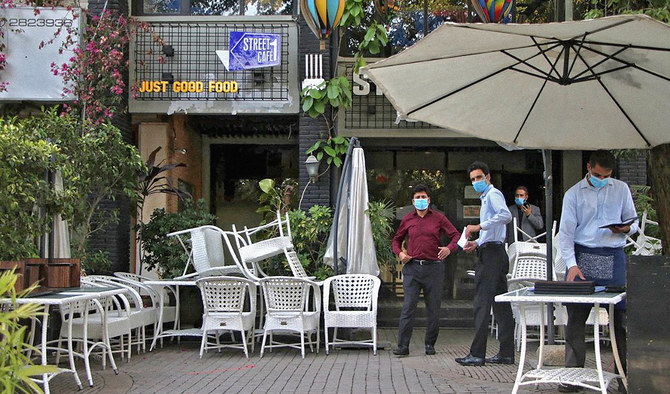
Small restaurants in Rawalpindi Saddar Bazaar make arrangements for outdoor dining on Friday, June 4, 2021, since indoor dining remains closed for customers due to the coronavirus pandemic. (Photo courtesy: All-Rawalpindi Restaurant Association)
Short Url
Updated 08 June 2021
Follow

Pakistani hotels, restaurants demand full reopening as COVID-19 infections decline

  • Thousands of restaurants and cafes in the country have gone out of business since the beginning of the pandemic, industrial representatives say
  • A major Pakistani restaurants association says the government has assured its members full resumption of operations by end of the month

ISLAMABAD: Hotel and restaurant owners across Pakistan have demanded the government allow full resumption of indoor and outdoor dining as the daily coronavirus positivity rate has dropped below four percent and the country’s vaccination drive is gathering momentum.
Pakistan’s hospitality industry and wedding halls have faced strict restrictions since March 2020 after the first wave of the pandemic hit Pakistan.
The virus curbs were eased in May last year after a drop in the daily infection rate, but the government reimposed them with the emergence of the third wave of COVID-19.
At the moment, Pakistan has only allowed outdoor dining with complete shutdown of restaurants on Friday and Saturday, putting the livelihood of thousands of people at risk. The authorities have also allowed staggered reopening of educational institutions, tourist resorts, parks and swimming pools with the ease in daily coronavirus infections.
“Thousands of restaurants and cafes have gone out of business since the beginning of the pandemic due to lack of financial support from the government,” Muhammad Farooq Chaudhry, general secretary for the All-Rawalpindi Restaurant Association, told Arab News on Friday.
Chaudhry said the government had raised the license fee of restaurants and hotels to nearly 15 percent, adding that electricity and gas tariffs had also been increased during different lockdown phases.
“The daily coronavirus positivity has now dropped to less than four percent, and we are also encouraging our staff to get vaccinated,” he said. “The government should allow us full reopening.”
The micro-enterprises of self-employed individuals in the sector remain part of the country’s informal economy.
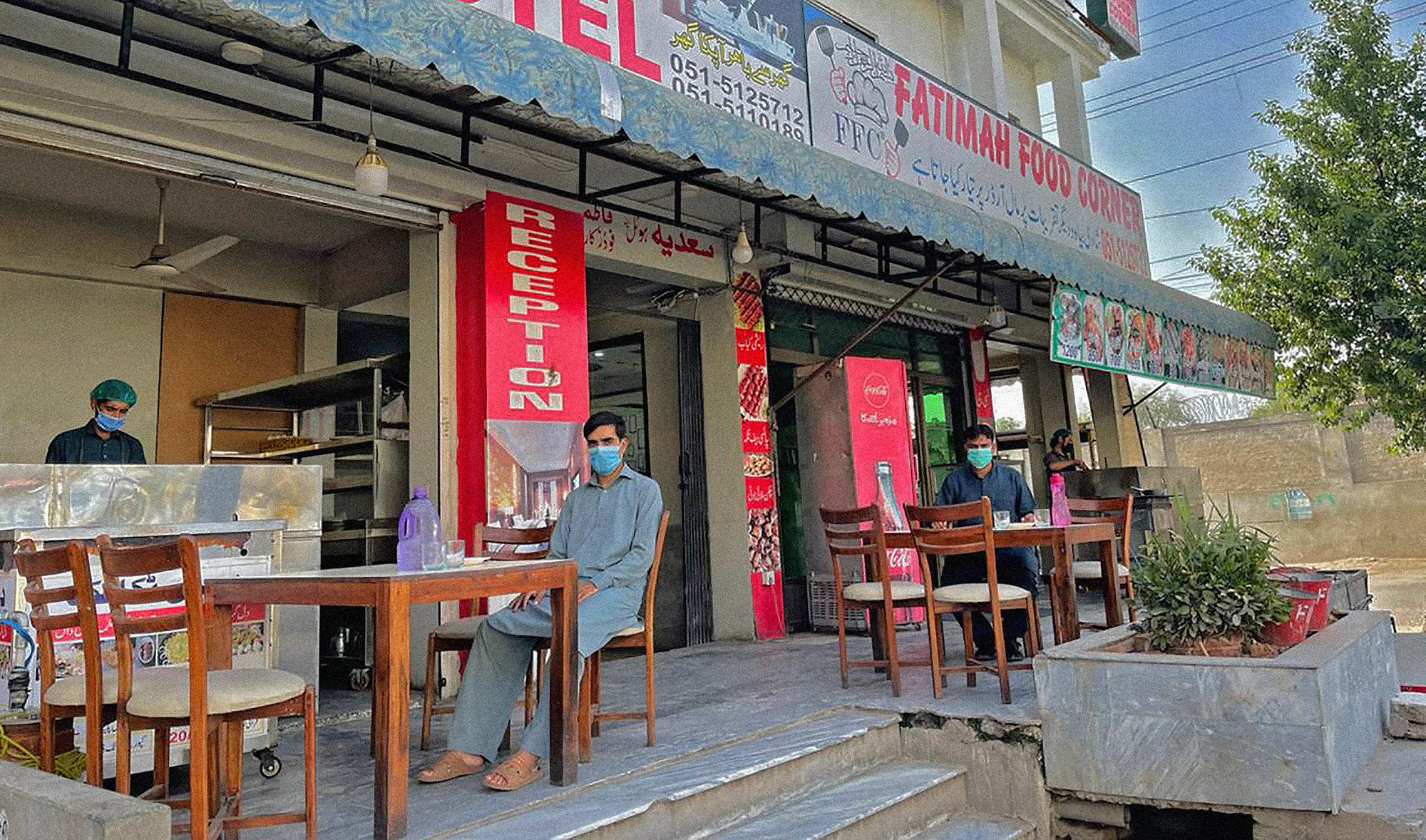


Workers in Islamabad's upscale Kohsar Market prepare to serve their customers in front of their restaurants on Friday, June 4, 2021, since indoor dining remains closed due to the coronavirus pandemic. (AN photo by Aamir Saeed)

While an accurate number of these businesses is not known, estimates suggest they account for 35.7 percent of the total national employment.
The Ministry of National Health Services and Regulations did not respond to repeated calls and text messages from Arab News about the reopening of restaurants, hotels, cafes and coffee shops. 
However, Athar Sultan Chawla, convener of the All-Pakistan Restaurant Association, said that planning minister Asad Umar had recently assured industry representatives full resumption of restaurant activities including indoor dining by the end of this month.
Chawla said most businesses, including manufacturing industries and shopping malls, had been opened, though restaurants, coffee shops and cafes were kept closed to curb the virus spread.
“We have been following the government notified SOPs [standard operating procedures], but even then we are kept closed,” he told Arab News, adding that a majority of people working with him had already got COVID-19 jabs and the government should allow indoor dinning so that these businesses could regain their full potential.
Official figures show daily virus positivity in Pakistan dropped to 3.58 percent on Friday from 11.63 percent on April 20, and COVID-19 vaccines have also been administered to over 8.5 million people.


Women traders face ruin as years of work turn to ash in deadly plaza inferno

Updated 5 sec ago
Follow

Women traders face ruin as years of work turn to ash in deadly plaza inferno

  • Traders estimate losses of over $53 million, more than 100 women workers, dozens of women-led businesses wiped out in Gul Plaza fire
  • In Pakistan, where women run a fraction of formal enterprises, disasters like Gul Plaza fire can erase decades of efforts overnight

KARACHI: Yasmeen Bano stood on the edge of MA Jinnah Road, staring at the blackened remains of Gul Plaza, a shopping center that for decades had been a gateway to financial independence for small traders in Pakistan’s commercial capital.

For Bano, a 55-year-old businesswoman, the charred structure represents far more than a shopping mall. It held the labor of two decades, the savings of a lifetime and the fragile economic security of her family, all wiped out in a deadly fire that tore through the multi-story plaza last week.

Bano began her ladies’ undergarments business in the mid-2000s, gradually expanding to own three shops in the bustling market, a rare achievement in a country where women face steep barriers to entrepreneurship. 

That progress vanished in hours as a blaze broke out on Jan. 17, trapping workers and shoppers inside and burning for more than 24 hours before being brought under control. Recovery operations are still underway as teams sift through unstable debris at the site, which housed over 1,200 shops.

“For 20 years, we worked day and night to build this business,” Bano told Arab News, standing near the wreckage. “I had three shops above, which were my own. All of them have been destroyed.”

Like many traders at Gul Plaza, she had restocked heavily ahead of the wedding season and the holy fasting month of Ramadan starting next month, when sales typically peak. Her inventory, worth around Rs15 million ($53,800), was entirely destroyed.

“All the season’s goods came on loan. Everything is finished,” she said. “Now we have nothing [left], we are insolvent financially.”

FRAGILE FOOTHOLD ERASED

Women entrepreneurs were among the hardest hit by the blaze, traders say. Many had invested personal savings, borrowed informally or relied on family credit to run small businesses that served as their households’ sole source of income.

In Pakistan, women own or lead only a small share of businesses. According to the World Bank and government data, fewer than 5 percent of women participate in formal entrepreneurship, with most operating in the informal sector, where access to insurance, credit protection and safety nets is minimal. In cities like Karachi, markets such as Gul Plaza have long offered women one of the few accessible entry points into commerce.

That precarious foothold has now collapsed.

Kainat Memon, an 18-year-old medical student, ran an undergarments shop with her widowed mother. Both were present when the fire broke out in the building, which housed around 1,200 shops selling garments, luggage, crockery and household goods.

“It was time to close the shop. Everyone was closing their shops... Suddenly there was a loud noise. People started saying that there is a fire,” she recalled.

“We were crying and our eyes were burning. We were having a hard time talking.”

The losses are devastating.

“We have incurred a loss of Rs7–8 million ($28,600) because we had stocked up. Ramadan was coming,” Memon said. “The goods are all burnt. We had invested all our savings. Now we are jobless. All our business is gone.”

For women traders, the losses extended beyond their own families. Many employed other women, often from low-income households, who depended on daily wages or monthly salaries.

“From the basement to the fourth floor, women work here. There are more than a hundred women working here,” said Aisha Farrukh, a 37-year-old trader whose family also lost its business in the blaze.

“Our workers are jobless. We can’t do anything for them now.”

Karachi has a long history of deadly fires in markets and factories, often linked to faulty wiring, overcrowding, illegal construction and weak enforcement of safety regulations. Police have said the Gul Plaza fire may have been triggered by a short circuit, though investigations are ongoing.

Farrukh questioned how quickly the fire spread through the building, saying safety measures were inadequate.

“The government would have to compensate for the financial losses but at this moment, it is difficult to understand how in 10 minutes the entire Gul Plaza turned to ash,” she said. 

“In front of our eyes, our 20 years of hard work turned to ash in under 20 minutes.”

LONG ROAD BACK

The scale of the losses has pushed many traders into insolvency. Tanveer Pasta, president of the Gul Plaza Market Association, said all shops in the plaza were destroyed, estimating total losses at up to Rs15 billion ($53.6 million).

“There were big importers sitting here,” he said. “Just three days before this fire, 31 [shipping] containers were unloaded.”

For women like Bano, Memon and Farrukh, the fire has stripped away not just income but autonomy, turning business owners into debtors overnight in an economy already strained by inflation and slow growth.

The traders are now appealing for government support, warning that without assistance, many women-led enterprises will never reopen.

“We are ruined now,” Farrukh said. “Whether it happened accidentally or because of someone, we need a solution.”