

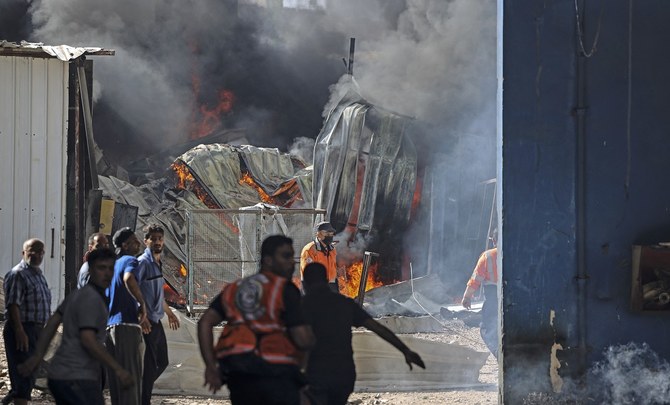

SAO PAULO: Palestinian communities in Latin America and their supporters have organized protests in major cities across the region in response to last month’s Israeli attacks on Gaza.
“The attacks were very painful for us,” Jaime Abedrapo, a Palestinian-Chilean political scientist, told Arab News. “We have relatives and friends living there, and we know that those strikes have been frequent over the past years. It’s a systemic problem.”
An estimated 1 million Palestinians live in Central and South America, especially in Chile, Honduras, Colombia and El Salvador.
About 500,000 live in Chile, forming the largest Palestinian community in Latin America.
On May 18, massive marches were organized in the capital Santiago and the city of Vina del Mar against the Israeli strikes.
“I’m part of the third generation of Palestinian Chileans, a group that has been demonstrating a great connection with Palestine and its challenges,” said Abedrapo.
He added that young Palestinian Chileans have been active on social media, criticizing what they see as biased coverage from mainstream media outlets.
“The world is changing. The younger generations are more worried about human rights. Chilean society as a whole is now more conscious of the Palestinian situation,” he said.
In Brazil, where the Palestinian community is estimated to number 100,000, there were demonstrations against the Israeli bombings as Palestinians desperately sought to stay in contact with their relatives in Gaza.
“My children, sisters and cousins live there,” Palestinian-born medical doctor Ahmed Shehada told Arab News. “I was in touch with them 24 hours a day. The number of dead and wounded kept growing all the time.”
Although the attacks only caused material damage for Shehada’s relatives, he was outraged at the killing of Palestinian civilians, especially children.
The Brazil-Palestine Institute, over which he presides, has been campaigning to raise awareness of the issue among Brazilians.
“One of the most relevant things we can do is spread the truth about the Israeli occupation and mobilize civic institutions, progressive social movements and political parties against Israel’s crimes,” he said.
One of Shehada’s concerns is the role of the Brazilian government in the international arena when it comes to the Palestinian question.
A close ally of Israeli Prime Minister Benjamin Netanyahu, President Jair Bolsonaro in 2019 announced that he would move the Brazilian Embassy from Tel Aviv to Jerusalem, though that has not yet happened.
Shehada lamented that the Bolsonaro administration “has joined a small group of countries in supporting shameful stances against the Palestinians’ rights.”
Adel Turjman, a Palestinian-born resident in Guatemala, also worries about the Central American country’s stance on the Palestine question.
In 2018, then-President Jimmy Morales moved the Guatemalan Embassy in Israel to Jerusalem.
“When his successor Alejandro Giammatei took office, we tried to talk to him about the need to respect UN resolutions. Unfortunately, we haven’t had success,” Turjman told Arab News.
Though the Palestinian community in Guatemala is not large, it has demonstrated against the bombing of Gaza.
“It doesn’t matter if one is Christian or Muslim — my cousins suffer like any other Palestinian under the Israeli state,” said Turjman, who is from a Palestinian-Christian family and has cousins living in Jerusalem.
Meanwhile, Palestinian communities in Latin America have been campaigning for the participation of all the diaspora in the Palestinian National Council (PNC) election.
On Jan. 15, President Mahmoud Abbas announced that the election would take place on Aug. 31.
But with the suspension of the election for the Palestinian Legislative Council that had been scheduled for May 22, it is uncertain now how the electoral process will evolve.
Simaan Khoury, president of the Palestinian Union in Latin America, is a vocal supporter of the diaspora’s participation in the PNC election.
A resident in El Salvador, where the Palestinian community numbers 150,000, he said many of his countrymen have demonstrated against Israel’s attacks.
“A brighter future” for “a free Palestine” can only be achieved with sovereign elections with the participation of all Palestinians, including the diaspora, he told Arab News.
“The Palestinian Latin Americans have never lost pride in their blood. We arrived here barefoot and now we’re doctors, businessmen, industrialists, poets,” Khoury said.
He added that Palestinian communities in Latin America lack regional organization and communication, but expressed hope that such problems would be resolved soon.
“Unfortunately, Palestinian domestic politics also divided us here in Latin America, but we love our nation and we want to take part in the decisions,” he said. “According to the (Palestinian) constitution, we have the right to do so.”


