

Dubai, Saudi oil firms compete with ADNOC for Egyptian military company

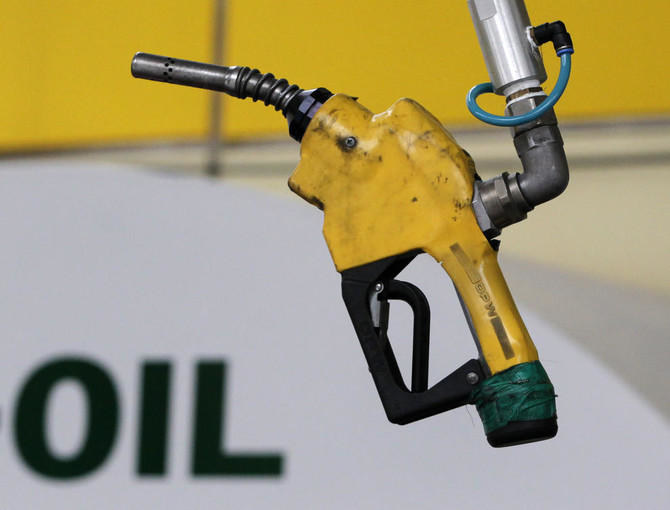
Egypt’s Wataniya Petroleum owns 200 filling stations. (Reuters)
Short Url
Updated 03 June 2021
Follow

Dubai, Saudi oil firms compete with ADNOC for Egyptian military company

  • Wataniya Petroleum is being sold to investors including Egypt's SWF
  • Bidding expected to be complete by end of 2021

RIYADH: Dubai’s state energy firm and Saudi Petromin Corporation have entered a competition with Abu Dhabi’s ADNOC to bid on the first company affiliated with Egyptian army to be offered to investors, Bloomberg reported, citing people familiar with the matter.

This bid will allow the winning company to take joint full ownership of military-owned Wataniya Petroleum, a fuel distribution company with 200 filling stations, with Egypt’s sovereign wealth fund (SFE).

The bidding race is expected to be finalized before the end of 2021. Cairo-based investment bank EFG Hermes is advising the wealth fund on the initiative.

Due diligence is underway on Wataniya, according to the people who asked to remain anonymous as the negotiations are confidential.

The upcoming deal will be the first to offer up to full ownership in about 10 companies owned by the Egyptian National Service Projects Organization, which is affiliated with the Ministry of Defense.

The selected companies would initially be offered to private investors and could then be listed on Egypt’s stock exchange.


GCC growth set to accelerate to 4.4% in 2026 on non-oil strength: World Bank 

Updated 14 January 2026
Follow

GCC growth set to accelerate to 4.4% in 2026 on non-oil strength: World Bank 

RIYADH: Economies across the Gulf Cooperation Council are forecast to grow 4.4 percent in 2026, accelerating to 4.6 percent in 2027, driven by rising non-oil activity in countries including Saudi Arabia, according to an analysis. 

In its Global Economic Prospects report, the World Bank said the Kingdom’s real gross domestic product is projected to grow 4.3 percent in 2026 and 4.4 percent in 2027, up from an expected 3.8 percent in 2025. 

Earlier this month, a separate analysis by Standard Chartered echoed similar expectations, forecasting the Kingdom’s GDP to expand by 4.5 percent in 2026, outperforming the projected global growth average of 3.4 percent, supported by momentum in both hydrocarbon and non-oil sectors. 

The World Bank’s latest forecast broadly aligns with the International Monetary Fund’s October outlook, which projects Saudi Arabia’s GDP to grow by about 4 percent in both 2025 and 2026. 

In its latest report, the World Bank said: “Growth in GCC countries is forecast to increase to 4.4 percent in 2026 and 4.6 percent in 2027, mainly reflecting a steady expansion of non-hydrocarbon activity, in addition to a further rise in hydrocarbon production.” 

It added: “The strengthening of non-hydrocarbon activity — accounting for more than 60 percent of GCC countries’ total GDP — is projected to be supported by expected large-scale investments, including in Kuwait and Saudi Arabia.” 

Expanding the non-oil sector remains a core objective of Saudi Arabia’s Vision 2030 agenda, as the Kingdom continues efforts to reduce its long-standing reliance on crude revenues. 

Highlighting the strength of Saudi Arabia’s non-oil momentum, S&P Global said the Kingdom recorded the highest purchasing managers’ index reading in the region in December, at 57.4, supported by rising new orders, continued growth in non-energy business activity, and expanding employment.

At the country level, the UAE’s economy is projected to grow by 5 percent in 2026, before accelerating to 5.1 percent in 2027. 

Oman’s GDP is forecast to expand by 3.6 percent in 2026 and 4 percent in 2027, while Qatar is expected to record growth of 5.3 percent next year, rising sharply to 6.8 percent in 2027. 

In Kuwait and Bahrain, GDP growth is projected at 2.6 percent and 3.5 percent, respectively, in 2026. 

Across the broader Middle East, North Africa, Afghanistan and Pakistan region, growth is estimated to have reached 3.1 percent in 2025 and is projected to strengthen further to 3.6 percent in 2026 and 3.9 percent in 2027, largely driven by improving performance among oil-exporting economies. 

Potential growth challenges 

The World Bank also outlined several downside risks that could weigh on economic growth across the region. 

These include a re-escalation of armed conflicts, heightened violence or social unrest, which could disrupt economic activity and weaken confidence. 

Other risks include tighter global financial conditions, further increases in trade restrictions and tensions, greater uncertainty over global trade policies, and more frequent or severe natural disasters. 

For oil exporters, lower-than-expected oil prices or heightened price volatility could also dampen growth. 

“A re-escalation of armed conflicts in the region could cause a significant deterioration in consumer and business sentiment, not only in the economies directly affected but also in neighboring economies,” the World Bank said.  

It added: “It could spill over into a broader increase in policy uncertainty and a tightening of financial conditions, dampening investment and economic activity.” 

Global outlook 

The World Bank said the global economy has proved more resilient than expected despite last year’s escalation in trade tensions and policy uncertainty. 

Global economic growth is projected at 2.6 percent in 2026, easing from an estimated 2.7 percent in 2025. 

“The modest slowdown comes on the heels of a post-pandemic rebound over 2021–25 that represented the strongest recovery from a global recession in more than six decades,” the World Bank said, adding that the rebound was uneven and came at the cost of higher inflation and rising debt. 

Among advanced economies, US GDP is projected to grow by 1.6 percent in both 2026 and 2027. 

China’s economy is expected to expand by 4.4 percent in 2026 before slowing to 4.2 percent in 2027, while India’s GDP is forecast to grow by 6.5 percent and 6.6 percent over the same period.