

Practice makes perfect: Serena’s serve leads to win in Paris

1 / 2
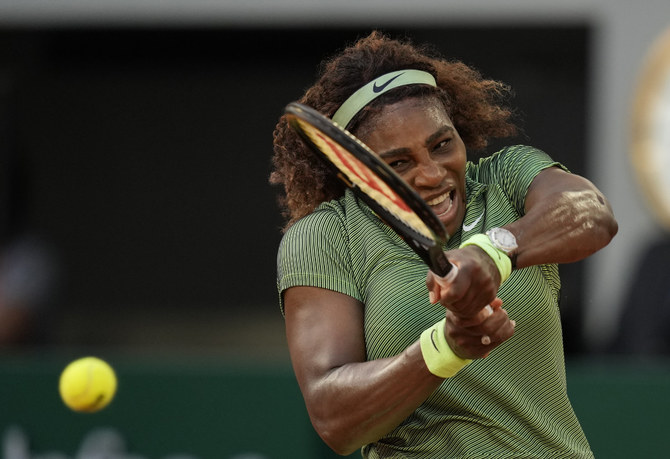
Serena Williams (US) plays a return to Mihaela Buzarnescu (Romania) during their match on day four of the French Open tennis tournament in Paris on June 2, 2021. (AP Photo/Thibault Camus)
2 / 2
Russia's Daniil Medvedev in action during his second round match against Tommy Paul of the US in the French Open on June 2, 202. (REUTERS/Benoit Tessier)
Short Url
Updated 03 June 2021
Follow

Practice makes perfect: Serena’s serve leads to win in Paris

  • In the men's edition, Russia's Daniil Medvedev defeated American Tommy Paul
  • Williams has won three of her 23 Grand Slam singles titles in the French Open

PARIS: Her superior serve back at its unreturnable best, Serena Williams was in full control of her French Open match — until, suddenly, that stroke wasn’t as dominant and neither was she.
And then, pushed to a third set by an opponent offering up all sorts of spins and speeds and angles, Williams regained her form and forged to the finish.
Williams got back to the third round at Roland Garros, where she has won three of her 23 Grand Slam singles titles, by pulling away to beat 174th-ranked Mihaela Buzarnescu 6-3, 5-7, 6-1 Wednesday on Court Philippe Chatrier.
Her serving, especially at the outset, was much better than in her first-round win. In that one Monday, she only put 51 percent of first serves in play and got broken three times in 10 games.
“I’ve been practicing my serve a lot. I’ve been playing, in practice, unbelievable on my serve. The other night was, ‘Wooooow,’ she said, rolling her eyes. “I’m glad it came better today. My coach told me it’s good that I’m doing it well in practice, because eventually it will be good in the match.”
It sure was, especially at the outset against Buzarnescu, who didn’t manage to put any serves in play in the first game.
By the end of the first set, Williams had won 20 of 23 points she served.
In the second set, things changed.
Buzarnescu made the measure of those powerful offerings and managed to get herself right back in the thick of things, breaking twice in a row.
“She’s one of the best servers in the world. It’s not easy to read her serve. Being the first time playing against her, it took a while for me to adjust my position in the court on the return,” said Buzarnescu, who called it “a dream” to be able to face Williams. “I’m just happy I was able to figure it out. I hope next time, I can do it earlier.”
After a bit of a reset, Williams got going back in the right direction.
“I knew going into the third, I just had to zero in on those important points,” she said. “If I could just take those, it would be an easier time for me.”
Last year, Williams withdrew before the second round in Paris because of an injured left Achilles. No such issues so far this time, and the 39-year-old American covered the court well, although she did have some tape on her right thigh.
Next for the No. 7-seeded Williams is an all-American matchup against Danielle Collins, who overwhelmed Anhelina Kalinina 6-0, 6-2.
It was a strong French Open afternoon for the US, including victories in the women’s draw for No. 23 Madison Keys and in the men’s for No. 31 John Isner, No. 32 Reilly Opelka and unseeded players Stevie Johnson and Marco Giron.
It’s the first time that four American men made it to the third round at Roland Garros since a half-dozen got there in 1996 — and Taylor Fritz still has to play his second match on Thursday.

Medvedev beats Tommy Paul

Another American, Tommy Paul, got off to a good start against No. 2 Daniil Medvedev, a two-time Grand Slam runner-up, in the night session Wednesday. But Medvedev, who was 0-4 for his career at the French Open until this week, came back to eliminate Paul 3-6, 6-1, 6-4, 6-3.
Medvedev will take on Opelka for a spot in Week 2.
Earlier in the day, down 4-1 in the third set, 2020 US Open runner-up Alexander Zverev decided it was time to shorten his match.
He was determined to avoid another lengthy fight following a five-setter in the first round, so he applied pressure on qualifier Roman Safiullin. The sixth-seeded German won the next game at love, broke back by pushing his rival into unforced errors and was nearly flawless in the tiebreaker.
The reward was a 7-6 (4), 6-3, 7-6 (1) victory to advance to the third round.
“I’m happy to be through in three sets,” Zverev said. “I think it’s going to be important for me during the course of this tournament.”
Zverev, facing a rival he has known since they were juniors, dropped his serve three times on Court Suzanne Lenglen and hit 10 double-faults. But a 25-shot rally in the final tiebreaker epitomized Zverev’s hang-in-there attitude.
First on the defensive, Zverev turned it around and won the point with a passing shot.
Others moving into the third round included qualifier Henri Laaksonen, who hit 53 winners to upset 11th-seeded Roberto Bautista Agut 6-3, 2-6, 6-3, 6-2, and Kei Nishikori, the 2014 US Open runner-up, who was taken to five sets for the second consecutive match before downing the big-hitting Karen Khachanov 4-6, 6-2, 2-6, 6-4, 6-4.
The 23rd-seeded Khachanov was treated by a trainer in the fifth set after cutting his right middle finger by hitting his racket strings in anger.
Nishikori extended his record in five-set matches to 26-7.


Riyadh 2026: The gateway to LIV’s most global season yet

Updated 27 January 2026
Follow

Riyadh 2026: The gateway to LIV’s most global season yet

  • We are the world’s golf league, says LIV Golf CEO Scott O’Neil
  • Riyadh will host the LIV Golf League season opener for the second consecutive season

RIYADH: Under the lights of Riyadh Golf Club, LIV Golf begins its campaign from February 4 to 7 in the Kingdom’s capital, opening what is the most international season to date. With 14 events scheduled across 10 countries and five continents, LIV has doubled down on its ambition to position itself as golf’s leading global circuit outside the United States.

For LIV Golf CEO Scott O’Neil, that identity is no longer about staging tournaments in different timezones, but also about aligning more closely with the sport’s tradition. One of the league’s headline shifts for 2026 has been the switch from 54-hole events to 72 holes.

“The move to 72 holes was much talked about,” O’Neil said at the pre-season press conference. “For us, that was relatively simple. We want to make sure that our players are best prepared for the majors, that it’s not as much of a sprint, that our teams have a chance to recover after a tough day one.”

He added that the decision was also driven by the league’s commercial and broadcast momentum across several markets.

“With the overwhelming support we have seen in several of our markets, quite frankly, more content is better. More fans come in, more broadcast content social hospitality checks check,” O’Neil said.

Launched in 2022 after a great deal of fanfare, LIV Golf had initially differentiated itself from other golf tours with a shorter, more entertainment-led event model. This includes team competition, alongside individual scoring, concert programming and fan-focused activations. 

After four campaigns with 54-holes, the shift back to 72 signals an attempt to preserve the golf identity while answering longstanding questions about competitive comparability with golf’s established tours.

Riyadh will now host the LIV Golf League season opener for the second consecutive season, following its debut under the night lights in February 2025. As the individual fund rises from $20 million to $22 million, and the team purse increases from $5 million to $8 million, LIV Golf is not backing down on its bid to showcase confidence and continuity as it enters its fifth season.

For the Kingdom, the role goes beyond simply hosting the opening event. Positioned at the crossroads of continents, Riyadh has become LIV’s gateway city — the place where the league sets its tone before exporting it across various locations across the world.

“Players from 26 countries? Think about that being even possible 10 years ago, 15 years ago, 20 years ago,” O’Neil said. “That there would be players from 26 countries good enough to play at an elite level globally, and there is no elite platform outside the U.S.”

The departure of Brooks Koepka from LIV and his return to the PGA Tour has inevitably raised questions around player movement and long-term sustainability. O’Neil, however, framed the decision as a matter of fit rather than fallout.

“If you are a global citizen and you believe in growing the game, that means getting on a plane and flying 20 hours,” he said. “That’s not for everybody. It isn’t.”

Despite the separation, O’Neil insisted there was no animosity.

“I love Brooks. I root for Brooks. I am hoping the best for him and his family,” he emphasised.

Attention now turns to the players who have reaffirmed their commitment to LIV Golf, including Bryson DeChambeau, Jon Rahm and Cam Smith. Amid continued tensions with the DP World Tour and the sport’s traditional power centres, O’Neil insists the league’s focus remains inward.

“There is no holy war, at least from our side. We are about LIV Golf and growing the game globally,” he said.

From Riyadh to Adelaide, from Hong Kong to South Africa, LIV Golf’s 2026 calendar stretches further ever than before. As debate continues over the league’s place within the sport, LIV is preparing to show that its challenge to golf’s established order is not, as some doubters suggest, fading.

 With the spotlight firmly on its fifth season, Riyadh will provide the first impression — the opening statement from which LIV Golf intends to show the world where it stands.