

30 coal miners diagnosed with TB as Pakistan’s Khyber Pakhtunkhwa launches first screening drive

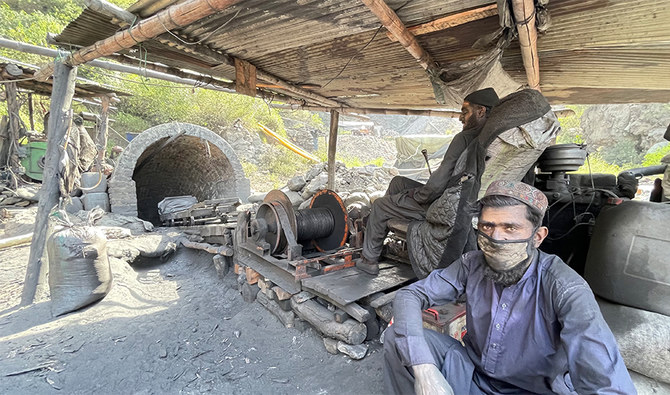
An operator lowers a conveyor trolly to extract coal at a mine in Dara Adam Khel, Pakistan, on May 29, 2021 (AN Photo)
Short Url
Updated 02 June 2021
Follow

30 coal miners diagnosed with TB as Pakistan’s Khyber Pakhtunkhwa launches first screening drive

  • Pakistan each year reports over half a million cases of tuberculosis, the world’s deadliest infectious disease
  • 60,000 cases are recorded in Khyber Pakhtunkhwa province, officials expect to diagnose 300 new cases in six weeks

PESHAWAR: At least 30 coal miners from Pakistan’s Shangla district have been diagnosed with tuberculosis (TB) in the past three weeks after health authorities in northwestern Khyber Pakhtunkhwa launched a screening project to monitor, for the first time, cases of the world’s most infectious disease in the province.

Pakistan each year reports over half a million cases of tuberculosis, more than 60,000 of them in Khyber Pakhtunkhwa. There is no reliable data on how many coal miners are affected by the disease in the country.
Over 70 percent men from Shangla above the age of 18 are involved with the coal mining industry and develop respiratory diseases after working for five to six years, provincial minister for labor and culture, Shaukat Ali Yousafzai, told Arab News.
What makes the problem worse is the COVID-19 pandemic, which is derailing global and national efforts to tackle tuberculosis. Last year, the World Health Organization Disruptions said the pandemic had led to major setbacks to tuberculosis programs, as human, financial and other resources were reallocated from tuberculosis to the coronavirus response in many countries, including Pakistan.
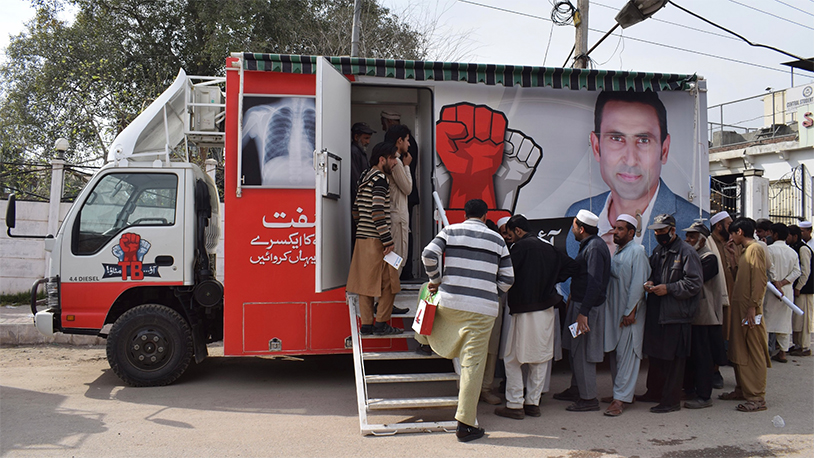


An ‘End TB' campaign mobile truck parked near the Peshawar Press Club offers free screenings to coal miners in Peshawar, Pakistan, on Feb 25, 2021 (AN Photo)

Assistant district health officer for Shangla, Dr. Ghafoor Ahmad, said authorities had launched a tuberculosis screening drive on May 8 to monitor the number of cases — the first such exercise in the province.
“Sputum samples are sent to five hospitals in the district,” Ahmad said. “We are expecting between 250 to 300 tuberculosis cases at the end of the six-week screening process.”
Secretary general of the Pakistan Mine Workers Federation, Sarzameen Khan, said the true number of tuberculosis cases was much higher since many coal miners had gone back to their places of work after last month’s Eid Al-Fitr holidays without being screened.
The federation’s meagre records for coal miners with tuberculosis were the only ones available in the province before the government launched last month’s screening drive to collect official data.
“A majority of the estimated 90,000 coal miners in the country belong to Shangla,” he said. “About 97 miners in Shangla and 64 in Pabbi [another district in Khyber Pakhtunkhwa] registered with us last year as critically ill. At least 77 mineworkers in Pabbi have died due to the disease in the last two decades.”
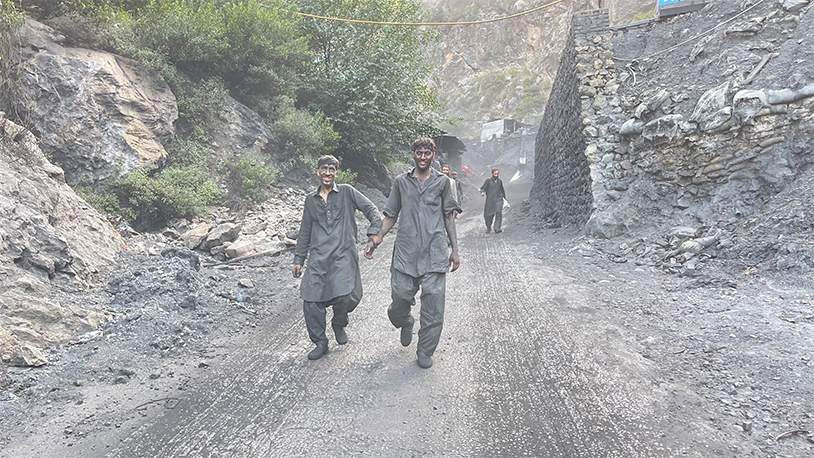


Young miners covered in coal dust at Akhorwal, Dara Adam Khel, Pakistan, on May 29, 2021 (AN Photo) 

Former vice-chancellor of Khyber Medical University Peshawar, Dr. Arshad Javaid, told Arab News he had been advocating better conditions and health services for coal miners for the past two decades.
“In my 30-year experience as a doctor, most patients suffering from serious lung diseases that I examined belonged to Shangla,” he said.
Coal miners like 22-year-old Bacha Hussain, who works in Dara Adam Khel, too lamented working conditions and lack of health facilities.
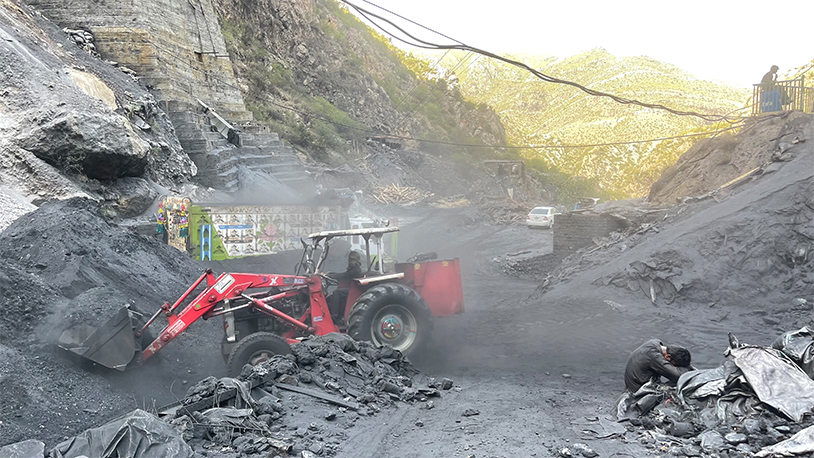


A worker is seen as a nearby tractor loads coal onto a truck in Dara Adam Khel, Pakistan, on May 29, 2021 (AN Photo) 

“We work, eat and live together and I fear sometimes that we will all die together,” he said. “I have a severe cough, but I cannot leave my work and go for a medical checkup to a doctor.”
Almost all mineworkers in Dara Adam Khel perform their jobs without proper gear, Hussain said. While some used safety hats, only a handful use masks or safety shoes.
“Masks cause a lot of suffocation inside a mine and most workers prefer to work without them since it makes it easier for them to breathe,” Hussain said.
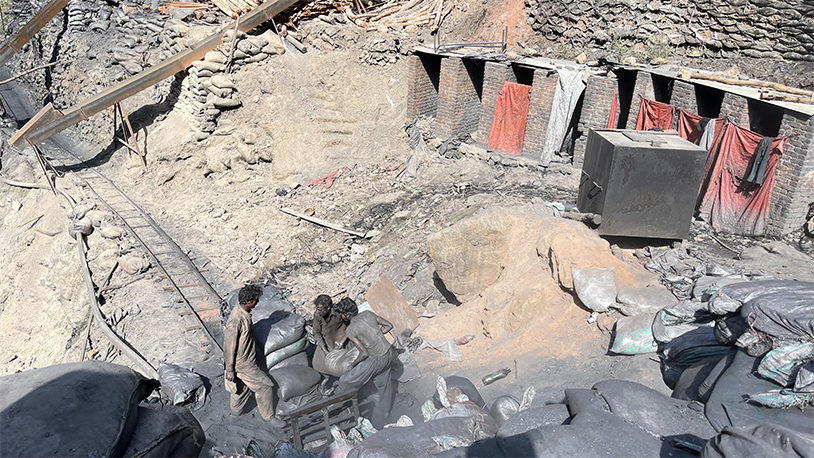


Workers load coal sacks onto a pushcart in Dara Adam Khel, Pakistan, on May 29, 2021. (AN Photo)

Officials like Yousafzai say health conditions can be better monitored if all mineworkers from Shangla are registered with the provincial Employees’ Social Security Institution or the federal Employees’ Old Age Benefits Institution so they are entitled to the same benefits other laborers receive.
Special Assistant to KP Chief Minister for Mines and Minerals, Muhammad Arif Ahmadzai, said his ministry had ordered all mine owners in the province to register their workers.
“We have provided them with registration forms,” he said. “Workers are asked to get themselves registered. They are encouraged to report any mine owner or leaseholder who denies them the chance to register.”
Ahmadzai said the government also planned to increase the number of grants for coal workers.
“The one-time disability grant has been increased to Rs300,000 per person,” he said, “while I am trying to increase the death grant from Rs300,000 to half a million rupees.”


IMF warns against policy slippage amid weak recovery as it clears $1.2 billion for Pakistan

Updated 11 December 2025
Follow

IMF warns against policy slippage amid weak recovery as it clears $1.2 billion for Pakistan

  • Pakistan rebuilt reserves, cut its deficit and slowed inflation sharply over the past one year
  • Fund says climate shocks, energy debt, stalled reforms threaten stability despite recent gains

ISLAMABAD: Pakistan’s economic recovery remains fragile despite a year of painful stabilization measures that helped pull the country back from the brink of default, the International Monetary Fund (IMF) warned on Thursday, after it approved a fresh $1.2 billion disbursement under its ongoing loan program.

The approval covers the second review of Pakistan’s Extended Fund Facility (EFF) and the first review of its climate-focused Resilience and Sustainability Facility (RSF), bringing total disbursements since last year to about $3.3 billion.

Pakistan entered the IMF program in September 2024 after years of weak revenues, soaring fiscal deficits, import controls, currency depletion and repeated climate shocks left the economy close to external default. A smaller stopgap arrangement earlier that year helped avert immediate default, but the current 37-month program was designed to restore macroeconomic stability through strict monetary tightening, currency adjustments, subsidy rationalization and aggressive revenue measures.

The IMF’s new review shows that Pakistan has delivered significant gains since then. Growth recovered to 3 percent last year after shrinking the year before. Inflation fell from over 23 percent to low single digits before rising again after this year’s floods. The current account posted its first surplus in 14 years, helped by stronger remittances and a sharp reduction in imports. And the government delivered a primary budget surplus of 1.3 percent of GDP, a key program requirement. Foreign exchange reserves, which had dropped dangerously low in 2023, rose from US$9.4 billion to US$14.5 billion by June.

“Pakistan’s reform implementation under the EFF arrangement has helped preserve macroeconomic stability in the face of several recent shocks,” IMF Deputy Managing Director Nigel Clarke said in a statement after the Board meeting.

But he warned that Islamabad must “maintain prudent policies” and accelerate reforms needed for private-sector-led and sustainable growth.

The Fund noted that the 2025 monsoon floods, affecting nearly seven million people, damaging housing, livestock and key crops, and displacing more than four million, have set back the recovery. The IMF now expects GDP growth in FY26 to be slightly lower and forecasts inflation to rise to 8–10 percent in the coming months as food prices adjust.

The review warns Pakistan against relaxing monetary or fiscal discipline prematurely. It urges the State Bank to keep policy “appropriately tight,” allow exchange-rate flexibility and improve communication. Islamabad must also continue raising revenues, broadening the tax base and protecting social spending, the Fund said.

Despite the progress, Pakistan’s structural weaknesses remain severe.

Power-sector circular debt stands at about $5.7 billion, and gas-sector arrears have climbed to $11.3 billion despite tariff adjustments. Reform of state-owned enterprises has slowed, including delays in privatizing loss-making electricity distributors and Pakistan International Airlines. Key governance and anti-corruption reforms have also been pushed back.

The IMF welcomed Pakistan’s expansion of its flagship Benazir Income Support Program, which raises cash transfers for low-income families and expands coverage, saying social protection is essential as climate shocks intensify. But it warned that high public debt, about 72 percent of GDP, thin external buffers and climate exposure leave the country vulnerable if reform momentum weakens.

The Fund said Pakistan’s challenge now is to convert short-term stabilization into sustained recovery after years of economic volatility, with its ability to maintain discipline, rather than the size of external financing alone, determining the durability of its gains.