Most Turks believe mob boss’s corruption claims, survey shows

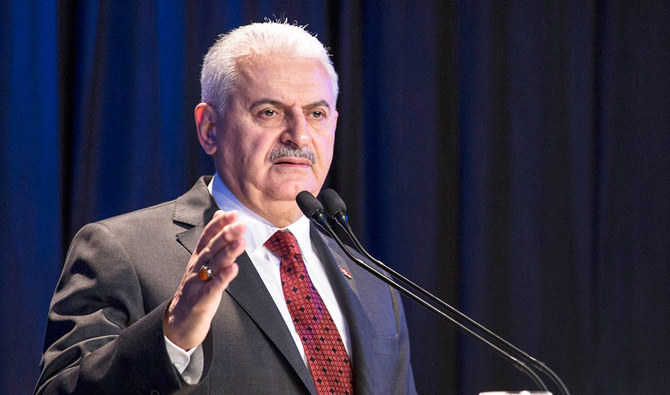
Former PM Binali Yildirim. (AP)
Short Url
Updated 01 June 2021
Follow

Most Turks believe mob boss’s corruption claims, survey shows

  • “Peker showed that he acts under the orders of Turkey’s enemies and domestic evil alliances with his ridiculous statements,” presidential adviser Saral said

JEDDAH: Most Turkish people believe the corruption claims leveled by fugitive mob boss Sedat Peker against the government, a new survey shows, despite presidential chief adviser Oktay Saral accusing him of being “used by Turkey’s enemies.”
In the wake of the bombshell allegations, Saral said: “Our state will do what’s necessary.”
For weeks, the Turkish government’s ally-turned-foe figure has published videos purporting to expose corruption and mismanagement within the ruling Justice and Development Party (AKP), especially concerning illegal drug and weapon trafficking and the longtime cooperation of Turkish senior officials with Al-Nusra extremists in Syria.
Through the eight consecutive videos, Peker has opened a Pandora’s box into “deep state secrets,” claiming revenge on government officials who launched a criminal prosecution against him and raided his home.
Turkish polling firm Avrasya revealed in its latest survey that 75 percent of those questioned believe that Peker’s claims are factual.
The survey was conducted in late May through 2480 respondents from across the political spectrum.
It also found that 95 percent of respondents from opposition parties believe that politicians who were implicated in the allegations should resign, while one-third of voters supporting the ruling government and its nationalistic ally think the same.
On Monday, Turkey’s dissident daily Cumhuriyet reported that Turkish customs data contradicted former prime minister and now deputy leader of the AKP, Binali Yildirim, who claimed that his son Erkam delivered COVID-19 aid to Venezuela in December.
His frequent visits to the country stirred controversy after Peker claimed the trips were made to establish a new international drug trafficking route from the country to Turkey.
Based on customs records between Oct. 1 and Dec. 31 last year, Cumhuriyet proved that no mask or test kit transfer was made from Turkey to Venezuela. Only about 1,500 test kits were sent to Caracas in that period as part of a business transaction between two companies not associated with Yildirim.
Cumhuriyet claimed that either Yildirim did not send masks and test kits to Venezuela or the transfer happened through illegal channels.
Peker claimed that the son of the former prime minister went to the Latin American country with the intention to set up a new route, following the seizure of 4.9 tons of cocaine headed for Turkey by Colombian authorities on June 9.
However, in a press speech on May 23, Yildirim said: “My son indeed went to Venezuela, but not in January or February. He went there in December last year.
“He distributed test kits, masks and other stuff to those in need as part of the fight against COVID-19.”
According to journalist Fehim Taskin, “what we are witnessing is the full adoption of a mafia style and energy within the executive branches of Turkey’s government, more deeply rooted than ever.”
He added: “The inside reflects upon the outside.”
In Peker’s latest video, where he covered Turkey’s dealings in Syria and Libya, the mob boss, who is believed to now live in Dubai, claimed that a paramilitary group named SADAT, under the supervision of Turkish presidency, sent weapons to Al-Nusra jihadists in Syria by disguising them an aid convoy he originally sent to Syrian Turkmens.
The allegations angered Turkish government and SADAT officials, who denied the claims.
“Peker showed that he acts under the orders of Turkey’s enemies and domestic evil alliances with his ridiculous statements,” presidential adviser Saral said.
“Our state will do what’s needed and all powers will recognize that this country won’t be damaged with such acts of nonsense,” he added.
Some former Cumhuriyet journalists were jailed for reporting Turkish weapons shipments sent to war-torn Syria via the Turkish intelligence agency, MIT, in 2015.
Peker has promised further videos about Turkey’s political elite in the near future. He is expected to talk about his relationship with Turkish President Recep Tayyip Erdogan in the next clip, which will be released over the weekend.


Syria moves military reinforcements east of Aleppo after telling Kurds to withdraw

Updated 3 sec ago
Follow

Syria moves military reinforcements east of Aleppo after telling Kurds to withdraw

ALEPPO: Syria’s army was moving reinforcements east of Aleppo city on Wednesday, a day after it told Kurdish forces to withdraw from the area following deadly clashes last week.
The deployment comes as Syria’s Islamist-led government seeks to extend its authority across the country, but progress has stalled on integrating the Kurds’ de facto autonomous administration and forces into the central government under a deal reached in March.
The United States, which for years has supported Kurdish fighters but also backs Syria’s new authorities, urged all parties to “avoid actions that could further escalate tensions” in a statement by the US military’s Central Command chief Admiral Brad Cooper.
On Tuesday, Syrian state television published an army statement with a map declaring a large area east of Aleppo city a “closed military zone” and said “all armed groups in this area must withdraw to east of the Euphrates” River.
The area, controlled by Kurdish forces, extends from near Deir Hafer, around 50 kilometers (30 miles) from Aleppo, to the Euphrates about 30 kilometers further east, as well as toward the south.
State news agency SANA published images on Wednesday showing military reinforcements en route from the coastal province of Latakia, while a military source on the ground, requesting anonymity, said reinforcements were arriving from both Latakia and the Damascus region.
Both sides reported limited skirmishes overnight.
An AFP correspondent on the outskirts of Deir Hafer reported hearing intermittent artillery shelling on Wednesday, which the military source said was due to government targeting of positions belonging to the US-backed, Kurdish-led Syrian Democratic Forces.

’Declaration of war’

The SDF controls swathes of the country’s oil-rich north and northeast, much of which it captured during Syria’s civil war and the fight against the Daesh group.
On Monday, Syria accused the SDF of sending reinforcements to Deir Hafer and said it would send its own personnel there in response.
Kurdish forces on Tuesday denied any build-up of their personnel and accused the government of attacking the town, while state television said SDF sniper fire there killed one person.
Cooper urged “a durable diplomatic resolution through dialogue.”
Elham Ahmad, a senior official in the Kurdish administration, said that government forces were “preparing themselves for another attack.”
“The real intention is a full-scale attack” against Kurdish-held areas, she told an online press conference, accusing the government of having made a “declaration of war” and breaking the March agreement on integrating Kurdish forces.
Syria’s government took full control of Aleppo city over the weekend after capturing its Kurdish-majority Sheikh Maqsud and Ashrafiyeh neighborhoods and evacuating fighters there to Kurdish-controlled areas in the northeast.
Both sides traded blame over who started the violence last week that killed dozens of people and displaced tens of thousands.

PKK, Turkiye

On Tuesday in Qamishli, the main Kurdish city in the country’s northeast, thousands of people demonstrated against the Aleppo violence, with some burning pictures of Syrian President Ahmed Al-Sharaa, an AFP correspondent said, while shops were shut in a general strike.
Some protesters carried Kurdish flags and banners in support of the SDF.
“Leave, Jolani!” they shouted, referring to President Sharaa by his former nom de guerre, Abu Mohammed Al-Jolani.
“This government has not honored its commitments toward any Syrians,” said cafe owner Joudi Ali.
Other protesters burned portraits of Turkish Foreign Minister Hakan Fidan, whose country has lauded the Syrian government’s Aleppo operation “against terrorist organizations.”
Turkiye has long been hostile to the SDF, seeing it as an extension of the Kurdistan Workers’ Party (PKK) and a major threat along its southern border.
Last year, the PKK announced an end to its long-running armed struggle against the Turkish state and began destroying its weapons, but Ankara has insisted that the move include armed Kurdish groups in Syria.
On Tuesday, the PKK called the “attack on the Kurdish neighborhoods in Aleppo” an attempt to sabotage peace efforts between it and Ankara.
A day earlier, Ankara’s ruling party levelled the same accusation against Kurdish fighters.
The Britain-based Syrian Observatory for Human Rights reported 45 civilians and 60 soldiers and fighters from both sides killed in the Aleppo violence.
Aleppo civil defense official Faysal Mohammad said Tuesday that 50 bodies had been recovered from the Kurdish-majority neighborhoods after the fighting.