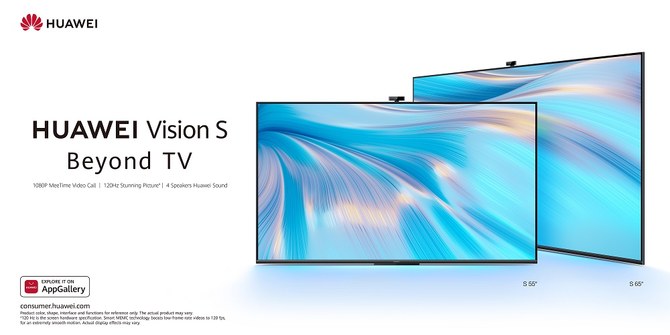

Huawei officially launched its next-generation TV — the Huawei Vision S — on May 27, with prices starting at SR3,499 ($933) in Saudi Arabia. With this new product, Huawei is ushering in a new collaborative and interconnected era for the company’s smart ecosystem.
The Huawei Vision S comes in two sizes, 55 and 65 inches, and serves as the linchpin for Huawei’s all-scenario intelligent connectivity solutions. It features support for 1080 p MeeTime Full HD video calling with its 13 MP magnetic camera, distributed multi-device collaboration, a 120 Hz display and the incredible Huawei Sound, all working together for intelligent interaction and facilitating groundbreaking audiovisual immersion and smart interactions.
The Huawei Vision S series will be available for pre-order starting from June 3, on Huawei’s official website and across select retailers.
In fact, Huawei Vision has made “TV calling” a trendy new form of communication. Huawei MeeTime video call is a feature designed to make video calling easier and more versatile than ever whilst Huawei Vision S is definitely bringing a few benefits beyond just a new network of entertainment content. Take TV calling as a prime example; this feature that is enabled by the staggering 1080 p MeeTime Full HD Video Calls could fundamentally change the way we communicate from our home. It is an example of how technology can bring people closer together, right from the comfort of their living rooms and how people can now use this next-generation TV and not just rely on their smartphones as a means to make crystal-clear video calls.
Premium video calling with MeeTime and 13 MP Magnetic Camera
The Huawei Vision S has been designed to facilitate ease of use, notably supporting the 1080 p MeeTime Full HD Video Call feature. When you are chatting with friends via MeeTime on your phone, you can seamlessly transfer the ongoing call to the Huawei Vision S as soon as you step through the door, to enjoy a true-to-life “face-to-face” experience.
The Huawei Vision S comes equipped with a 13 MP magnetic suction camera, which enables you to make and field 1080 p video calls in 1920 × 1080 splendor from the big screen. The camera adjusts all the way to 180°, to ensure that you always get the perfect view.
Distributed multi-device collaboration: The springboard for all-scenario intelligence
The Huawei Vision S boasts a rich array of next-generation intelligent interaction features, which allow it to seamlessly interact and collaborate with other smart devices, and even incorporate the features and attributes of a smartphone or another device. For instance, it comes equipped with the OneHop Projection feature, which enables you to transfer your phone screen to the big screen in the blink of an eye, simply by tapping your phone against the Huawei Share icon on the remote. The two devices don’t even need to be paired with each other or connected to the same Wi-Fi network.
The Mirror Control with Phone feature enables you to control the Huawei Vision S directly with your phone, by mirroring the displayed content to your phone screen. Once your phone is projected on the Huawei Vision S, you can block incoming call reminders and notifications from displaying on the screen, keeping your private information and correspondences out-of-view. Images, audio, videos, apps, among other files, can be transferred from your phone via Huawei Share, literally in an instant.
Distributed gaming, with a phone-turned-gamepad
The Huawei Vision S also ushers in a new paradigm for smart screen entertainment with its distributed gaming capability. It allows you to use your phone as a gamepad, when you’re playing on the larger display. The phone’s touchscreen, gravity sensor, and gyroscope can provide for a more intense and immersive gaming experience. Games are loaded directly from the Huawei Vision S, and thus run far smoother than you ever could have imagined.
120 Hz stunning picture and Huawei Sound
Audiovisual entertainment is a highlight on Huawei Vision S. It sports a 120 Hz refresh rate display that covers 92 percent of the DCI-P3 wide color gamut, and comes bolstered with TÜV Rheinland-certified low-blue-light and flicker-free technologies, to ensure lifelike viewing across each frame, while also protecting your vision.
Huawei’s one-of-a-kind Honghu Picture Engine works in concert with the motion estimation and motion compensation (MEMC) technology and fine-tuned graphics processing technology, to deliver silky-smooth images with standout color saturation and contrasts. Remarkably, Huawei performs color calibration for each individual Huawei Vision S during the manufacturing process to ensure that each device generates the same effects.
Vision S houses four 10 W speakers, two full frequency and two high frequency, and a massive 1L sound cavity, taking audiovisual entertainment to a whole new level. Armed with a unique patented technology, the two high frequency speakers bring out the richness of high frequency sounds and vocals, rendering them with crystal clarity, to give the impression that the movie dialogue is being performed right in front of you. Virtual sound field expansion technology enables the Huawei Vision S to transcend physical limitations, and virtually reproduce surround sound from both sides of the device, creating an all-encompassing, immersive sound field.
Videos, regardless of their nature, are usually rendered with the same audio and visual settings on traditional TVs. But Vision S is capable of identifying what is currently streaming, and adjusting the outputs to create the best possible picture and sound. For instance, when streaming a movie, it will automatically switch to Cinema mode to produce a more evocative effect.
The Huawei Vision S truly stands apart as the next-generation TV, bringing forth strong features such as 1080 p MeeTime Full HD Video Calling, distributed multi-device collaboration and top-notch audio and picture quality.