

Pakistan says will solve ‘tough problem’ of vaccinating over 3 million stateless people

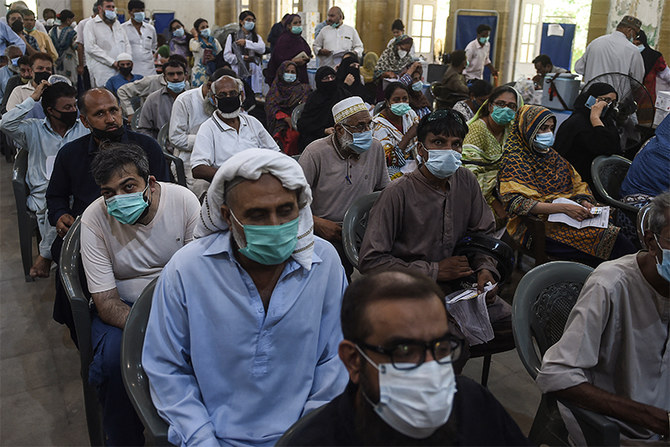
People wait for their trun to get a dose of the Covid-19 coronavirus Sinopharm vaccine at a vaccination camp in Karachi on May 25, 2021. (AFP)
Short Url
Updated 26 May 2021
Follow

Pakistan says will solve ‘tough problem’ of vaccinating over 3 million stateless people

  • Stateless people lack 16-digit national identity card number required to register for government vaccine program
  • Senior health official say all non-Pakistani residents eligible for COVID-19 jabs after proving identity using relevant documents

ISLAMABAD: Pakistan’s health chief Dr. Faisal Sultan said on Wednesday the government would solve the “tough problem” of vaccinating its more than three million stateless people living in different parts of the country.

In a story published in Arab News on Tuesday, several refugees in Pakistan described being unable to get citizenship despite decades of living in the country. Now they fear being left out of a national vaccination drive as registering for a free government-run immunization drive requires that citizens send a 16-digit computerized national identity card number to a 1166 number.
“Slightly tough problem but will be solved,” Dr. Faisal Sultan, who advises Prime Minister Imran Khan on public health, told Arab News.
According to Article 15 of the Universal Declaration of Human Rights, “everyone has the right to a nationality.” Nevertheless, statelessness remains a reality across the world.
While the exact numbers are not known, Pakistan’s leading association of doctors recently wrote a letter to the government about the plight of stateless people in Pakistan, saying they were no fewer than three million in number.
In September 2018, Prime Minister Imran Khan pledged citizenship for Bengali and Afghan refugees, a decision widely hailed by the United Nations High Commissioner for Refugees agency, civil society groups and human rights organizations. However, that promise is yet to be fulfilled.
Pakistan’s Ministry of National Health Services and Regulations says “every person currently in Pakistan” would get the COVID-19 vaccine by waiting for the immunization process to begin for people in their respective age brackets.
Rana Muhammad Safdar, director-general health at the ministry, told Arab News refugees or any other persons in Pakistan would have to prove their identity to be eligible to get a vaccine.
“This can be done using any document from the UNHCR or any other organization that proves their identity as non-Pakistani residents of the country,” he said in an interview on Tuesday.
Safdar, however, declined to comment when asked how individuals could register themselves through the official helpline when it only recognized 16-digit computerized national identity card numbers issued to Pakistani citizens, or why some people were being turned away even when they directly approached vaccination centers with relevant documents.


Pakistan expresses condolences as Bangladesh’s first female PM passes away

Updated 9 sec ago
Follow

Pakistan expresses condolences as Bangladesh’s first female PM passes away

  • Khaleda Zia passed away in Dhaka after prolonged illness at the age of 80, says her party
  • PM Shehbaz Sharif describes Zia as a “committed friend of Pakistan” in condolence message

ISLAMABAD: Prime Minister Shehbaz Sharif on Tuesday expressed condolences over the passing of Bangladesh’s first female prime minister, Khaleda Zia, describing her as a committed friend of Islamabad. 

In a statement on Tuesday, the Bangladesh Nationalist Party (BNP) announced its leader Zia had passed away at the age of 80 after prolonged illness. She died at the Evercare Hospital in Dhaka, where the former prime minister was admitted on Nov. 23 with symptoms of a lung infection, according to The Daily Star, a Bangladesh news website.

“Deeply saddened by the passing of Begum Khaleda Zia, Chairperson of the BNP and former Prime Minister of Bangladesh,” Sharif wrote on social media platform X. 

“Her lifelong service to Bangladesh and its growth and development leaves a lasting legacy.”

Sharif said his government and people stand with the people of Bangladesh during this difficult time. 

“Begum Zia was a committed friend of Pakistan,” he added. 

Pakistan and Bangladesh used to be part of the same country before the latter seceded into the separate nation of Bangladesh after a bloody civil war in 1971. 

Ties between the two countries have remained mostly strained since then. However, Islamabad enjoyed better relations with Dhaka under Zia’s government compared to when Bangladesh was led by her arch-rival, Sheikh Hasina. 

Hasina was ousted after a violent uprising last year, leading to improved relations between Islamabad and Dhaka. 

Despite years of ill health and imprisonment, Zia vowed in November to campaign in elections set for February 2026.

The BNP is widely seen as a frontrunner, and Zia’s son Tarique Rahman, who returned only on Thursday after 17 years in exile, is seen as a potential prime minister if they win a majority.

-With additional input from AFP