- Pakistan Medical Association urges government to vaccinate stateless people with single-dose vaccine to stem coronavirus spread
- Senior health officials say all non-Pakistani residents eligible for COVID-19 jabs after proving their identity using relevant documents
ISLAMABAD: Jamshed Iqbal, 52, was denied a COVID-19 vaccine jab in Karachi last Sunday because he does not own a national ID card and thus could not send a text message to 1166 and register himself for a government-run vaccination program that started in February.
Iqbal, an ethnic Urdu-speaking Bihari, is a daily wage laborer whose family moved to Pakistan in 1971 after Bangladesh became an independent state. To date, him and his two sons and daughters have been struggling to get Pakistani nationality so they can enjoy the benefits of citizenship. Their efforts have so far been in vain, and now they fear being left out of a national vaccination drive as Pakistan battles a third wave of the coronavirus pandemic.
Last week, authorities turned Iqbal away when he arrived at the Expo Center in the sprawling seaside metropolis of Karachi where he now lives to get a COVID-19 jab.
“I was told that I could not register for vaccination without an identity card,” he said. “I was turned away, and I can barely describe my agony in words.”
“We are stranded Pakistanis, and unfortunately we are citizens of nowhere,” Iqbal added. “Statelessness is nothing less than a curse.”
Many of his relatives in the city’s Bihar Colony, Iqbal said, got the coronavirus, but the government did not provide them proper medical facilities and was now depriving them of COVID-19 shots also.
According to Article 15 of the Universal Declaration of Human Rights, “everyone has the right to a nationality.” Nevertheless, statelessness remains a reality across the world.
While the exact numbers are not known, Pakistan’s leading association of doctors recently wrote a letter to the government about the plight of stateless people in Pakistan and suggested they were no fewer than three million in number.
Pakistan’s Ministry of National Health Services and Regulations said “every person currently in Pakistan” would get the COVID-19 vaccine by waiting for the immunization process to begin for people in their respective age brackets.
Rana Muhammad Safdar, director-general health at the ministry, said refugees or any other persons in Pakistan would have to prove their identity for vaccine eligibility.
“This can be done using any document from the UNHCR or any other organization that proves their identity as non-Pakistani residents of the country,” he told Arab News.
Safdar declined to comment when asked how individuals like Iqbal could register themselves through the official helpline that only recognized 16-digit computerized national identity card numbers issued to Pakistani citizens, or why some were being turned away directly approached vaccination centers with documents.
Meanwhile, refugees continue to suffer.
Another Bihari, Salman Mushtaq, a 47-year-old auto mechanic, too tried to get the privately imported Sputnik V vaccine for his parents and himself, though he knew it would cost him a fortune. But despite willing to pay thousands of rupees for the jabs, he was refused.
“The government should at least help us get private vaccines since it is our right to save our lives like other Pakistanis,” he told Arab News. “After all, we don’t have any other option since we are not eligible for the government [free] vaccine, since we are a group of stateless people.”
In September 2018, Prime Minister Imran Khan pledged citizenship for Bengali and Afghan refugees, a decision widely hailed by the United Nations High Commissioner for Refugees agency, civil society groups and human rights organizations. However, that promise is yet to be fulfilled.
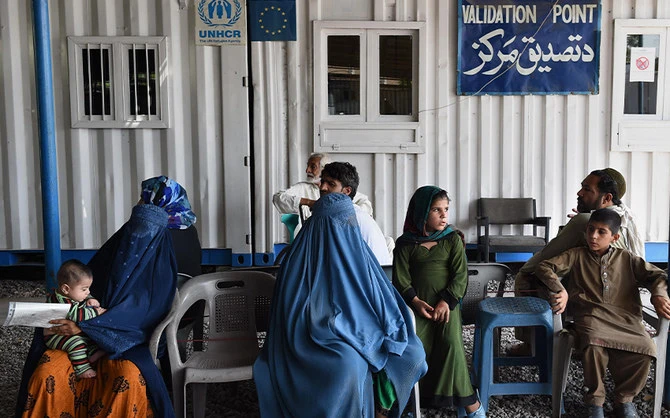
Much like the Bihari community, Afghan nationals too face the same challenge of vaccine inaccessibility.
“We cannot get such government facilities,” 65-year-old Wakeel Khan told Arab News when asked about COVID-19 vaccination.
The Pakistan Medical Association (PMA) has urged the government to start a mobile vaccination program for stateless people.
“Majority of stateless people in Pakistan live in small settlements surrounded by densely populated neighborhoods in places like Karachi. The government can use a single-dose vaccine to immunize these communities,” Dr. Qaiser Sajjad, secretary-general of the PMA, told Arab News.
He said Pakistanis would continue to face the threat of the debilitating coronavirus disease “unless its three million stateless people” were also vaccinated.
“It is responsibility of the state to own them, vaccinate them and protect other communities too from the spread of the virus,” Sajjad said.