

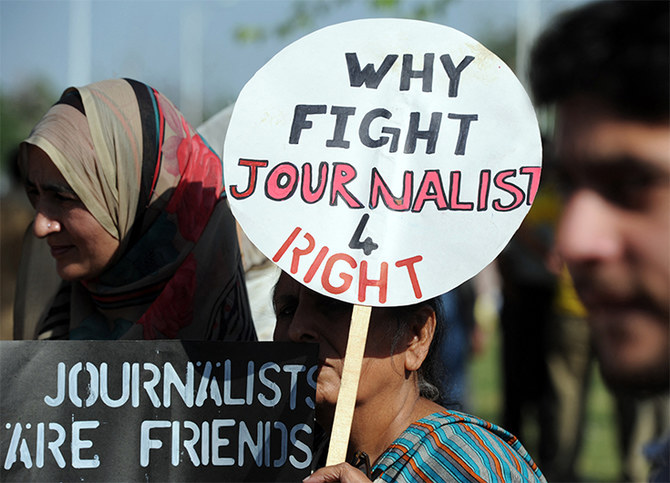

ISLAMABAD: Pakistani journalists have cautiously welcomed a proposed journalists’ protection bill, questioning whether a commission to be set up under the new law could be independent since its head is to be appointed by the government, which will also allocate funds for the body.
The government introduced the new legislation in the National Assembly last Friday following years of demands by media bodies, civil society organizations and the international community. It still has to be debated and voted into law.
The Committee to Protect Journalists (CPJ) estimates that between 1992 and 2019, at least 61 journalists were killed in Pakistan. Last year, it ranked Pakistan number nine on its annual Global Impunity Index, which spotlights countries where journalists are slain and their killers go free. Nine of the 65 journalists and media workers killed worldwide while on duty in 2020 were in Pakistan, according to the International Federation of Journalists.
Under the new proposed legislation, the government will set up an “independent commission” where a journalist or media professional threatened or abused by an individual or institution can file a complaint within 14 days. Upon receipt of the complaint, the commission is bound to “take all necessary actions” to investigate and prosecute within 14 days.
Journalists and media professionals have, however, raised questions over the autonomy and independence of the commission as the government will appoint its chairperson for a two-year term and allocate funds for its functions.
“We want this commission to be financially autonomous and fully independent from government intervention,” Shahzada Zulfiqar, president of the Pakistan Federal Union of Journalists (PFUJ), told Arab News, adding that PFUJ would share its suggestions and recommendations with the government to further strengthen the legislation. “We want some ambiguities ... and other loopholes in the legislation be addressed before its passage from the parliament.”
Information minister Chaudhry Fawad Hussain has called the bill a “great success” for working journalists, saying it took two and a half years to prepare.
“Today our Journalist and Media Professionals Protection bill has finally been ‘introduced’ in NA,” human rights minister Shireen Mazari tweeted. “Want to thank all those who participated & gave valuable inputs.”
Today our Journalist and Media Professionals Protection bill has finally been "introduced" in NA so now it will go to the SC on HR of the NA. Want to thank all those who participated & gave valuable inputs @HamidMirPAK @arsched @MazharAbbasGEO @Xadeejournalist @NasimZehra
— Shireen Mazari (@ShireenMazari1) May 21, 2021
Journalists, though they appreciate the bill, have their concerns.
“My apprehension is that different interest groups may now try to get this bill amended to tone down the commission in the standing committee,” senior journalist and talk show host Hamid Mir told Arab News. “I believe the government won’t create problems [to get the bill passed], but it’s a test case for the opposition parties who always championed the freedom of press to support the legislation in its current form,” he added.
Mir said if the legislation was passed without amendments, this would not only be a “great achievement” for Pakistani journalists, but would also serve as a model for other Asian countries.
“Safety and security of journalists must be top priority of the state, and this legislation will help deter those who dare to threaten, harass and kill journalists,” he said.
Zohra Yusuf, a former chairperson of the Human Rights Commission of Pakistan, said the implementation and enforcement of the legislation would remain a challenge for civilian governments, adding:
“The legislation should also cater to security and training of the stringers and freelance journalists who work in difficult situations in far-flung areas and conflict zones.”


