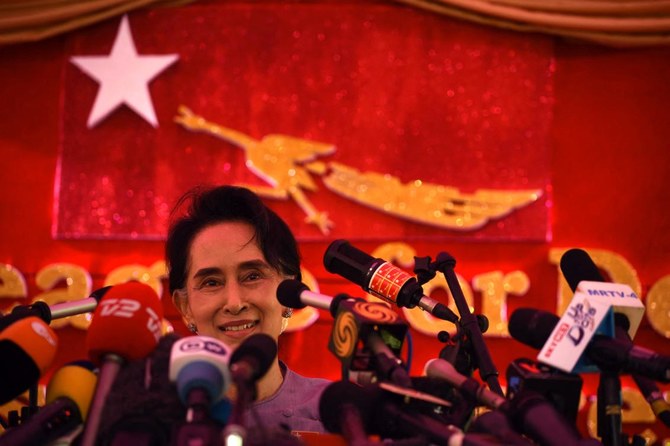
Myanmar junta leader says Aung San Suu Kyi will soon appear

Aung San Suu Kyi is among more than 4,000 people detained since the February coup. (AFP)
Short Url
Updated 22 May 2021
Follow

Myanmar junta leader says Aung San Suu Kyi will soon appear

  • The military coup has plunged the Southeast Asian country into chaos

Myanmar’s junta leader Min Aung Hlaing said deposed leader Aung San Suu Kyi was healthy at home and would appear in court in a few days, in his first interview since overthrowing her in a Feb. 1 coup.
The coup has plunged the Southeast Asian country into chaos and one of several ethnic armed groups opposed to the ruling junta advanced to attack a military post in a northwestern jade mining town on Saturday, local media said.
Suu Kyi, a Nobel Peace Prize laureate for her long struggle against previous military rulers, is among more than 4,000 people detained since the coup. She faces charges that range from illegally possessing walkie-talkie radios to violating a state secrets law.
“Daw Aung San Suu Kyi is in good health. She is at her home and healthy. She is going to face trial at the court in a few days,” Min Aung Hlaing said by video link with the Hong Kong-based Chinese language broadcaster Phoenix Television on May 20, in excerpts released on Saturday.
The interviewer asked him what he thought of the performance of Suu Kyi, 75, who is widely admired in the country of 53 million for her campaign that had brought tentative democratic reforms which were cut short by the coup.
“She tried all she could,” Min Aung Hlaing responded.
He reiterated that the army had seized power because it had identified fraud in an election won by Suu Kyi’s party in November — although its accusations were rejected by the then election commission.
He said the army would hold elections and potential changes to the constitution had been identified and would be made if they were “the people’s will.”
Suu Kyi’s next court appearance is due on Monday in the capital Naypyidaw. So far she has appeared only by video link and as yet to be allowed to speak directly to her lawyers.
The junta has cited security reasons for not allowing her to speak to her lawyers in private at a time the military authorities have not established control of the country in the face of daily protests, strikes and renewed insurgencies.
The Kachin Independence Army (KIA) attacked an army post at Hkamti township in the Sagaing region early on Saturday, the Irrawaddy and Mizzima online publications said. Pictures showed columns of dark smoke rising from the scene.
KIA spokesman Naw Bu told Reuters he was aware of the attack but could give no details. Reuters was unable to reach a junta spokesman for comment.
Mizzima said the site attacked was near a mining venture that involves the military-owned Myanma Economic Holdings Ltd. conglomerate. Independent broadcaster DVB said three members of the security forces had been wounded and nine were captured by the insurgents.
Reuters was unable to confirm the reports independently.
Since the coup, open conflict resumed between the army and the KIA, which has been fighting for greater autonomy for the Kachin people for some six decades and has voiced support for anti-junta protesters.
Mizzima said the army used jets in attacks on the KIA at Hkamti, a town on the Chindwin river in a remote region rich in jade and gold about 50 km (30 miles) from the border with India.
The army has carried out numerous bombing attacks on KIA positions in recent weeks and has also clashed with ethnic armies in the east and west of Myanmar.
Security forces have killed at least 812 people since the coup, according to the Assistance Association for Political Prisoners activist group.
Min Aung Hlaing said the actual figure was around 300 and that 47 police had also been killed.
Myanmar media reported that a soldier had been killed in a shooting in the commercial hub, Yangon, on Saturday.


Judge bars federal prosecutors from seeking the death penalty against Luigi Mangione

Updated 02 February 2026
Follow

Judge bars federal prosecutors from seeking the death penalty against Luigi Mangione

  • Judge Margaret Garnett’s Friday ruling foiled the Trump administration’s bid to see Mangione executed
  • Garnett dismissed a federal murder charge against Mangione, finding it technically flawed. She left in place stalking charges that could carry a life sentence

NEW YORK: Federal prosecutors can’t seek the death penalty against Luigi Mangione in the killing of UnitedHealthcare CEO Brian Thompson, a federal judge ruled Friday, foiling the Trump administration’s bid to see him executed for what it called a “premeditated, cold-blooded assassination that shocked America.”
Judge Margaret Garnett dismissed a federal murder charge that had enabled prosecutors to seek capital punishment, finding it technically flawed. She wrote that she did so to “foreclose the death penalty as an available punishment to be considered by the jury” as it weighs whether to convict Mangione.
Garnett also dismissed a gun charge but left in place stalking charges that carry a maximum punishment of life in prison. To seek the death penalty, prosecutors needed to show that Mangione killed Thompson while committing another “crime of violence.” Stalking doesn’t fit that definition, Garnett wrote in her opinion, citing case law and legal precedents.
In a win for prosecutors, Garnett ruled they can use evidence collected from his backpack during his arrest, including a 9mm handgun and a notebook in which authorities say Mangione described his intent to “wack” an insurance executive. Mangione’s lawyers had sought to exclude those items, arguing the search was illegal because police hadn’t yet obtained a warrant.
During a hearing Friday, Garnett gave prosecutors 30 days to update her on whether they’ll appeal her death penalty decision. A spokesperson for the US attorney’s office in Manhattan, which is prosecuting the federal case, declined to comment.
Garnett acknowledged that the decision “may strike the average person — and indeed many lawyers and judges — as tortured and strange, and the result may seem contrary to our intuitions about the criminal law.” But, she said, it reflected her “committed effort to faithfully apply the dictates of the Supreme Court to the charges in this case. The law must be the Court’s only concern.”
Mangione, 27, appeared relaxed as he sat with his lawyers during the scheduled hearing, which took place about an hour after Garnett issued her written ruling. Prosecutors retained their right to appeal but said they were ready to proceed to trial.
Outside court afterward, Mangione attorney Karen Friedman Agnifilo said her client and his defense team were relieved by the “incredible decision.”
Jury selection in the federal case is set for Sept. 8, followed by opening statements and testimony on Oct. 13. The state trial’s date hasn’t been set. On Wednesday, the Manhattan district attorney’s office urged the judge in that case to schedule a July 1 trial date.
“That case is none of my concern,” Garnett said, adding that she would proceed as if the federal case is the only case unless she hears formally from parties involved in the state case. She also said the federal case will be paused if the government appeals her death penalty ruling.
Thompson, 50, was killed on Dec. 4, 2024, as he walked to a midtown Manhattan hotel for UnitedHealth Group’s annual investor conference. Surveillance video showed a masked gunman shooting him from behind. Police say “delay,” “deny” and “depose” were written on the ammunition, mimicking a phrase used by critics to describe how insurers avoid paying claims.
Mangione, an Ivy League graduate from a wealthy Maryland family, was arrested five days later at a McDonald’s in Altoona, Pennsylvania, about 230 miles (about 370 kilometers) west of Manhattan.
Following through on Trump’s campaign promise to vigorously pursue capital punishment, Attorney General Pam Bondi ordered Manhattan federal prosecutors last April to seek the death penalty against Mangione.
It was the first time the Justice Department sought the death penalty in President Donald Trump’s second term. He returned to office a year ago with a vow to resume federal executions after they were halted under his predecessor, President Joe Biden.
Garnett, a Biden appointee and former Manhattan federal prosecutor, ruled after hearing oral arguments earlier this month.
Besides seeking to have the death penalty rejected on the grounds Garnett cited, Mangione’s lawyers argued that Bondi’s announcement flouted long-established Justice Department protocols and was “based on politics, not merit.”
They said her remarks, followed by posts to her Instagram account and a TV appearance, “indelibly prejudiced” the grand jury process resulting in his indictment weeks later.
Prosecutors urged Garnett to keep the death penalty on the table, arguing that the charges were legally sound and Bondi’s remarks weren’t prejudicial, as “pretrial publicity, even when intense, is not itself a constitutional defect.”
Prosecutors argued that careful questioning of prospective jurors would alleviate the defense’s concerns about their knowledge of the case and ensure Mangione’s rights are respected at trial.
“What the defendant recasts as a constitutional crisis is merely a repackaging of arguments” rejected in previous cases, prosecutors said. “None warrants dismissal of the indictment or categorical preclusion of a congressionally authorized punishment.”