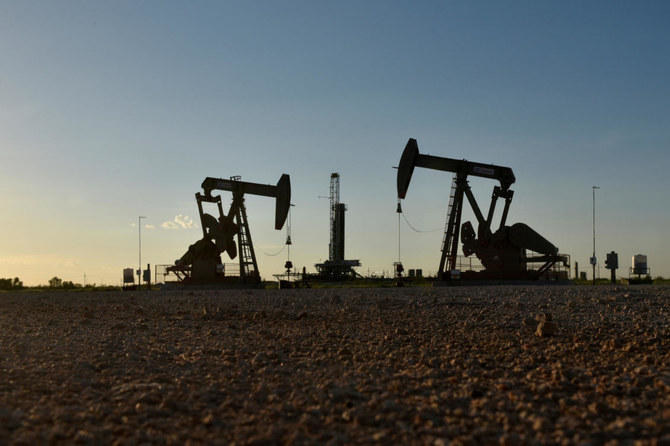
LONDON: Oil prices rose on Friday after three days of losses, but were on track for a weekly fall as investors braced for the return of Iranian crude supplies after officials said Iran and world powers made progress a nuclear deal.
Brent crude futures rose 87 cents, or 1.3 percent, to $65.98 a barrel by 12.35 pm GMT, while US West Texas Intermediate was at $62.90 a barrel, up 96 cents, or 1.6 percent.
The two contracts are on track to fall about 4 percent on the week — their biggest loss since March — after Iran’s president said the United States was ready to lift sanctions on his country’s oil, banking and shipping sectors.
Iran and world powers have been in talks since April on reviving the 2015 deal and the European Union official leading the discussions said on Wednesday he was confident a deal would be reached.
Still, investors remain upbeat about fuel demand recovery this summer as vaccination programs in Europe and the United States would allow more people to travel, although rising cases across parts of Asia are raising concerns.
Option bets on oil prices rising above $100 for the December 2021 Brent contract have jumped after last week’s surprisingly strong US inflation data, with open interest on calls nearly tripling in May, JPMorgan analysts said. The bank’s forecast is for Brent to end 2021 at $74.
To reach $100, demand would need to average above 102.6 million bpd in the third quarter and grow to 103.6 million bpd in the fourth quarter, JPMorgan said, in the absence of any additional OPEC+ supply response.
It expects Iranian crude and condensate production to rise to 3.2 million barrels per day in December, from around 2.8 million bpd in the first quarter.
Barclays expects Brent and WTI oil prices to average $66 a barrel and $62 a barrel, respectively, this year.
It cut demand estimates for the Emerging Markets Asia (ex-China) region, flagging the risk of further downside if the recent surge in infections persisted.
“Extended mobility restrictions in the region might slow the demand recovery somewhat, but seem unlikely to stall it for a sustained period, given largely positive results of vaccination programs worldwide,” it said.


Oil set for biggest weekly loss since March on Iran nuclear talks
https://arab.news/bswb4
Oil set for biggest weekly loss since March on Iran nuclear talks

- Iran's Rouhani says US will lift sanctions


Saudi Arabia’s foreign reserves rise to a 6-year high of $475bn
RIYADH: Saudi Arabia’s foreign reserves climbed 3 percent month on month in January to SR1.78 trillion, up SR58.7 billion ($15.6 billion) from December and marking a six-year high.
On an annual basis, the Saudi Central Bank’s net foreign assets rose by 10 percent, equivalent to SR155.8 billion, according to data from the Saudi Central Bank, Argaam reported.
The reserve assets, a crucial indicator of economic stability and external financial strength, comprise several key components.
According to the central bank, also known as SAMA, the Kingdom’s reserves include foreign securities, foreign currency, and bank deposits, as well as its reserve position at the International Monetary Fund, Special Drawing Rights, and monetary gold.
The rise in reserves underscores the strength and liquidity of the Kingdom’s financial position and aligns with Saudi Arabia’s goal of strengthening its financial safety net as it advances economic diversification under Vision 2030.
The value of foreign currency reserves, which represent approximately 95 percent of the total holdings, increased by about 10 percent during January 2026 compared to the same month in 2025, reaching SR1.68 trillion.
The value of the reserve at the IMF increased by 9 percent to reach SR13.1 billion.
Meanwhile, SDRs rose by 5 percent during the period to reach SR80.5 billion.
The Kingdom’s gold reserves remained stable at SR1.62 billion, the same level it has maintained since January 2008.
Saudi Arabia’s foreign reserve assets saw a monthly rise of 5 percent in November, climbing to SR1.74 trillion, according to the Kingdom’s central bank.
Overall, the continued advancement in reserve assets highlights the strength of Saudi Arabia’s fiscal and monetary buffers. These resources support the national currency, help maintain financial system stability, and enhance the country’s ability to navigate global economic volatility.
The sustained accumulation of foreign reserves is a critical pillar of the Kingdom’s economic stability. It directly reinforces investor confidence in the riyal’s peg to the US dollar, a foundational monetary policy, by providing SAMA with ample resources to defend the currency if needed.
Furthermore, this financial buffer enhances the nation’s sovereign credit profile, lowers national borrowing costs, and provides essential fiscal space to navigate global economic volatility while continuing to fund its ambitious Vision 2030 transformation agenda.