DUBAI: Egypt is prioritizing the vaccination of tourism workers to support the sector’s recovery and is on track to announce full inoculation of two resort areas this month, its tourism minister said.
While Egypt’s tourism industry is still reeling from the COVID-19 pandemic, the sector has picked up in recent months, with more visitors heading to resorts along the Red Sea and Mediterranean coasts.
“We will prioritize workers in the tourism industry, which is an essential sector for Egypt’s economy,” Tourism and Antiquities Minister Khaled Al-Enani told AFP.
“In May, I will announce, along with the minister of health, the complete vaccination of Egyptian workers in hotels, resorts, businesses and restaurants in South Sinai and the Red Sea,” he said on the sidelines of a travel industry conference in Dubai.
About 65 percent of tourists in Egypt head to those coastal destinations, he said.
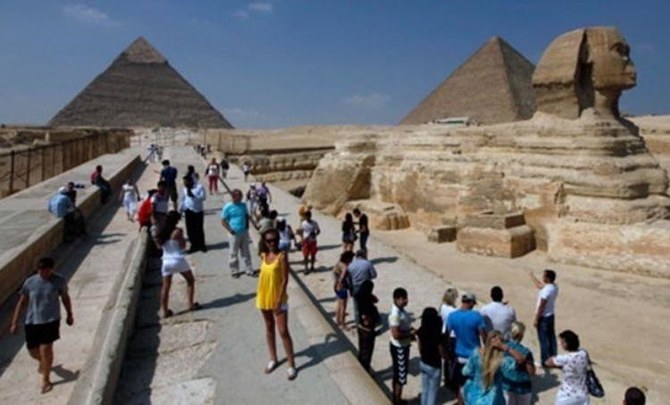
Enani said other tourist spots will follow, such as Luxor, Aswan and the capital Cairo, home of the Giza pyramids and major museums.
Egypt, which has a population of approximately 100 million, has administered some one million doses, according to authorities.
About two million people work in the tourism industry or organizations linked to it.
Along with its pyramids and pharaonic temples, Egypt is also known for its seaside resorts.
After experiencing “significant and continuous loss” since the coronavirus outbreak, the sector has picked up, said Enani.
He said Egypt welcomed 500,000 tourists in April, more than double the number in January and up from just 200,000 tourists a month in the second half of last year.
“The important thing is there is an upward curve,” Enani said.
“We hope the numbers will increase again in the near future with the opening of some countries and the easing of restrictions, including in Arab countries, Europe and Russia,” he said.
“The return of tourism in Egypt does not only depend on us, but remains linked to other countries.”
Cairo has announced several major new archaeological discoveries in recent months, hoping to revive a sector which was battered by a 2011 uprising, political unrest and jihadist attacks.
While the industry recorded a rebound of nearly $13 billion in revenues for 2018-2019, tourism was hit hard again by the pandemic.
Official figures show a drop of more than 20 percent in revenues for mid-2019 to mid-2020.
Egypt reopened to foreign tourists in July last year after having closed its borders in March. Visitors only need to produce a negative PCR test.
Russia earlier this year resumed flights to Egypt’s Red Sea resorts after the lifting of a flight ban.
Moscow banned direct flights to Egypt after the 2015 bombing of a Russian airliner shortly after it took off from the Red Sea resort of Sharm el-Sheikh, killing all 224 people on board.


Egypt to prioritize vaccination of tourism workers
https://arab.news/j5twj
Egypt to prioritize vaccination of tourism workers

- About 65 percent of tourists in Egypt head to those coastal destinations
Related


‘The future is renewables,’ Indian energy minister tells World Economic Forum
- ‘In India, I can very confidently say, affordability (of renewables) is better than fossil fuel energy,’ says Pralhad Venkatesh Joshi during panel discussion
- Renewables are an increasingly important part of the energy mix and the technology is evolving rapidly, another expert says at session titled ‘Unstoppable March of Renewables?’
BEIRUT: “The future is renewables,” India’s minister of new and renewable energy told the World Economic Forum in Davos on Wednesday.
“In India, I can very confidently say, affordability (of renewables) is better than fossil fuel energy,” Pralhad Venkatesh Joshi said during a panel discussion titled “Unstoppable March of Renewables?”
The cost of solar power has has fallen steeply in recent years compared with fossil fuels, Joshi said, adding: “The unstoppable march of renewables is perfectly right, and the future is renewables.”
Indian authorities have launched a major initiative to install rooftop solar panels on 10 million homes, he said. As a result, people are not only saving money on their electricity bills, “they are also selling (electricity) and earning money.”
He said that this represents a “success story” in India in terms of affordability and “that is what we planned.”
He acknowledged that more work needs to be done to improve reliability and consistency of supplies, and plans were being made to address this, including improved storage.
The other panelists in the discussion, which was moderated by Godfrey Mutizwa, the chief editor of CNBC Africa, included Marco Arcelli, CEO of ACWA Power; Catherine MacGregor, CEO of electricity company ENGIE Group; and Pan Jian, co-chair of lithium-ion battery manufacturer Contemporary Amperex Technology.
Asked by the moderator whether she believes “renewables are unstoppable,” MacGregor said: “Yes. I think some of the numbers that we are now facing are just proof points in terms of their magnitude.
“In 2024, I think it was 600 gigawatts that were installed across the globe … in Europe, close to 50 percent of the energy was produced from renewables in 2024. That has tripled since 2004.”
Renewables are an increasingly important and prominent part of the energy mix, she added, and the technology is evolving rapidly.
“It’s not small projects; it’s the magnitude of projects that strikes me the most, the scale-up that we are able to deliver,” MacGregor said.
“We are just starting construction in the UAE, for example. In terms of solar size it’s 1.5 gigawatts, just pure solar technology. So when I see in the Middle East a round-the-clock project with just solar and battery, it’s coming within reach.
“The technology advance, the cost, the competitiveness, the size, the R&D, the technology behind it and the pace is very impressive, which makes me, indeed, really say (renewables) is real. It plays a key role in, obviously, the energy demand that we see growing in most of the countries.
“You know, we talk a lot about energy transition, but for a lot of regions now it is more about energy additions. And renewables are indeed the fastest to come to market, and also in terms of scale are really impressive.”
Mutizwa asked Pan: “Are we there yet, in terms of beginning to declare mission accomplished? Are renewables here to stay?”
“I think we are on the road but (its is) very promising,” Pan replied. There is “great potential for future growth,” he added, and “the technology is ready, despite the fact that there are still a lot of challenges to overcome … it is all engineering questions. And from our perspective, we have been putting in a lot of resources and we are confident all these engineering challenges will be tackled along the way.”
Responding to the same question, Arcelli said: “Yes, I think we are beyond there on power, but on other sectors we are way behind … I would argue today that the technology you install by default is renewables.
“Is it a universal truth nowadays that renewables are the cheapest?” asked Mutizwa.
“It’s the cheapest everywhere,” Arcelli said.


