

US approves release of oldest Guantanamo prisoner from Pakistan

US military guards walk within Camp Delta military-run prison, at the Guantanamo Bay U.S. Naval Base, Cuba, in April 2006. (AP/File)
Short Url
Updated 18 May 2021
Follow

US approves release of oldest Guantanamo prisoner from Pakistan

  • 73-year-old Saifullah Paracha suffers from a number of ailments and is not considered to be a ‘continuing threat’ to the United States
  • The US government will now be negotiating a repatriation agreement with Pakistan for Paracha’s return

WASHINGTON: A 73-year-old from Pakistan who is the oldest prisoner at the Guantanamo Bay detention center was notified on Monday that he has been approved for release after more than 16 years in custody at the US base in Cuba, his lawyer said.
Saifullah Paracha, who has been held on suspicion of ties to Al Qaida but never charged with a crime, was cleared by the prisoner review board along with two other men, said Shelby Sullivan-Bennis, who represented him at his hearing in November.
As is customary, the notification did not provide detailed reasoning for the decision and concluded only that Paracha is “not a continuing threat” to the US, Sullivan-Bennis said.
It does not mean his release his imminent. But it is a crucial step before the US government negotiates a repatriation agreement with Pakistan for his return. President Joe Biden’s administration has said it intends to resume efforts to close the detention center, a process that former President Donald Trump halted.
Paracha’s attorney said she thinks he will be returned home in the next several months.
“The Pakistanis want him back, and our understanding is that there are no impediments to his return,” she said.
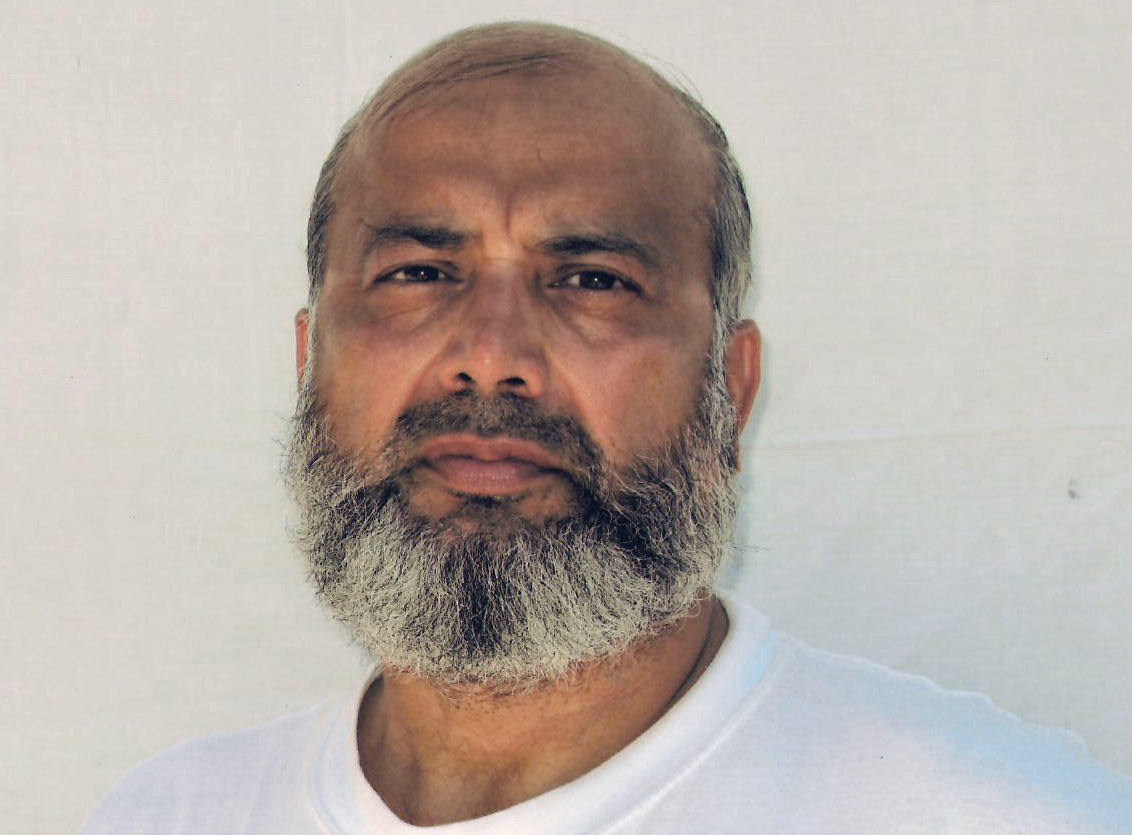


This undated photo made by the International Committee of the Red Cross and provided by lawyer David H. Remes, shows Guantanamo prisoner Saifullah Paracha. (AP)

A Pentagon spokesman had no immediate comment.
The prisoner review board also informed Uthman Abd Al-Rahim Uthman, a Yemeni who has been held without charge at Guantanamo since it opened in January 2002, was also notified that he had been cleared, according to his attorney, Beth Jacob, who spoke to him by phone.
“He was happy, relieved and hopeful that this will actually lead to his release,” Jacob said.
Paracha, who lived in the US and owned property in New York City, was a wealthy businessman in Pakistan. Authorities alleged he was an Al Qaida “facilitator” who helped two of the conspirators in the Sept. 11 plot with a financial transaction. He says he didn’t know they were Al Qaida and denies any involvement in terrorism.
The US, which captured Paracha in Thailand in 2003 and has held him at Guantanamo since September 2004, has long asserted that it can hold detainees indefinitely without charge under the international laws of war.
In November, Paracha, who suffers from a number of ailments including diabetes and a heart condition, made his eighth appearance before the review board, which was established under President Barack Obama to try to prevent the release of prisoners who authorities believed might engage in anti-US hostilities upon their release from Guantanamo.
At the time, his attorney said he was more optimistic about his prospects because of Biden’s election, his ill health and developments in a legal case involving his son, Uzair.
Uzair Paracha was convicted in 2005 in federal court in New York of providing support to terrorism, based in part on testimony from the same witnesses held at Guantanamo whom the US relied on to justify holding the father.
In March 2020, after a judge threw out those witness accounts and the government decided not to seek a new trial, Uzair Paracha was released and sent back to Pakistan.
Saifullah Paracha is one of 40 prisoners still held at Guantanamo, down from a peak of nearly 700 in 2003.
With this latest review board decision, there are now about nine men held at Guantanamo who have been cleared for release, including one who has been approved since 2010. Under Obama, the US would not return men to Yemen because of the civil war there and often struggled to find third countries to accept former prisoners.
Given that history, Jacob was only cautiously optimistic about her client’s release. “I’m just hoping that in 11 years he’s not just still sitting there with his clearance still at Guantanamo,” she said.
There are 10 facing trial by military commission and two who have been convicted, including one awaiting sentencing. Proceedings in the tribunals have been on hold because of the COVID-19 pandemic.


Pakistan launches privatization process for five power distributors under IMF reforms

Updated 10 sec ago
Follow

Pakistan launches privatization process for five power distributors under IMF reforms

  • Power-sector losses have pushed circular debt above $9 billion, official documents show
  • Move is tied to IMF and World Bank conditions aimed at cutting subsidies and fiscal risk

KARACHI: Pakistan has appointed financial advisers and launched sell-side due diligence for the privatization of five electricity distribution companies, marking a long-awaited step in power-sector reforms tied to International Monetary Fund (IMF) and World Bank programs, according to official documents shared with media on Monday.

The five companies, namely Islamabad Electric Supply Company (IESCO), Faisalabad Electric Supply Company (FESCO), Gujranwala Electric Power Company (GEPCO), Hyderabad Electric Supply Company (HESCO) and Sukkur Electric Power Company (SEPCO), supply electricity to tens of millions of customers and have long been a major source of financial losses for the state.

Pakistan’s power sector has accumulated more than Rs2.6 trillion (about $9.3 billion) in circular debt as of mid-2025, driven largely by distribution losses, electricity theft and weak bill recovery, according to official government data cited in the documents. The shortfall has repeatedly forced the government to provide subsidies, adding pressure to public finances in an economy under IMF supervision.

“The objective is to reduce losses, improve efficiency and limit the government’s fiscal exposure by transferring electricity distribution operations to the private sector,” the documents said, adding that sell-side due diligence for five distribution companies is under way as a prerequisite for investor engagement.

Two utilities, the Quetta Electric Supply Company and Tribal Areas Electric Supply Company, are excluded from the current privatization phase due to security and structural constraints, the documents said.

Power-sector reform is a central pillar of Pakistan’s IMF bailout program, under which Islamabad has committed to restructuring state-owned enterprises, improving governance and reducing budgetary support. The World Bank has also linked future energy-sector financing to progress on structural reforms.

Electricity distribution companies in Pakistan routinely report losses exceeding 20 percent of supplied power, far above international benchmarks, according to official figures. These inefficiencies have been a persistent obstacle to economic growth, investment and reliable power supply.

Previous attempts to privatize power distributors have stalled amid political resistance, labor union opposition and concerns over tariff increases. While officials have not announced a timeline for completing transactions, the launch of due diligence marks the most concrete step taken in years. International lenders and investors will now be closely watching whether Pakistan can translate this phase into completed sales, a key test of its ability to deliver on IMF-backed reforms.

In a related development in Pakistan’s privatization agenda, the government last month concluded the long-delayed sale of a 75 percent stake in national flag carrier Pakistan International Airlines (PIA) in a publicly televised auction. A consortium led by the Arif Habib Group emerged as the highest bidder with a Rs135 billion ($482 million) offer for the controlling stake, in a transaction officials have said will end decades of state-funded bailouts and inject fresh capital into the loss-making airline.