

COVID-19 vaccines work against Indian variant: Study

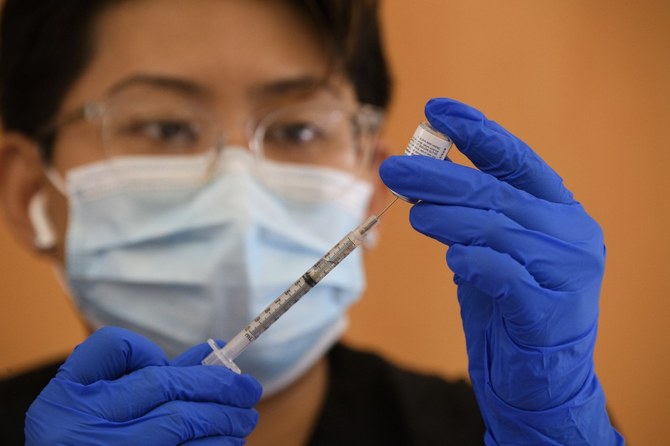
The Indian coronavirus variant is less resistant to vaccines than the South African variant, a study showed. (AFP)
Short Url
Updated 17 May 2021
Follow

COVID-19 vaccines work against Indian variant: Study

  • It is less resistant to existing jabs than South African variant: Oxford team
  • Scientist warns slow European vaccine rollout could open door to new variants

LONDON: Approved COVID-19 vaccines are effective against the Indian variant (B.1.617.2), a study by scientists at Oxford University has found.

“It looks like the Indian variant will be susceptible to the vaccine in the way that other (variants) are,” Prof. Sir John Bell, emeritus professor of medicine at Oxford, told Times Radio in the UK.

“The data looks rather promising. I think the vaccinated population are going to be fine. And we just need to pump our way through this.”

The study, led by Oxford’s Prof. Gavin Screaton, looked at two vaccines — Pfizer-BioNTech and Oxford-AstraZeneca — and found that both create sufficient antibodies to neutralize the Indian variant in enough incidences to drastically reduce hospitalizations and fatalities.

It also found that B.1.617.2 is less resistant to vaccines than the South African variant, and is more similar to the Kent and Brazilian variants.

“If you do the lab experiment, which is you take plasma serum from someone who’s received the vaccine and you look to see its ability to neutralize the virus, that’s a highly effective way of telling whether you’re going to be protected or not,” Sir John said.

“It looks OK. It’s not perfect but it’s not catastrophically bad. There’s a slight reduction in the ability to neutralize the virus, but it’s not very great and certainly not as great as you see with the South African variant. It’s rather close to the Brazilian version where the vaccine serum seems to be very effective in neutralizing the virus,” he added.

“The antibodies you’ve made after you’ve had the vaccine, which are floating around in your blood, are good enough to neutralize the virus if you get it.”

But Sir John warned that the lack of vaccinations across Europe and elsewhere means the continent is more susceptible to variants, and the possibility remains that more could emerge due to a lack of immunization and increased transmission.

“There are very broad swathes of Europe that are largely unvaccinated. So they’re pretty vulnerable to new variants — be it Indian or otherwise — sweeping across the continent and leaving very, very high levels of disease,” he added.


Rubio says new governance bodies for Gaza will be in place soon

Updated 4 sec ago
Follow

Rubio says new governance bodies for Gaza will be in place soon

  • Rubio said progress had been made recently in identifying Palestinians to join the technocratic group and that Washington aimed to get the governance bodies in place “very soon,” without offering a specific timeline.

WASHINGTON: US Secretary of State Marco Rubio said that a ​new governance structure for Gaza — made up of an international board and a group of Palestinian technocrats — would be in place soon, followed by the deployment of foreign troops, as the US hopes to cement a fragile ceasefire in Israel’s war in the Palestinian enclave. 
Rubio, speaking at a year-end news conference, said the status quo was not sustainable in Gaza, where Israel has continued to strike Hamas targets while the group has reasserted its control since the October peace agreement ‌brokered by the US.
“That’s why we have a sense of ‌urgency about ​bringing ‌phase one to its full completion, which is the establishment of the Board of Peace, and the establishment of the Palestinian technocratic authority or organization that’s going to be on the ground, and then the stabilization force comes closely thereafter,” Rubio said.
Rubio said progress had been made recently in identifying Palestinians to join the technocratic group and that Washington aimed to get the governance bodies in place “very soon,” without offering a specific timeline. Rubio was speaking after the US Central Command hosted a conference in Doha this week with partner nations to plan ‌the International Stabilization Force for Gaza. 
Two US officials said last week that international troops could be deployed in the strip as early as next month, following the UN Security Council’s November vote to authorize the force.
It remains unclear how Hamas will be disarmed, and countries considering contributing troops to the ISF are wary that Hamas will engage their soldiers in combat.
Rubio did not specify who would be responsible for disarming Hamas and conceded that countries contributing troops want to know the ISF’s specific mandate and how it will be funded. 
“I think ⁠we owe them a few more answers before we can ask anybody to commit firmly, but I feel very confident that we have a number of nation states acceptable to all sides in this who are willing to step forward and be a part of that stabilization force,” Rubio said, noting that Pakistan was among the countries that had expressed interest.
Establishing security and governance was key to securing donor funding for reconstruction in Gaza, Rubio added.
“Who’s going to pledge billions of dollars to build things that are going to get blown up again because a war starts?” Rubio said, discussing the possibility of a donor conference to raise reconstruction funds. 
“They want to know ‌who’s in charge, and they want to know that there’s security so and that there’ll be long term stability.”