Pakistan imposes travel ban on key opposition leader Shehbaz Sharif

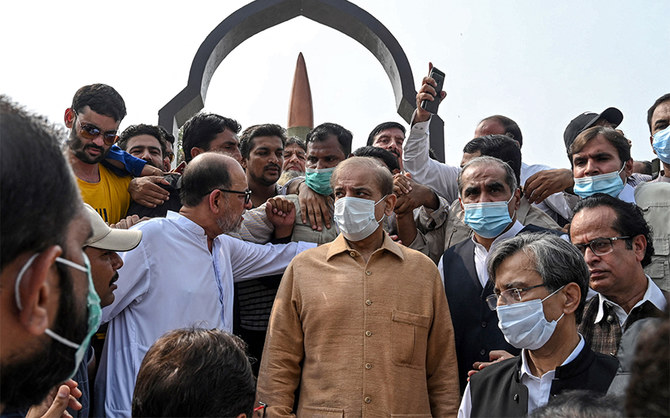
Pakistan's opposition leader Shehbaz Sharif (C) stands with party leaders and activists in Lahore, Pakistan, on September 6, 2020. (AFP/File)
Short Url
Updated 17 May 2021
Follow

Pakistan imposes travel ban on key opposition leader Shehbaz Sharif

  • Places him on the country’s exit control list a week after he was off-loaded from a UK-bound flight
  • Court had permitted him to travel abroad for medical treatment

ISLAMABAD: Pakistan has imposed a travel ban on the parliamentary leader of the opposition, Shehbaz Sharif, based on a recommendation by its anti-graft agency, the National Accountability Bureau (NAB), Interior Minister Sheikh Rashid Ahmed said on Monday.
The decision to place Shehbaz on the country’s Exit Control List (ECL) follows a week after he was off-loaded from a UK-bound flight, despite a top Pakistani court permitting him to travel to London for medical treatment.
In a press conference on Monday, Ahmed said that “members of the Sharif family,” who were co-accused in a money laundering case, “were already in London.”
“Nawaz Sharif did not return, so how could Shehbaz?” he added.
Shehbaz, a former chief minister of the populous Punjab province and younger brother of former Prime Minister Nawaz Sharif, is co-accused in a money laundering case amounting to billions of rupees.
Nawaz left Pakistan in November 2019 to seek medical treatment in the UK after being granted bail from a seven-year jail sentence for corruption. He denies the corruption charges and continues to live in exile in London.
Shehbaz, who heads the Pakistan Muslim League-Nawaz (PML-N) party – after Nawaz was disqualified from office – was released on bail in April, nearly seven months after the NAB detained him over his alleged role in the money laundering case.
“Therefore, like his brother, if Mian Muhammad Shehbaz Sharif absconds, his extradition from the UK will not be possible,” Ahmed said.


Pakistan stock market crosses record 174,000 points during intraday trading

Updated 14 sec ago
Follow

Pakistan stock market crosses record 174,000 points during intraday trading

  • Pakistan Finance Adviser Khurram Schehzad says stock market’s equity investor base has increased by over 120,000 in last 18 months
  • Official says stock market’s record levels reflect growing investor confidence supported by continued macro stability and key reforms

ISLAMABAD: The Pakistan Stock Exchange (PSX) crossed a record 174,000 points on Monday, Finance Adviser Khurram Schehzad said, marking a strong start to the business week. 

According to the data available on the PSX’s official website, the KSE-100 benchmark reported 174,411.72 points during the intraday trading on Monday morning. 

“Another milestone for Pakistan’s equity market,” Schehzad wrote on social media platform X. “The KSE-100 Index has crossed 174,400 points, marking yet another record high.”

Pointing out the stock market’s achievements this year, Schehzad said the PSX has delivered 50 percent plus returns in US dollar terms to investors since January this year, “making it one of the best markets in Asia.”

He noted that investors’ participation in the PSX is rising fast, adding that the equity investor base has increased by over 120,000 to cross the 450,000 figure in the last 18 months, marking a 37 percent increase. 

“These record levels reflect growing investor confidence, supported by continued macro stability, key reforms, and improving prospects for more sustainable, higher future growth,” he said. 

Pakistan’s stocks have surged in recent years, marking a strong performance this year as Islamabad moves to consolidate its financial recovery after years of economic turbulence, which saw it on the verge of a sovereign default in June 2023. 

Pakistan’s foreign exchange reserves have surged past the $21 billion mark, as per the central bank’s latest data. 

In recent years, the South Asian country has also implemented tough structural reforms under the International Monetary Fund (IMF) loan programs, aimed at reducing fiscal deficits and restoring investor confidence.