- Israeli airstrikes on the Gaza Strip have killed at least 181 people, including 52 children since last week
- Virtual emergency meeting called at Saudi Arabia's request to address Israeli attacks in the Palestinian territories
ISLAMABAD: Pakistan demanded that Israel be held accountable for crimes against humanity during an emergency session of the Organization of Islamic Cooperation (OIC) on Sunday.
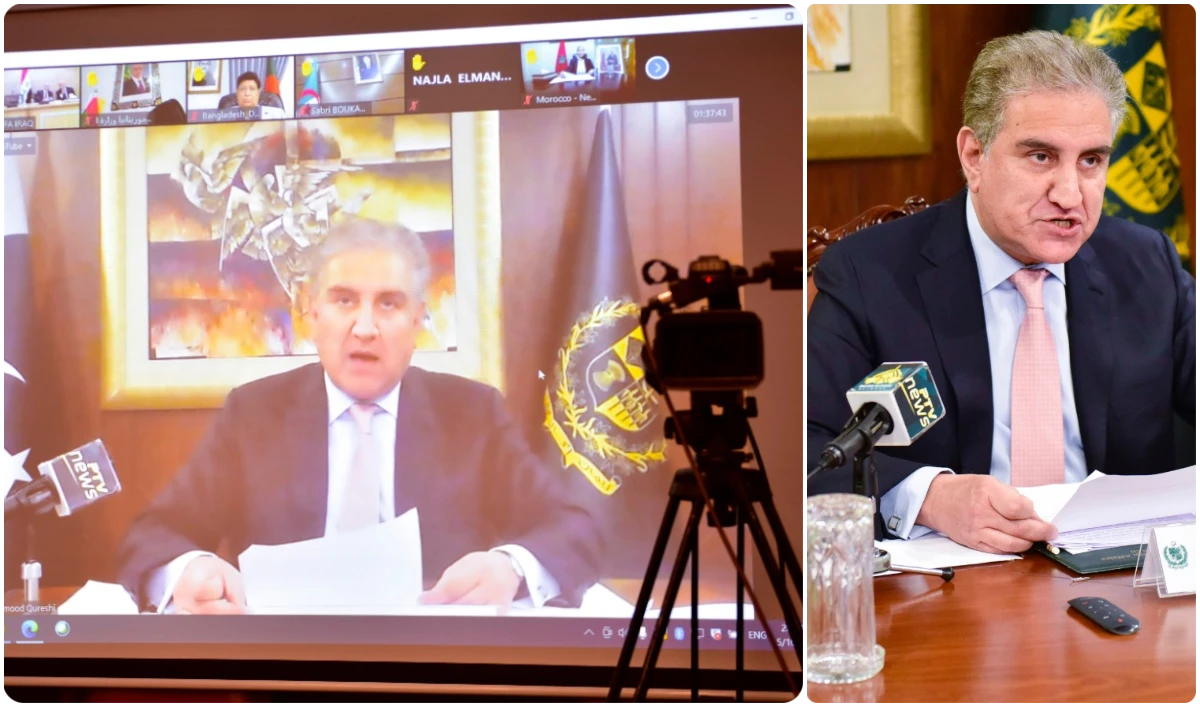
The virtual emergency meeting of the foreign ministers of OIC member states was chaired by Saudi Arabia's foreign minister, Prince Faisal bin Farhan. It was called at the kingdom's request to address continuing Israeli attacks in the Palestinian territories.
Israeli airstrikes on the Gaza Strip have killed at least 181 people in the self-governing Palestinian territory, including 52 children, and injured over 1,225 since last week, according to Gazan health authorities.
"Israel's crimes against humanity should not escape accountability," Pakistan's Foreign Minister Shah Mahmood Qureshi said during the OIC session, as he named several other issues that require immediate action from the international community, including "concerted actions to stop Israeli atrocities against civilian population in Gaza. The bombardment in Gaza must be stopped immediately."
He added it has become "critical and urgent" to implement a series of United Nations that call for the establishment of a Palestinian state, the right of return of Palestinian refugees, and an end to Israeli settlement building.
The latest wave of violence escalated in the final days of the fasting month of Ramadan after Israeli police fired tear gas, rubber-coated steel bullets, and stun grenades at Palestinians gathered at Al-Aqsa Mosque in Jerusalem — the third holiest site in Islam.
The violence was triggered by protests as Israeli forces tried to expel Palestinians from their houses in the Sheikh Jarrah neighborhood of East Jerusalem and hand over their property to Jewish settlers.
"The tragedy of forced evictions of Palestinians from the Shaikh Jarrah neighborhood of Al-Quds Al-Shareef is the latest manifestation of the systematic Israeli effort to change the demographic structure; historical and legal status; and Arab-Islamic and Christian character of Al-Quds Al-Shareef. This is patently illegal, immoral and unacceptable," Qureshi said.
He added: "There should be no impunity for Israel’s violation of international law, including the Fourth Geneva Convention and the various human rights treaties."
The Fourth Geneva Convention of 1950, ratified by 192 nations, including Israel, says that an occupying power "shall not deport or transfer parts of its own civilian population into the territory it occupies." Such transfers are also classified as war crimes under the 1998 statute that established the International Criminal Court.
As numerous Western politicians, including members of the US administration, have referred to the Israeli attacks as "self-defense," Qureshi said that "attempts to create a false equivalence between Israel, the aggressor, and Palestinians, the victims, are inexcusable."
"As the collective voice of the Muslim Ummah, the OIC should work in unity to dispel this deliberately deceptive perception," he said.
He reiterated Pakistan's support for an independent State of Palestine with the pre-1967 borders, in accordance with the relevant UN and OIC resolutions and "Al-Quds Al-Shareef as the capital of a viable, independent and contiguous Palestinian State."
"Support for the Palestinian cause has been a defining principle of Pakistan’s foreign policy since our inception," Qureshi said. "Our founding father, Quaid-i-Azam Muhammad Ali Jinnah, was unrelenting in upholding the legitimate rights of the Palestinian people."