MUMBAI: India reported on Saturday its smallest daily increase in coronavirus infections in nearly three weeks, but deaths stayed near the 4,000-mark as the World Health Organization warned that the second year of the pandemic could be worse than the first.
In the past 24 hours, India had 326,098 new infections, taking its tally to 24.37 million, with 3,890 deaths, for a toll of 266,207, health ministry data shows. But the slow growth may also reflect test rates that are at their lowest since May 9.
In Geneva, the World Health Organization’s chief said India was a huge concern, with the second year of the pandemic set to be more deadly than the first.
Tedros Adhanom Ghebreyesus’s remarks to an online meeting came after Indian Prime Minister Narendra Modi sounded the alarm on Friday over the rapid spread of the disease through the vast countryside.
During the past week, the south Asian nation has added about 1.7 million new cases and more than 20,000 deaths in a second wave of infections that has overwhelmed hospitals and medical staff.
Police are patrolling the banks of the Ganges in India’s most populous state of Uttar Pradesh to stop any dumping of corpses in the river, a government official said.
“We keep recovering 10 to 20 bodies every now and then,” Navneet Sehgal, a spokesman for the northern state, which has more people than Brazil, said.
“We have put a police force on the river and have also sent communications to local authorities that this practice be stopped.”
Sehgal was denying a report in the Asian Age newspaper, citing federal government sources, that nearly 2,000 bodies of possible virus victims had been pulled from the river in the past week or so.
Some riverside villages did not cremate their dead in line with Hindu tradition during certain periods of religious significance, he added.
The state’s virus infections officially peaked late last month but experts say many more cases are going undetected in the villages home to the bulk of the state’s 240 million people.
Cases have fallen steadily in some Indian states hit by an initial surge in infections, such as the richest state of Maharashtra and the capital New Delhi, after they imposed stringent lockdowns.
Delhi’s positive cases as a share of tests have fallen to 11 percent, Chief Minister Arvind Kejriwal told a news briefing, from more than 30 percent early this month.
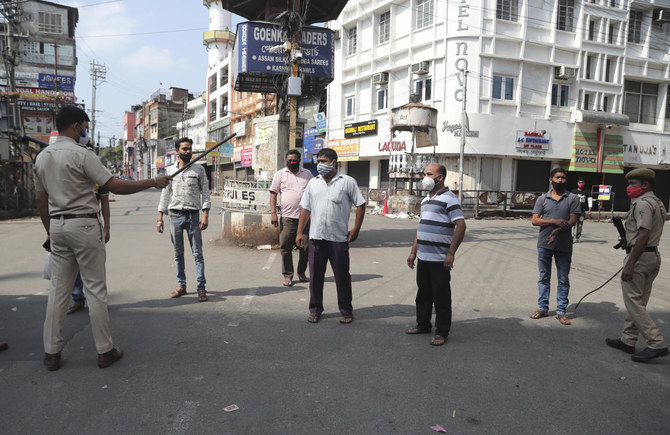
But the eastern state of West Bengal, which held elections last month, had its biggest single-day spike. On Saturday, it ordered a state-wide lockdown for 15 days until the end of May.
Some other states, such as Karnataka in the south, have also reported recent rises, implying an fall in overall cases is still some time away.
Prime Minister Boris Johnson vowed to accelerate Britain’s vaccination program, reducing the gap between doses for the vulnerable, to try to contain a fast-spreading variant first detected in India.
Johnson’s comments came soon after India accepted a government panel’s recommendation to double to 12 to 16 weeks the gap between doses of the AstraZeneca vaccine.


![]()

India’s daily COVID-19 deaths near 4,000 as police sent to halt dumping of bodies
Short Url
https://arab.news/ny5n3
India’s daily COVID-19 deaths near 4,000 as police sent to halt dumping of bodies
- The World Health Organization's chief said India was a huge concern
- Police are patrolling the banks of the Ganges in India's most populous state of Uttar Pradesh to stop any dumping of corpses in the river


Latest updates


Recommended


© 2026 SAUDI RESEARCH & PUBLISHING COMPANY, All Rights Reserved And subject to Terms of Use Agreement.