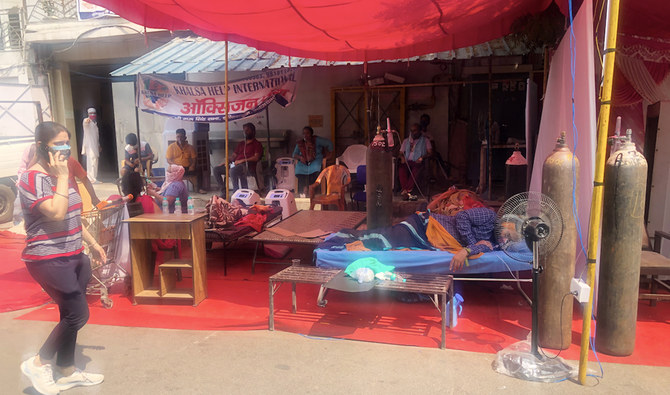

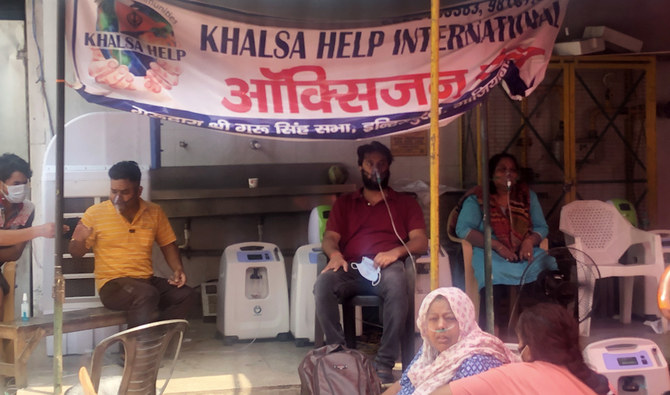

NEW DELHI: New Delhi’s Sikh community has opened an oxygen station at its temple, saving thousands of lives, as hospitals in the capital continue to be overwhelmed by coronavirus patients.
Recent weeks have seen the city’s hospitals unable to help people due to a shortage of beds and oxygen supplies.
Since late April, India has been reporting the world’s highest daily tally of coronavirus cases.
It surpassed 414,000 new cases and 4,000 virus-related deaths on Friday. New Delhi is among the cities worst hit by the disease and has reported nearly 20,000 new cases and 400 COVID-19 deaths — many due to a shortage of hospital beds and oxygen supplies.
The oxygen station has been set up at Gurdwara Sri Guru Singh Sabha in the suburban town of Indirapuram. It is based on the concept of langars, or free community kitchens, where Sikhs serve meals to all those in need, regardless of their religion or caste.
The lifesaving initiative started in the third week of April, helping 40 people every day. It has since expanded with 100 volunteers now caring for at least 700 patients daily.
“It all started when my father, a businessman with good contacts with local industries, started getting calls for help and oxygen support when the COVID-19 cases started escalating in the second week of April,” Gurpreet Singh Rummy, president of the gurdwara committee and founding member of Khalsa Help, told Arab News on Friday. “Initially we supported some individuals but later decided to mobilize all our resources and set up an ‘oxygen langar’ to help.”
FASTFACT
India has been reporting the world’s highest daily tally of coronavirus cases since late April. It surpassed 414,000 new cases on Friday.
The langar has already helped 12,000 people, he said.
Ravindra Ahuja, a 62 year-old-resident from the Ghaziabad neighborhood, was brought to the langar on Thursday night when his oxygen levels plummeted to 80. His family tried to admit him to a hospital, but no beds were available.
“We came here in despair when we did not see any hope in any hospital,” Ahuja’s brother Ravi told Arab News. “The langar was sent by God and it is really helping people like us.”
But Ahuja’s condition started to deteriorate, even as his family’s struggle was being recounted.
Dr. Gaurav Srivastva, one of the langar’s volunteers, asked the family to immediately find a hospital with a ventilator as the gurdwara’s facility did not have the specialist equipment to help.
“The problem is that we cannot do anything here except giving oxygen. I feel 70 percent of his lungs are damaged,” the doctor told Arab News. “What is happening is that the patients who could have been saved with timely medical intervention are dying because of the lack of medical support. Some patients move around different hospitals of Delhi from morning to evening looking for a bed and finally come here. Imagine a patient who travels the whole day in a tuk-tuk looking for a hospital and finally comes here. How can we save such a person?”
Health authorities warned the coronavirus situation was worsening across the country and that India’s medical infrastructure was unable to cope.
“The situation is worrisome, and the cases are increasing day by day. We are trying to improve the situation,” Dr. Rajni Kant, spokesperson for the Indian Council of Medical Research, told Arab News. “The sudden surge in cases has taken us by surprise, creating more pressures on an already inadequate medical infrastructure.”
Dr. Adarsh Pratap Singh, from the All India Institute of Medical Science, described the situation as “very alarming.”
“Data about the death and infection (rates) are not the real figure actually. The figure is much higher than what is shown,” he said. “We might be heading toward an unimaginable crisis. What the government should now do is to create field hospitals on a war footing to take care of the patients.”