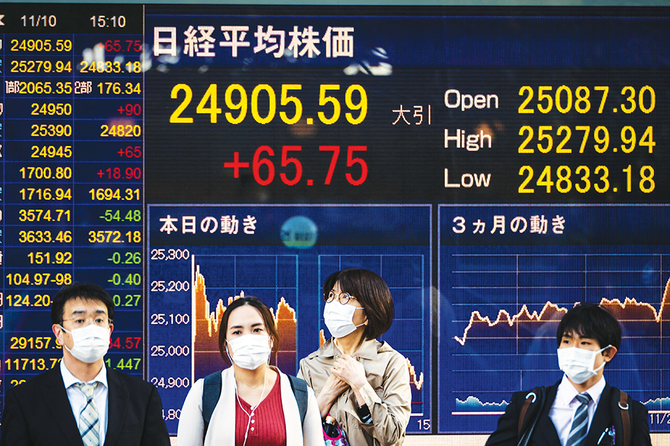

LONDON: US stocks rebounded on Thursday, a day after slumping on worries that soaring US inflation could trigger interest rate rises sooner than expected, and in turn harm global economic recovery.
Focus was also on bitcoin, which resumed sharp falls after Tesla’s Elon Musk stopped allowing people to pay for his electric cars with the cryptocurrency.
While US stocks opened higher, with the Dow adding 0.3 percent, their sharp losses on Wednesday pulled Asian and European stocks along with them on Thursday.
Tokyo’s main stocks index closed down 2.5 percent and European stocks also suffered sharp losses but recovered as the opening bell in New York approached.
With little in the way of news to spur the reversal, this invites “the notion that the scope of recent losses has gone far enough to whet the appetite of buy-the-dippers who have successfully feasted over the last year or so on down moves like the one that has recently unfolded,” said analyst Patrick J. O’Hare at Briefing.com.
Stock markets were already awash with red this week owing to growing fears that the blockbuster global economic recovery and vast stimulus measures will see cashed-up consumers go on a pent-up spending spree that will strain supplies and push up costs.
And those concerns were given oxygen Wednesday by figures showing US consumer inflation spiked at 4.2 percent in April, far higher than estimates and the highest since 2008 just before the global financial crisis kicked in.
That was followed on Thursday by data showing that producer prices jumped by 6.2 percent in April, the highest pace since 2010.
The advances were driven by a rally in commodity prices such as widely used copper, iron and lumber, which are sitting at record or multi-year highs.
“For stocks this might be an even tougher moment, given that companies may find themselves struggling to pass on price increases to customers, hitting profitability and putting the year-long earnings recovery in jeopardy,” noted Chris Beauchamp, chief market analyst at IG trading group.
Tech firms, which blossomed during lockdowns as people were forced to stay home, have led the share-price losses as they are more susceptible to higher interest rates.
The Fed has repeatedly insisted it expects such sharp price spikes but they will be transitory owing to last year’s low base and policymakers will not make any adjustments until they are happy unemployment is under control and inflation is running hot for some time.
However, investors are not convinced and there is growing unease that the central bank could lose control of the situation if it does not act in time, with analysts warning it could risk people’s confidence in the institution.
Tai Hui, at JP Morgan Asset Management, remained broadly upbeat about the outlook for equities, saying that while the sell-off was heavy, the gain in US Treasury yields — a gauge of future interest rates — was less severe.
“The market’s reaction ... (was) mild, reflecting the belief that this jump in inflation will eventually calm and revert closer to the Fed’s long-term target,” he said.
Regarding Bitcoin meanwhile, after Musk cited the environmental impact caused by the computing-intense mining process of creating new units, the cryptocurrency slumped around 16 percent.
It later recovered before trading down around 10 percent at $50,400 on Thursday.