

Leading British Imam urges caution during Eid celebrations
Leading British Imam urges caution during Eid celebrations/node/1858326/world
Leading British Imam urges caution during Eid celebrations
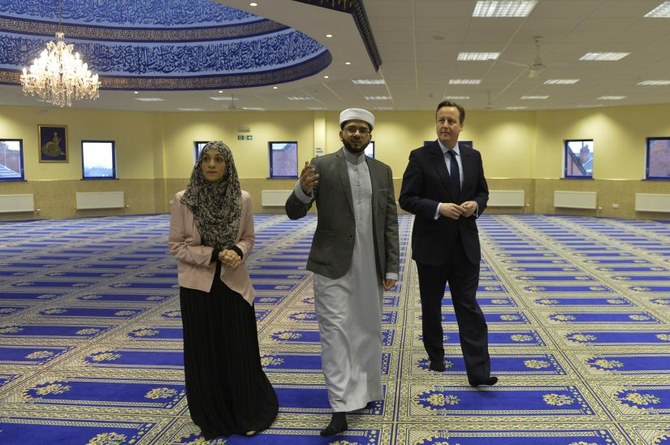
Britain’s then-PM David Cameron, right, with Imam Qari Asim and Shabana Muneer in the Makkah Masjid Mosque, Leeds, England, January 18, 2016. (Reuters)
Leading British Imam urges caution during Eid celebrations
Qari Asim urged Muslims to “not drop the ball before restrictions are eased”
British Muslims have now celebrated two Ramadans while adhering to social distancing measures
Updated 13 May 2021
Arab News
LONDON: One of Britain’s leading imams has urged British Muslims to exert caution and continue to observe coronavirus disease (COVID-19) restrictions on personal contact and indoor gatherings during Eid celebrations.
Qari Asim, chairman of the Mosques and Imams National Advisory Board, said it would be “excruciatingly painful” to celebrate Eid without gathering in numbers and embracing loved ones — but that everyone should “take that extra step” to keep people safe before restrictions are lifted.
Thursday marks the end of the second Ramadan Muslims in Britain have spent adhering to restrictions on personal contact and large gatherings — both of which are hallmarks of traditional Ramadan and Eid celebrations.
Asim said: “This Eid will be very different in the sense that we will not be able to greet each other in the traditional way of embracing each other, hugging and handshaking with each other.
“But I’m really hopeful that next Eid we will be able to be with each other and embrace each other and share a meal with our extended family and friends.”
He added: “It’s excruciatingly painful because the easing of restrictions is taking place next week when we will be able to hug each other and we will be able to embrace each other.
“We just have to take that one extra step to get us through this pandemic and make sure that we do not drop the ball before the restrictions are completely eased.”
On May 17, Britain will see a raft of pandemic-related restrictions to social life relaxed — including a cap on the number of worshippers allowed into mosques and other places of worship.
Asim said: “It’s been extremely challenging to follow the restrictions that have been in place but people have made incredible sacrifices and the Muslim community has strictly followed the guidelines given by the government.”
Instead of the traditional shared iftar meal, mosques in the UK have chosen to share food with vulnerable members of their local communities.
His own mosque, Asim said, has handed out more than 7,000 food parcels in the local area throughout Ramadan.
US hotels seek World Cup boost after tourism dip under Trump
At the US hotels that Meade Atkeson manages, a drop in tourism weighs heavily on business — but hoteliers like him hope that World Cup enthusiasm will soon eclipse wariness over President
Updated 2 sec ago
AFP
WASHINGTON: At the US hotels that Meade Atkeson manages, a drop in tourism weighs heavily on business — but hoteliers like him hope that World Cup enthusiasm will soon eclipse wariness over President Donald Trump’s policies. The US hospitality sector has been reeling from a tourism slump in the world’s biggest economy, which became the only major destination to see a drop in foreign visitors last year. “Just financially, it’s difficult when international travel is down,” Atkeson told AFP, noting that such visitors tend to stay longer and spend more. Foreign travelers account for nearly a quarter of business at the three hotels under Sonesta group that he manages — two in Washington and a third in Miami Beach. Yet, in the first eleven months of 2025, US official data showed that inbound travel dropped by 5.4 percent. Canadians were noticeably absent, with travel plunging by 21.7 percent from 2024, translating to about four million fewer people. The decline was nearly seven percent for French visitors. Industry professionals see this as a consequence of Trump’s policies, even if they may not openly say so. Visitors have chafed at the Republican president’s sweeping tariffs on foreign goods, broadsides against other countries, tightening immigration rules and portrayal of certain Democrat-led cities as ridden with crime. Canadians “were asked to be the 51st state, right?” Atkeson said. “If you talk to Canadians, many of them have chosen not to travel out of conscience” or on principle, he added. Brazilian tourists meanwhile “can go anywhere they want,” he said. “And so they may have gone to Europe, they may have gone to the islands.” ‘Fear’ Thousands of kilometers away, the major resort city of Las Vegas in Nevada — boasting 150,000 hotel rooms — has also had a bad year. Elsa Rodan, a chambermaid at the Bellagio resort and casino, says her establishment is “blessed” compared with others. But even so, it has had to lower prices to attract guests, added Rodan, a representative of the Unite Here union who spoke at a Washington press conference. Unite Here President Gwen Mills urges for a renewed effort to lobby the Trump administration over policies and rhetoric that she believes are jeopardizing the sector employing more than two million people. According to her, hoteliers are not pushing the government enough. Employers express “fear, the fear of picking your head up,” she said. Hopefully ‘better’ Fewer visitors and overnight stays, alongside a drop in revenue, have triggered a $6.7 billion shortfall for Nevada hotels in 2025, according to the American Hotel and Lodging Association (AHLA). But the organization hopes that 2026 will be a turning point — it is counting on the World Cup, from June 11 to July 19, to attract visitors. Eleven US cities will be hosting matches. “It’s being equated to having nearly 80 Super Bowls in just over a month,” AHLA spokesman Ralph Posner told AFP. “The economic lift won’t be limited to host cities,” he added. “Destinations across the country are hoping to benefit as international visitors extend their trips and travel between markets.” Las Vegas, for example, hopes to draw fans who might stop there before or after a game in Los Angeles or Kansas City. Organizers say that besides the seven million spectators in stadiums, the World Cup is set to attract 20-30 million tourists. The whole event, they believe, can generate $30 billion for the US economy. “I hope that things will look better,” Atkeson said. His Miami hotel is under renovations and cannot host much World Cup-related activity. But his Washington establishments are highlighting their proximity to Philadelphia, where several matches will be held. Another complication is war in the Middle East following US-Israeli strikes on Iran, which could snarl travel. “It’s a little too soon to tell how we’re going to do with that, but we’ll see,” he said.