

‘Virtual Ramadan’ helps British Muslims struggling with restrictions

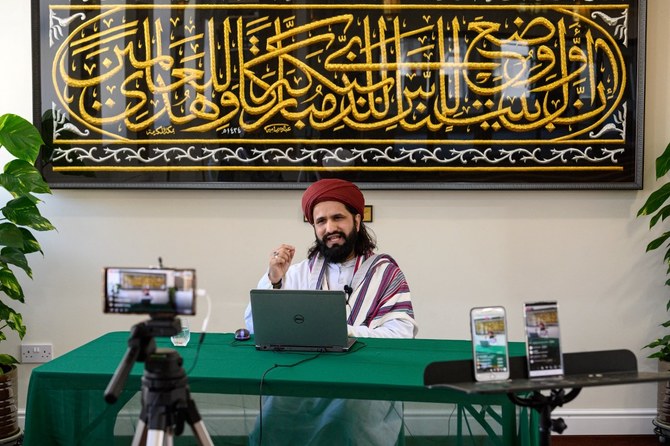
Imam Hassanat Ahmed delivers his Friday broadcast via multiple social media platforms from the otherwise empty Noor Ul Islam Mosque in Bury, Manchester, UK. (AFP)
Short Url
Updated 24 April 2021
Follow

‘Virtual Ramadan’ helps British Muslims struggling with restrictions

  • Millions of British Muslims are enduring their second straight Ramadan under strict virus protocols
  • Online sessions educate about Islam and provide relief from the possible mental strains of isolation

LONDON: Mental health charity collaborates with Islamic education platform to deliver a series of educational and spiritual workshops throughout Ramadan that will provide Muslims relief from the mental health strain of spending a second straight holy month under tight coronavirus (COVID-19) restrictions. 

Mental health charity Supporting Humanity has partnered with Islamic education platform Teach Me Islam to deliver the online sessions.

The organizations will provide Islamic talks, children’s stories, interactive baking for Iftar, along with health and fitness sessions for free, three times a week throughout the month.

During Ramadan, Muslims fast during the day and normally gather after the sunset to share in food and worship with their friends, family and the wider community.

This Ramadan is the second straight that the UK’s 3.3 million Muslims have spent adhering to strict curbs on social gatherings due to the COVID-19 pandemic. 

While last year’s curbs saw a total ban on social interaction as the virus swept across the country, this year sees looser restrictions for worshippers. Though the amount of social interaction still falls far short of what Muslims would normally expect from the holiest month on the Islamic calendar.

Nabeela Raza, the CEO of Teach Me Islam, told Arab News that her platform learned from the first Ramadan lockdown just how important it is for people to remain socially engaged and connected during the holy month, even if it has to be online.
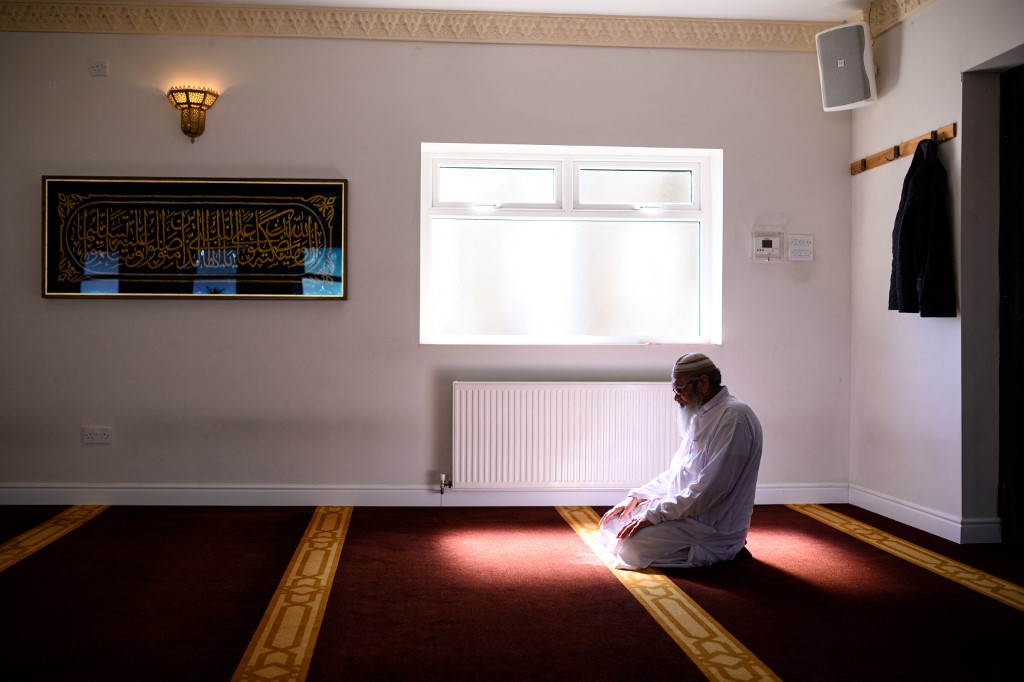


A member of mosque staff prays in the otherwise empty Noor Ul Islam Mosque on the day before Ramadan commences in the UK, in Bury, Greater Manchester on April 24, 2020. (AFP)

“Last year was the hardest Ramadan that the Muslim community has gone through,” Raza said. “A year on, some restrictions still in place are not allowing us to enjoy the company of friends and family, break fast together, and do the things we would usually do.”

Raza explained that during the lockdown, and particularly during Ramadan, people need Teach Me Islam’s services more than usual.

With online educational services, she said, people were able to “still feel like they had humane interaction or have the personal tutor that gives them the right advice. But it also makes it feel like they are not alone.”

In hard times, Raza added, religious education can “provide us with the coping mechanisms and tools we need to make it through.”

Supporting Humanity is a London-based mental health charity that has been providing bereavement counseling to many families who have lost loved ones during the pandemic.

In a statement to Arab News, Idris Patel, the CEO of Supporting Humanity, said: “Ramadan is a time for Muslims to spiritually connect as well as remember the less fortunate and give to charity, but it is also a time where families get together.

“The pandemic will make this very difficult this year for many Muslims, and we, as a mental health charity, want people to feel that there is something for the community to log into and be part of and not feel isolated.”

The online sessions are free and will run throughout the whole month.


Ex-Syrian intelligence officer appears in UK court charged with crimes against humanity

Updated 5 sec ago
Follow

Ex-Syrian intelligence officer appears in UK court charged with crimes against humanity

LONDON: A former member ‌of Syria's Air Force Intelligence attended a British court hearing via videolink on Tuesday charged with crimes against humanity and torture relating to the suppression of pro-democracy demonstrations ​in Damascus in 2011.
Salem Michel Al-Salem, 58, who now lives in Britain, appeared virtually at the hearing at London's Westminster Magistrates' Court from his home. He was wearing a breathing apparatus mask and the court was told he suffered from degenerative motor neurone disease.
Al-Salem is charged with three counts of murder as a crime against humanity relating to deaths in April and July 2011 "as part of ‌a widespread or ‌systematic attack against a civilian population with ​knowledge ‌of ⁠the attack".
He ​is ⁠also accused of three charges of torture relating to incidents in 2011 and 2012, and one of conduct ancillary to murder as a crime against humanity. He did not speak during the hearing and there was no indication as to how he would plead.
His lawyer Sean Caulfield told the court that Al-Salem was too unwell to confirm his ⁠name.
The seven charges were brought under a British ‌law that allows the prosecution of serious ‌international crimes committed abroad. The Crown Prosecution ​Service said it was the ‌first time it had brought charges of murder as crimes against ‌humanity.
In 2005, Afghan warlord Faryadi Zardad was convicted by a British court of torture that had taken place in Afghanistan.
Al-Salem, who has sought indefinite leave to remain in Britain, was a colonel in the Syrian Air Force ‌Intelligence department with oversight of the Information Branch in the district of Jobar, to the east of ⁠central Damascus, British prosecutors ⁠say.
He is accused of leading a group tasked with quelling the demonstrations, which mostly occurred during Friday afternoon prayers. Prosecutors say he gave his men orders to open fire on protesters, which led to the deaths of some individuals.
Prosecutors say he was also present at, or took part in, the torture of men at the Information Branch building.
Al-Salem was first arrested in central England in December 2021. His lawyer had sought an order to withhold his name, arguing it could pose a risk to his safety. England's ​Chief Magistrate Paul Goldspring rejected the ​application but ordered that his address not be made public.
He will next appear on Friday at London's Old Bailey court.