Leading British Imam urges caution during Eid celebrations

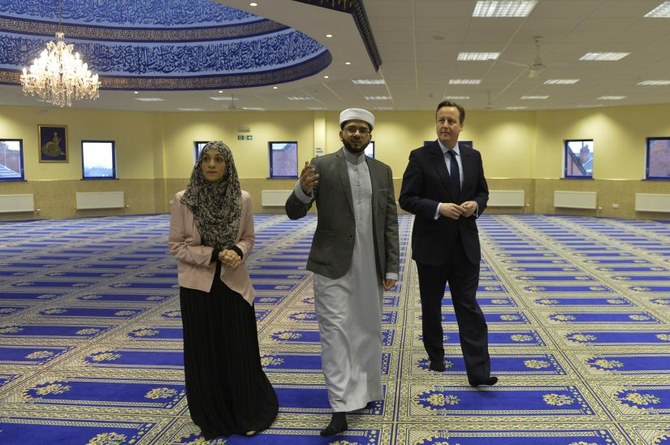
Britain’s then-PM David Cameron, right, with Imam Qari Asim and Shabana Muneer in the Makkah Masjid Mosque, Leeds, England, January 18, 2016. (Reuters)
Short Url
Updated 13 May 2021
Follow

Leading British Imam urges caution during Eid celebrations

  • Qari Asim urged Muslims to “not drop the ball before restrictions are eased”
  • British Muslims have now celebrated two Ramadans while adhering to social distancing measures

LONDON: One of Britain’s leading imams has urged British Muslims to exert caution and continue to observe coronavirus disease (COVID-19) restrictions on personal contact and indoor gatherings during Eid celebrations.

Qari Asim, chairman of the Mosques and Imams National Advisory Board, said it would be “excruciatingly painful” to celebrate Eid without gathering in numbers and embracing loved ones — but that everyone should “take that extra step” to keep people safe before restrictions are lifted.

Thursday marks the end of the second Ramadan Muslims in Britain have spent adhering to restrictions on personal contact and large gatherings — both of which are hallmarks of traditional Ramadan and Eid celebrations.

Asim said: “This Eid will be very different in the sense that we will not be able to greet each other in the traditional way of embracing each other, hugging and handshaking with each other.

“But I’m really hopeful that next Eid we will be able to be with each other and embrace each other and share a meal with our extended family and friends.”

He added: “It’s excruciatingly painful because the easing of restrictions is taking place next week when we will be able to hug each other and we will be able to embrace each other.

“We just have to take that one extra step to get us through this pandemic and make sure that we do not drop the ball before the restrictions are completely eased.”

On May 17, Britain will see a raft of pandemic-related restrictions to social life relaxed — including a cap on the number of worshippers allowed into mosques and other places of worship.

Asim said: “It’s been extremely challenging to follow the restrictions that have been in place but people have made incredible sacrifices and the Muslim community has strictly followed the guidelines given by the government.”

Instead of the traditional shared iftar meal, mosques in the UK have chosen to share food with vulnerable members of their local communities.

His own mosque, Asim said, has handed out more than 7,000 food parcels in the local area throughout Ramadan.


Pakistanis fleeing Iran describe strikes shaking ground under their feet

Updated 7 sec ago
Follow

Pakistanis fleeing Iran describe strikes shaking ground under their feet

QUETTA: Pakistanis fleeing Iran described explosions and missile strikes across Tehran shaking the ground under ​their feet and engulfing buildings in fire and smoke in a city emptied of many of its residents. The conflict has widened sharply, with a US submarine sinking an Iranian warship off Sri Lanka on Wednesday and NATO air defenses destroying an Iranian missile fired toward Turkiye.
Governments have been scrambling to evacuate stranded citizens, with most of the region’s airspace closed due to the risk of missiles hitting passenger planes.
“I was in the classroom when a powerful explosion rocked our university building,” Hareem ‌Zahra, 23, a ‌student at the Tehran University of Engineering, told ​Reuters ‌after ⁠crossing Pakistan’s land ​border with ⁠Iran.
“We saw thick smoke coming from many buildings on fire,” she said, adding Tehran was under attack until the moment she left.

TEHRAN LOOKED DESERTED
Nearly 1,000 students, businessmen and pilgrims have fled Iran since the war started out of a total 35,000 Pakistanis in the country, Mudassir Tipu, Pakistan’s ambassador to Tehran, said.
“There are now serious challenges. As you know there is no Internet in most parts of Iran,” he said. Iran ⁠has retaliated with a barrage of ballistic missiles targeting Israel and ‌Washington’s allies in the Gulf, including Qatar, Kuwait, ‌the UAE, and Saudi Arabia, following US and Israeli ​air strikes that killed Supreme Leader ‌Ayatollah Ali Khamenei on Saturday.
Tehran has looked deserted since the conflict began, said Nadir ‌Abbas, 25, a student of Persian literature at a university in the Iranian capital.
“I saw a drone hit a basketball court where six girl players lost their lives.”
Reuters could not verify his account.

’DESTRUCTION EVERYWHERE’ Islamabad is walking a diplomatic tightrope as it attempts to maintain warming ‌ties with Washington while expressing solidarity with Iran.
Pakistan is home to the second-largest Shiite population in the world after Iran and ⁠being drawn into ⁠the conflict could lead to instability at home as well as complications evacuating its citizens.
“The first attack happened right next to my hospital,” said Sakhi Aun Mohammad, a student at Tehran University of Medical Sciences. After he reached the border, an Iranian friend called to check if he was safe, saying: “’Thank God, you have gone to Pakistan, all of you are safe, but your hostel has been attacked’.” A Pakistani diplomat who is still in Tehran said attacks took place every four or five hours, adding one missile struck a building next to his office. “At times you will feel as if something exploded right at your feet,” he said. “The last time ​I got out was at night. ​Buildings had collapsed, some others were on fire. There is destruction everywhere.”
He added: “It is almost like a ghost town.”