

Afghan president says Pakistan will not support return of Taliban

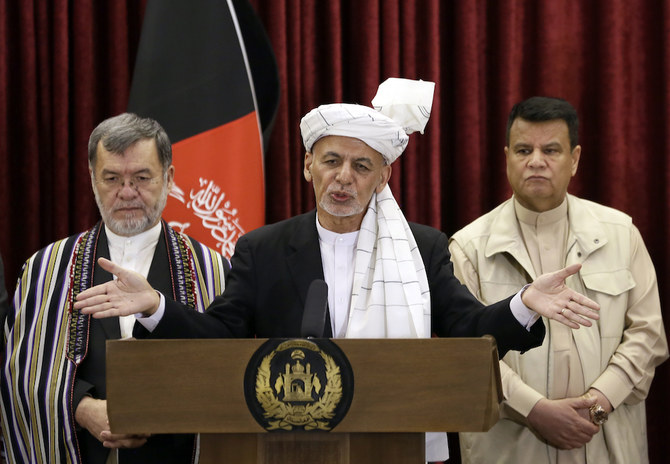
Afghanistan’s President Ashraf Ghani, center, makes an address during Eid Al-Fitr at the presidential palace in Kabul, Afghanistan, Thursday, May 13, 2021. (AP Photo)
Short Url
Updated 13 May 2021
Follow

Afghan president says Pakistan will not support return of Taliban

  • Ghani’s remarks come days after the Pakistan army chief visits Kabul despite stalled negotiations
  • Ties between Kabul and Islamabad have been historically tense but have soured even more in the past 20 years

KABUL: Afghanistan President Ashraf Ghani said on Thursday that Pakistan, which Kabul has long seen as a supporter of the Taliban, is not in favor of the group’s return to power in his war-battered country.

Concerns are mounting among the current Afghan administration because the complete US troop withdrawal, expected by September, could leave the country vulnerable to a Taliban takeover 20 years after it was ousted from power in a US-led invasion.

Ghani’s remarks came days after a visit from Pakistan’s army chief, Gen. Qamar Javed Bajwa, to Kabul.

“Pakistan’s army, in utter clarity, announced that the revival of Islamic Emirate is not in Pakistan’s national interest,” Ghani said in a televised speech after Eid Al-Fitr prayers, marking the end of Ramadan.

The Islamic Emirate of Afghanistan was the country’s name during Taliban rule from 1996-2001.

“Afghanistan’s peace and stability means peace and stability in the region,” the president said, adding the Pakistani general expressed his support for “the republic” — which is understood as Ghani’s government.

The Pakistani military did not immediately comment on Ghani’s statement. Its spokesperson also was not available when contacted by Arab News.

Ties between Kabul and Islamabad have been historically tense but have soured even more in the past 20 years. The Afghan government accused Pakistan of backing the Taliban which has been fighting to drive foreign troops out of the country and return to power.

While Pakistan has denied supporting the Taliban, its influence has been crucial in persuading the militants to join ongoing US-sponsored negotiations for a permanent ceasefire and power-sharing arrangement in Afghanistan.

Gen. Bajwa’s visit to Kabul came as the negotiations have stalled for months and violent attacks in Afghanistan have been on the rise since the US missed a May 1 deadline to withdraw its soldiers under last year’s agreement between Washington and the Taliban.

“Pakistan is also not keen on seeing an extremist ideology taking root in Afghanistan. It represents a risk for the generals and Pakistan’s democracy as well,” Toreq Farhadi, a former adviser to the Afghan government, told Arab News.

“Pakistan wants a political settlement in Afghanistan where Taliban can be part of the governing structure and opposes a total takeover of power by the Taliban.”


US immigration officials grilled by Congress over Trump crackdown

Updated 2 sec ago
Follow

US immigration officials grilled by Congress over Trump crackdown

  • Trump administration officials faced a barrage of criticism and tough questions from Democratic lawmakers over the major crackdown on migrants in multiple US cities
  • Rodney Scott hailed efforts on the southern US frontier, saying CBP ‘spent the last year rebuilding what was an intentionally broken border’
WASHINGTON: The heads of US immigration agencies faced heavy criticism in Congress Tuesday as they defended President Donald Trump’s mass deportation drive and fielded questions about the fatal shootings of two protesters in Minneapolis.
Trump acknowledged in the wake of the Minneapolis killings that a “softer touch” may be needed on immigration, and his administration announced concessions including the withdrawal of hundreds of officers from the Midwestern city.
But the issue remains far from resolved, with Democrats demanding changes to the way the Department of Homeland Security (DHS) conducts its immigration sweeps and threatening to block its funding, while Trump’s administration vows to maintain its deportation efforts, with backing from Republican lawmakers.
“The president tasked us with mass deportation, and we are fulfilling that mandate,” Todd Lyons, the acting head of Immigration and Customs Enforcement (ICE), said in his opening remarks during the Tuesday hearing on DHS oversight.
He testified alongside Rodney Scott, the head of US Customs and Border Protection (CBP), and Citizenship and Immigration Services director Joseph Edlow.
Scott hailed efforts on the southern US frontier, saying CBP “spent the last year rebuilding what was an intentionally broken border” and that “the United States... enjoys the most secure border in our nation’s history.”
The Trump administration officials faced a barrage of criticism and tough questions from Democratic lawmakers over the major crackdown on migrants in multiple US cities, which Republican representatives largely defended.
“This administration and the agencies represented before us have shown a complete and utter disregard for the law and the Constitution,” Democratic Representative Tim Kennedy said.
Representative Eli Crane, a Republican, pushed back on criticism of immigration enforcement, accusing Democrats of seeking to “demonize ICE and Homeland Security.”

‘Days, not weeks’

In Minneapolis, thousands of federal agents have in recent weeks conducted raids in what the administration claims are targeted operations against criminals.
Minnesota Governor Tim Walz said Tuesday that he expects the crackdown — which has seen detentions of broad categories of immigrants and sometimes citizens — to end soon.
“We’re very much in a ‘trust but verify’ mode. But it’s my expectation... that we are talking days, not weeks and months, of this occupation,” Walz said.
The operations have sparked mass protests in Minneapolis, and the fatal shootings of US citizens Renee Good and Alex Pretti less than three weeks apart last month led to a wave of outrage.
When Democratic Representative Eric Swalwell asked Tuesday if Lyons would apologize to Good and Pretti’s families over the Trump administration’s initial description of them as “domestic terrorists,” he declined, saying he would not comment on active investigations.
Opposition Democrats have been calling for sweeping reforms to ICE operations, including ending mobile patrols, prohibiting agents from concealing their faces, and requiring warrants.
Democratic leaders in Congress are also threatening to block the 2026 funding bill for DHS. The White House has indicated it is willing to negotiate, but its response has failed to satisfy opposition lawmakers so far.
“Republicans shared an outline of a counterproposal, which included neither details nor legislative text,” House Minority Leader Hakeem Jeffries and Senate Minority Leader Chuck Schumer said in a statement.
They denounced the White House response as “incomplete and insufficient in terms of addressing the concerns Americans have about ICE’s lawless conduct,” and said they were awaiting further details.
If negotiations fail, DHS could face a funding shortfall starting Saturday. CBP and ICE operations could continue using funds approved by Congress last year, but other sub-agencies such as federal disaster organization FEMA could be affected.