Israel declares curfew in Arab-Jewish town hit by violence

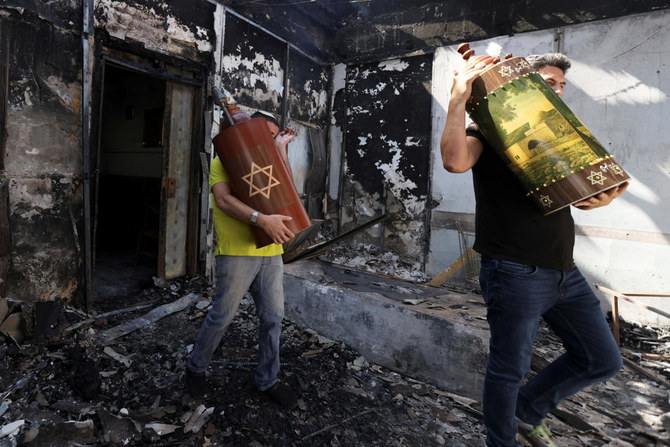
Torah scrolls, Jewish holy scriptures, are removed from a synagogue which was torched during violent confrontations in Lod between Israeli Arab demonstrators and police, amid hostilities between Israel and Gaza. (REUTERS)
Short Url
Updated 13 May 2021
Follow

Israel declares curfew in Arab-Jewish town hit by violence

  • Israeli police declared a night-time curfew and deployed heavily armed reinforcements after violence erupted in mixed towns
  • "We have lost control of the city and the streets," Lod Mayor Yair Revivo told Channel 12 News

LOD/ISRAEL: Jews cleared Torah scrolls from a torched synagogue on Wednesday and burnt-out cars lined nearby streets in an ethnically mixed Israeli town hit by violence denounced by the president as “unforgivable” acts by Arabs incensed at air strikes on Gaza.
Moving to head off further violence in Lod, which has also seen assaults by Jews on Arab passersby, police declared a night-time curfew and deployed heavily armed reinforcements.
In several other areas populated by Israel’s 21 percent Arab minority, Palestinian flags adorned electricity poles and hundreds of residents have turned out for protests, sometimes clashing with police or Jewish residents.
“We have lost control of the city and the streets,” Lod Mayor Yair Revivo told Channel 12 News after nightly confrontations, in which an Arab townsman was shot dead, a killing in which two Jewish suspects have been arrested.
Scores of other people have been arrested in Lod and in majority-Arab towns in central and northern Israel, including Umm Al-Fahm along the West Bank border and Jisr Al-Zarqa on the Mediterranean coast, police said.
In Lod, men carried Torah scrolls through the blackened and debris-strewn yard of the torched synagogue. President Reuven Rivlin described events in terms recalling anti-Semitism abroad.
“The sight of the pogrom in Lod and the disturbances across the country by an incited and bloodthirsty Arab mob ... is unforgivable,” he said, calling the flying of the Palestinian flag by protesters “a brutal assault on shared existence.”
Israel’s Arab minority — Palestinian by heritage, Israeli by citizenship — is mostly descended from the Palestinians who lived under Ottoman and then British colonial rule before staying in Israel after the country’s 1948 creation.
Most are bilingual in Arabic and Hebrew, and feel a sense of kinship with Palestinians in the occupied West Bank and the Gaza Strip. They often complain of systemic discrimination, unfair access to housing, health care, and education services.

Opinion

This section contains relevant reference points, placed in (Opinion field)

Tension in Arab-Jewish towns has risen as Israel conducted air strikes in Gaza and Palestinian militants fired rockets into Israel in an escalation of violence since clashes in East Jerusalem on Monday morning.
Ibrahim, an Arab councillor with the Lod municipality, said: “What is happening now is (an) uprising that is going on (in) cities like Ramle, Lod, Jaffa, Acre and Haifa,” calling events in Gaza and Jerusalem a “red line” for Arabs.
In the coastal city of Acre, Uri Buri, a Jewish-owned fish restaurant, was set fire to and some Arab residents said they were scared to leave home.
In Jaffa, near Tel Aviv, Arab protesters clashed with police firing stun grenades to disperse them.
“We condemn that our people’s solidarity and cohesion with our brethren in Jerusalem and the Gaza Strip is being channelled through acts of sabotage to public and private property, as is now happening at Umm Al-Fahm’s entrance,” said Samir Mahamid, Mayor of Umm Al-Fahm.
Neighbourhoods with Arab residents, including Lod and Jaffa, were among those where sirens were triggered by rocket fire. An Arab resident of Lod and his daughter were killed on Wednesday when a vehicle was hit by a rocket, Israeli authorities said.
In Haifa and Jaffa, and in the Arab city of Nazareth, protesters have chanted slogans in support of Palestinians facing eviction from an East Jerusalem neighborhood under a long-running legal case.
Arab citizens of Israel were among the thousands of protesters who have faced off in recent days with Israeli police near Al-Aqsa mosque and elsewhere in Jerusalem’s Old City.
A spokesman for the Hamas Islamist militant group in Gaza encouraged Arab citizens to “rise up” against “our enemy and yours.”


Turkiye’s Kurdish party says Syria deal leaves Ankara ‘no excuses’ on peace process

Updated 4 min 10 sec ago
Follow

Turkiye’s Kurdish party says Syria deal leaves Ankara ‘no excuses’ on peace process

  • Turkish officials said earlier on Monday that the Syrian integration deal, if implemented, could advance the more than year-long process with the ​PKK, which is based in northern Iraq

ANKARA: Turkiye’s pro-Kurdish DEM Party said on Monday that the Turkish government had no more “excuses” to delay a peace process with the Kurdistan Workers Party (PKK) now that a landmark integration deal was achieved in neighboring Syria.

On Sunday in Syria, the Kurdish-led Syrian Democratic Forces (SDF) agreed to come under the control of authorities in Damascus — a move that Ankara had long sought as integral to ‌its own peace ‌effort with the PKK.

“For more than a ‌year, ⁠the ​government ‌has presented the SDF’s integration with Damascus as the biggest obstacle to the process,” Tuncer Bakirhan, co-leader of the DEM Party, told Reuters, in some of the party’s first public comments on the deal in Syria.

“The government will no longer have any excuses left. Now it is the government’s turn to take concrete steps.” Bakirhan cautioned President Tayyip Erdogan’s ⁠government against concluding that the rolling back Kurdish territorial gains in Syria negated the need ‌for a peace process in Turkiye.

“If the ‍government calculates that ‘we have weakened ‍the Kurds in Syria, so there is no longer a ‍need for a process in Turkiye,’ it would be making a historic mistake,” he said in the interview.

Turkish officials said earlier on Monday that the Syrian integration deal, if implemented, could advance the more than year-long process with the ​PKK, which is based in northern Iraq. Erdogan urged swift integration of Kurdish fighters into Syria’s armed forces.

Turkiye, the strongest ⁠foreign backer of Damascus, has since 2016 repeatedly sent forces into northern Syria to curb the gains of the SDF — which after the 2011–2024 civil war had controlled more than a quarter of Syria while fighting Islamic State with strong US backing.

The United States has built close ties with Damascus over the last year and was closely involved in mediation between it and the SDF toward the deal.
Bakirhan said progress required recognition of Kurdish rights on both sides of the border.

“What needs to be done is clear: Kurdish rights must be recognized ‌in both Turkiye and Syria, democratic regimes must be established, and freedoms must be guaranteed,” he said.

Meanwhile, outlawed Kurdish militants in Turkiye said they will “never abandon” Kurds in Syria following the offensive by Damascus. 

You should know that we will not leave you alone. Whatever the cost, we will never leave you alone.. we as the entire Kurdish people and as the movement, will do whatever is necessary,” Murat Karayilan of the Kurdistan Workers’ Party (PKK) was quoted as saying by Firat.

Karayilan said the Damascus-led offensive was an “attempt to nullify” the peace process in Turkiye.
“This decision by international powers to enable these attacks, will be a black mark for the US, the UK, Germany, France and other international coalition states,” he said.
On Monday, at least 500 people rallied in Turkiye’s Kurdish-majority city of Diyarbakir against the Syrian offensive. Clashes erupted when pollice tried to break up the protest.
The pro-Kurdish DEM party, the third largest force in the Turkish parliament, called for a rally on Tuesday in the town of Nusaybin, located on the border with Syia.

*With Reuters and AFP