

Egypt unearths 250 tombs dating back 4,200 years

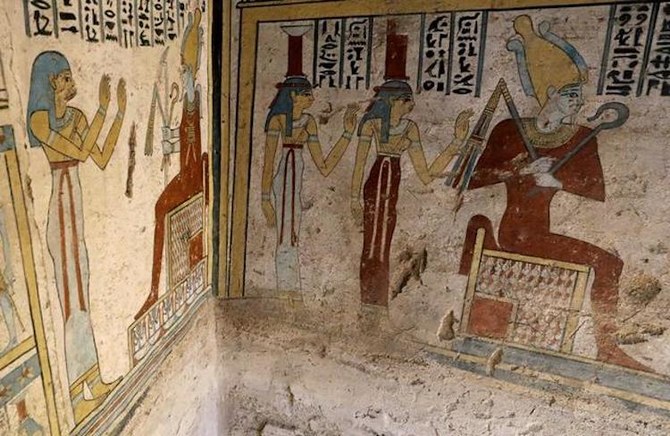
Preserved wall paintings inside the burial site, Tomb of Tutu, at al-Dayabat, Sohag, Egypt, April 5, 2019. (Reuters)
Short Url
Updated 13 May 2021
Follow

Egypt unearths 250 tombs dating back 4,200 years

  • Tombs ranged in age from the end of the Old Kingdom to the end of the Ptolemaic period
  • Tombs contained small alabaster vessels, animal and human bones, as well as limestone remnants thought to be funerary plates

CAIRO: Around 250 tombs dating back around 4,200 years have been unearthed by archaeologists in Egypt.

The country’s archaeological mission of the Supreme Council of Antiquities made the finds in the southern province of Sohag.

The graves, discovered in Sohag’s Al-Hamidiyah cemetery, included “some with a well or several burial wells and other cemeteries with a sloping corridor that ends with a burial room,” the Egyptian Antiquities Ministry said in a statement.

Officials added that the tombs ranged in age from the end of the Old Kingdom to the end of the Ptolemaic period.

The Old Kingdom lasted for around 500 years until 2200 B.C., while Egypt’s Ptolemaic dynasty ruled for 300 years to about the time of Cleopatra’s death in 30 B.C., according to AFP.

Mostafa Waziri, head of the Supreme Council of Antiquities, said one tomb dating back to the Old Kingdom had faint remains of hieroglyphic inscriptions and a chamber for sacrifices.

He noted that the graves were of multiple styles and were discovered at several levels of the mountain, adding that more were likely to be uncovered.

Mohammed Abdel-Badie, head of the Central Department of Upper Egypt Antiquities, said pottery and votive objects had also been found, dedicated to ancient Egyptian deities.

He said some of the pots had been used in daily life and others within the funerary foundation as miniature symbolic deposits, which were small spherical vessels with traces of yellowish paint on the outside.

Small alabaster vessels, animal and human bones, as well as limestone remnants thought to be funerary plates dating back to the Sixth Dynasty, were also discovered, he added.

As part of the project, more than 300 tombs were recorded and documented in the area, which stretches from Nag Al-Sheikh in the south to Al-Khazendarah in the north.

Egypt has announced several major new archaeological discoveries in recent months, in the hope of helping to revive a vital tourism sector battered by a 2011 uprising, ongoing political unrest, jihadist attacks, and the coronavirus disease (COVID-19) pandemic.


Art Cairo returns under theme ‘Arab. Art. Here’

Updated 21 sec ago
Follow

Art Cairo returns under theme ‘Arab. Art. Here’

DUBAI: Art Cairo 2026 is being held under the theme “Arab. Art. Here,” inspired by Palestinian poet Mahmoud Darwish’s words, “This is my language, my miracle, my magic wand.” 

The art fair is set to run from Jan. 23-26 at the buzzed-about Grand Egyptian Museum.

According to organizers, the theme explores the Arabic language as a living cultural force shaping artistic expression across the region.

Participating galleries hail from across the region, with a heavy showing from Egypt, the Levant and beyond.

From Egypt, galleries include Zamalek Art Gallery, Mashrabia Gallery of Contemporary Art, Gallery Misr, Villa Azad, and Le Lab. by Mark Hachem, Maya Art Space, Arame Art Gallery, ZAAT. KAF Art Gallery will represent the Lebanese art scene, while Jordan’s participating galleries include Wadi Finan Art Gallery and Orfali Art Gallery.

Gulf-based galleries taking part in Art Cairo include Salwa Zeidan Gallery from Abu Dhabi, Fann A Porter from Dubai and Folk Art Space from Bahrain, while northern Europe’s showing includes Galerie SANAA from the Netherlands and Quartum Galleri  from Norway.

As part of the fair’s seventh outing, Art Cairo will stage a solo museum exhibition dedicated to pioneering artist Inji Efflatoun, drawn from the collection of the Egyptian Museum of Modern Art. The Egyptian painter, who died in 1989, was also an activist in the women’s movement.

The Hiwar Programme — meaning “dialogue” in Arabic — returns as a core component of Art Cairo 2026, offering a curated series of panel discussions examining artistic practice, institutional responsibility and the evolving regional art market.

Topics include the relationship between galleries, auction houses, artists and collectors; the shared responsibilities shaping artistic legacy; collaboration between designers and galleries; art’s role in building communities; and reflections on modern Egyptian art as a lens for cultural memory.

Speakers include representatives from Christie’s, artists, academics, entrepreneurs and cultural leaders from Egypt and the wider region.

Beyond the halls of the Grand Egyptian Museum, the fair is hosting a cultural and social program including curated visits to historic landmarks. Highlights include Aisha Fahmy Palace, Amir Taz Palace, and the Mahmoud Khalil Museum.