



QUETTA: It’s an unlikely trio in an unlikely place-- two smart young Baloch students stand proudly outside their university in Quetta with an all-white, five feet, four inches tall humanoid robot between them.
Aziz Ullah Shahwani, 24, and Mukhtiar Ahmed Rodini, 25, are students of physics at the University of Balochistan, and the robot they created, named Bolani, is their final project.
“I didn’t take any interest in technology-related experiments till I graduated school due to the absence of a physics teacher in my native district Kalat... but when I came to the University of Balochistan for my master’s degree in physics I decided to invent something new, something no other student in the history of UoB has done,” Shahwani told Arab News, as he proudly unveiled Bolani outside the Physics department of his university.
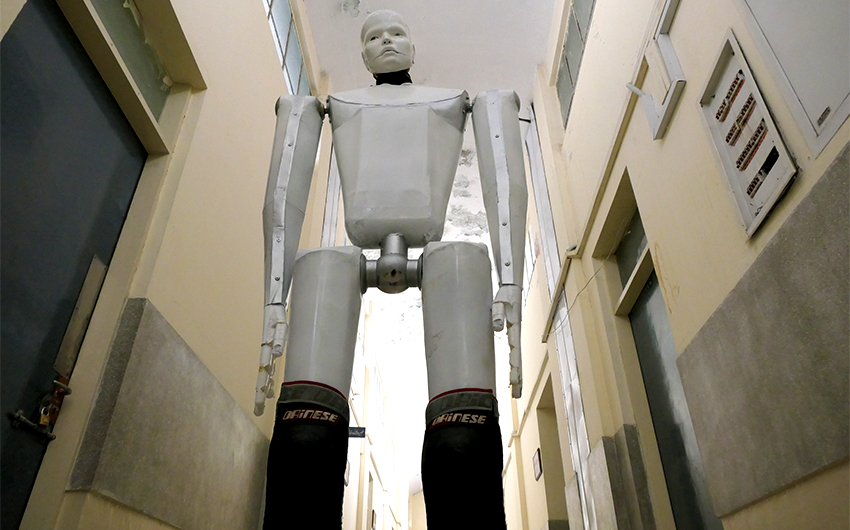
Five feet, four inches tall humanoid robot Bolani is ready for a walk at the Physics Department of the University of Balochistan, Quetta, May 4, 2021. (AN photo)
Coming from the remote Kalat and Sorab districts in Pakistan’s restive southwestern Balochistan province, Shahwani and Rodini are largely self-taught, and said they had received close to no financial support during their endeavour from their university or the government of Balochistan.
The two boys from these distant Pakistani towns worked for six months to conquer the impossible, working on advanced 3D softwares, even welding and painting the body of their robot themselves.
“While making Bolani, I learned the use of new software and 3D printing,” Shahwani said.
“Because I have designed Bolani by myself on solid work software, it was an unforgettable experience,” he continued.
Bolani is named after the famed mountain pass Bolan, roughly 127 km from the capital Quetta, south of the Hindu Kush mountains.
For now, Bolani can move forward and backward, he can move his eyes, neck and jaw and can shake hands with human beings when Shahwani, gives him the command through an app installed in his mobile phone.
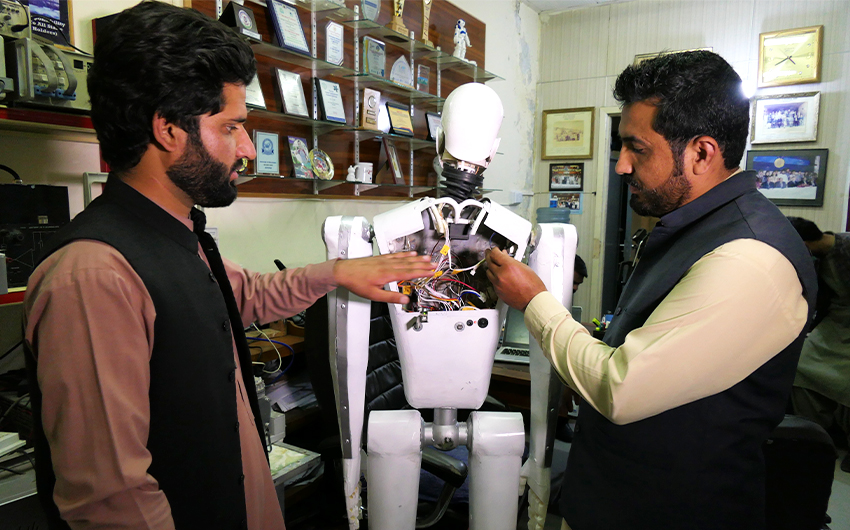
Aziz Ullah Shahwani and Mukhtiar Ahmed Rodini check Bolani's circuits at a lab of the Physics Department of the University of Balochistan, Quetta, May 4, 2021. (AN photo)
Mukhtiar Ahmed Rodini who assisted Aziz in building Bolani, said they wanted to create something new instead of submitting research papers like everybody else.
“We took assistance and guidance from our professors because after thorough searching we couldn’t find the robotic circuits and motors in Quetta... later we installed locally purchased motors in order to finalize Bolani,” Rodini told Arab News.
“Bolani cost us Rs.50,000 ($326) and due to the lack of financial assistance, we used iron and steel to shape the humanoid robot,” Rodini said. He added there had been ‘zero support’ from the university’s higher authorities and provincial government.
Shahwani and Rodini are now planning to upgrade Bolani with additional features like voice and face recognition censors that will allow the robot to talk.
Professor Ajab Khan Kasi, head of the physics department at the University of Balochistan supervised the students while they built Bolani and said their creation was a ‘milestone’ in the history of the university.
“It took six months to complete the robot and during this period, Aziz and Mukhtiar have done all the processes with their own hands... even the welding, coloring and mechanical work on Bolani,” Professor Kasi told Arab News.
“The humanoid robot has been working in 9 degree freedom which allows him to move his hands, neck and eyes,” he said.
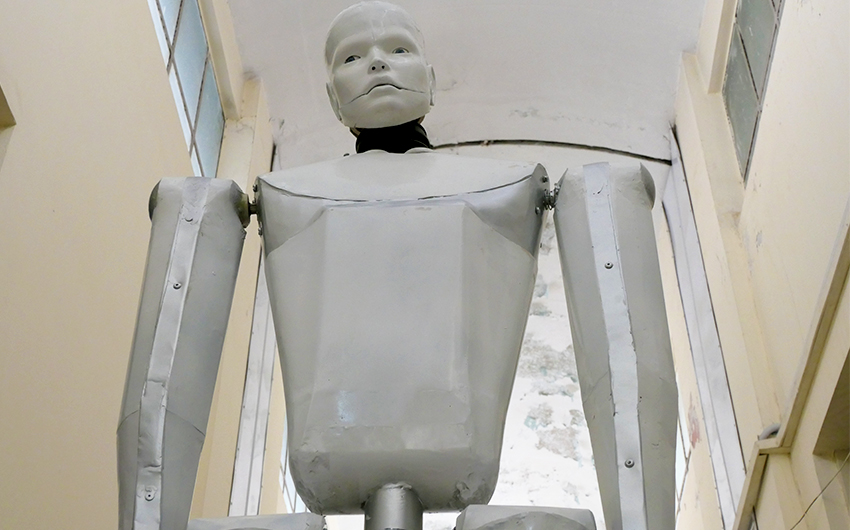
Bolani can move his eyes, jaw and neck on commands sent to him via Bluetooth. (AN photo)
For now, Shahwani has said he will upgrade Bolani by installing motion sensors, and aims to continue his studies. He said he is now looking for support from the government and his university.
But until that happens, he said, the two of them would not feel disappointed.
“Because we are inspired by Pakistan’s Nobel prize laureate Dr. Abdul Salam and the young Dr. Yar Jan Baloch who works as a space scientist in Cambridge University,” he added.
“We are following in their footsteps.”


