

Welcome to KP: Pakistani province exempts foreigners from travel curbs

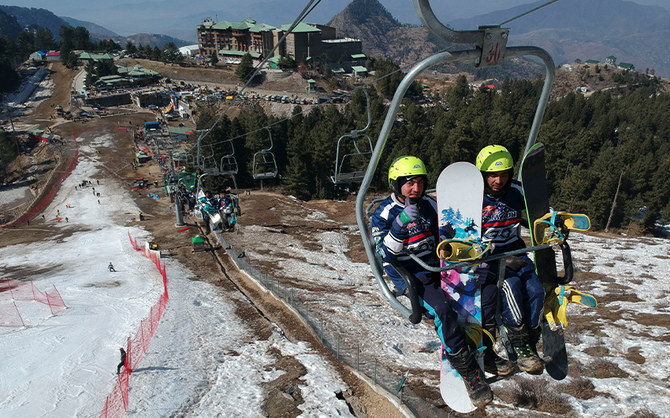
Foreign tourists use a chairlift at an event at the Malam Jabba ski resort in Pakistan's Khyber Pakhtunkhwa province on February 13, 2021. (AFP/File)
Short Url
Updated 11 May 2021
Follow

Welcome to KP: Pakistani province exempts foreigners from travel curbs

  • Residents, however, continue to face restrictions, including the closure of all tourist resorts from May 8 to 16
  • Move part of measures to limit COVID-19 as Pakistan grapples with the third wave of the outbreak

ISLAMABAD: Foreigners visiting Pakistan’s northwestern Khyber Pakhtunkhwa province will be exempted from travel restrictions imposed in the wake of the COVID-19 outbreak, despite strict anti-virus measures being followed by the rest of the country grappling with the third wave of the disease. 
In a directive issued earlier this week, the provincial government in KP, famous for its tourist venues and mountain resorts, “exempted foreign tourists/foreign tour groups” from the nationwide ban on tourism and travel from May 8 to 16. 
“Tour operators and hoteliers catering to these individuals should ensure standard operating procedure (SoPS) for COVID-19 and negative PCR tests of these foreign tourists and tourism workforce, keeping health, safety and security as foremost priority,” the statement said. 
Pakistan announced a new set of restrictions earlier this month, which includes the closure of all tourist resorts from May 8 to 16, to limit the third wave of the COVID-19 outbreak, with Planning Minister Asad Umar warning people against visiting tourist areas during the Eid holidays. 
“Anyone who tries will be turned back,” he said on Saturday. 

On Tuesday, the South Asian nation of over 220 million reported 113 deaths and 3,084 new infections in the past 24 hours. 
Since the start of the pandemic in February last year, Pakistan has registered 19,106 deaths and 864,557 COVID-19 cases.


Thousands flee northwest Pakistan after mosques warn of possible military action

Updated 11 sec ago
Follow

Thousands flee northwest Pakistan after mosques warn of possible military action

  • Residents of the Tirah Valley said they have moved out of the area into nearby towns despite heavy snowfall and cold winter temperatures
  • Defense Minister Khawaja Asif denied any operation was planned or underway in Tirah, calling the movement a routine seasonal migration

BARA/KARACHI: Tens of thousands of people have fled a remote mountainous region in northwestern Pakistan in recent weeks, ​residents said, after warnings broadcast from mosques urged families to evacuate ahead of a possible military action against militants.

Residents of the Tirah Valley, in the Pakistani province of Khyber Pakhtunkhwa that borders Afghanistan, said they have moved out of the area into nearby towns despite heavy snowfall and cold winter temperatures because of the announcements to avoid the possible fighting.

“The announcements were made in the mosque that everyone should leave, so everyone was leaving. We left too,” said Gul Afridi, a shopkeeper who fled with his family to the town of Bara located 71 km (44 miles) east ‌of the ‌Tirah Valley.

Local officials in the region, who asked to remain unidentified, ‌said ⁠thousands ​of families ‌have fled and are being registered for assistance in nearby towns.

The Tirah Valley has long been a sensitive security zone and a stronghold for Tehreek-e-Taliban Pakistan, a militant group that has carried out attacks on Pakistani security forces.

The Pakistani government has not announced the evacuation nor any planned military operation.

On Tuesday, Pakistan’s Defense Minister Khawaja Muhammad Asif denied any operation was planned or underway in Tirah, calling the movement a routine seasonal migration driven by harsh winter conditions.

However, a Pakistani military source with knowledge of ⁠the matter said the relocation followed months of consultations involving tribal elders, district officials and security authorities over the presence of militants in ‌Tirah, who they said were operating among civilian populations and ‍pressuring residents.

The source asked to remain unidentified as ‍they are not authorized to speak to the media.

The source said civilians were encouraged to ‍temporarily leave to reduce the risk of harm as “targeted intelligence-based operations” continued, adding there had been no build-up for a large-scale offensive due to the area’s mountainous terrain and winter conditions.

Pakistan’s military media wing, the Inter-Services Public Relations, the interior ministry, and the Khyber Pakhtunkhwa provincial government did not respond to requests for comment made on Friday.

NOT ​THE COLD

Residents rejected suggestions that winter alone drove the movement.“No one left because of the cold,” said Abdur Rahim, who said he left his village for Bara ⁠earlier this month after hearing evacuation announcements. “It has been snowing for years. We have lived there all our lives. People left because of the announcements.”

Gul Afridi described a perilous journey through snowbound roads along with food shortages that made the evacuation an ordeal that took his family nearly a week.

“Here I have no home, no support for business. I don’t know what is destined for us,” he said at a government school in Bara where hundreds of displaced people lined up to register for assistance, complaining of slow processes and uncertainty over how long they would remain displaced.

Abdul Azeem, another displaced resident, said families were stranded for days and that children died along the way.

“There were a lot of difficulties. People were stuck because of the snow,” he said.

The Tirah Valley drew national attention in September after a deadly ‌explosion at a suspected bomb-making site, with officials and local leaders offering conflicting accounts of whether civilians were among the dead.