

With cleavers and blowtorches, Pakistan barber offers hair-raising cuts 

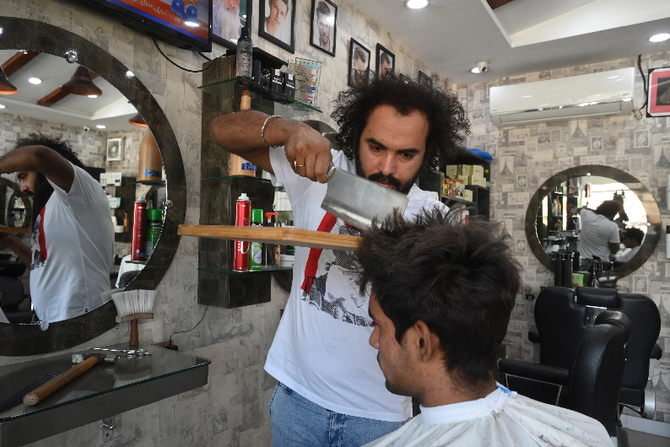
In this picture taken on April 8, 2021, Pakistani barber Ali Abbas uses a butcher knife to cut the hair of a customer at his shop in Lahore. (AFP)
Short Url
Updated 11 May 2021
Follow

With cleavers and blowtorches, Pakistan barber offers hair-raising cuts 

  • Abbas’s fringe style is proving a hit, with customers flocking to his shop in the eastern city of Lahore 
  • He charges 2,000 rupees ($13) for the unorthodox treatment — or 1,000 rupees for a traditional trim with scissors

LAHORE: Hoping to prove a cut above the competition, Pakistani barber Ali Abbas relies on an unusual array of tools to practice his craft — including blowtorches, meat cleavers, and even broken glass.
Abbas’s fringe style is proving a hit in the conservative nation, with customers flocking to his shop in the eastern city of Lahore.
During a typical trim, Abbas will take a bit off the top with a blowtorch.
He adds some layers with the help of a cleaver and butcher’s block, while occasionally thinning out a thicker mane with a bit of broken glass.
“I thought I should do something different to attract more clients,” Abbas told AFP.

“In the beginning, I tried it on artificial hair, and then — after practicing it for some time — I used it on a client, and he liked it a lot.”
Since first unveiling his style in 2016 and after brushing away customer fears, he says the unconventional approach has become a hit.
His popularity has only grown since, resulting in television appearances and fashion shoots.
“There has been a very good response from my clients, who were quite scared in the beginning,” said Abbas, whose eccentric manner and own unkempt, frizzy locks gives him the look of a mad scientist.
Abbas charges 2,000 rupees ($13) for the unorthodox treatment — or 1,000 rupees for a traditional trim with scissors.
“I am feeling quite relaxed and comfortable,” said Ali Saqlain, as the barber took a blowtorch to his head.
Abbas says he also enjoys a large number of women customers, who he charges an additional 500 rupees for extra styling.
“I had my hair cut done at this salon three times,” said Arooj Bhatti.
“I prefer it to be done with a cleaver as my hair grows fast after,” she added.


Pakistan stocks recover as oil supply fears ease after Islamabad seeks Red Sea route— analyst

Updated 05 March 2026
Follow

Pakistan stocks recover as oil supply fears ease after Islamabad seeks Red Sea route— analyst

  • Pakistan has sought Saudi help to secure oil supplies via Red Sea port after Iran’s closure of Strait if Hormuz
  • Analyst says higher crude oil prices, expectations of IMF releasing next loan tranche also triggered bullish activity

ISLAMABAD: Pakistani stocks marked a sharp recovery when trading closed on Thursday, as institutional activity increased following Islamabad’s move to seek crude oil supplies through the Red Sea port eased oil supply fears, a financial analyst said. 

Pakistani stocks have recorded a sharp decline this week, with the benchmark KSE-100 index recording its largest-ever single-day decline on Monday when it plunged 16,089 points. Escalating conflict in the Middle East triggered panic selling at the Pakistani bourse, forcing a temporary trading halt on Monday. 

The KSE-100 index, however, gained 3.49 percent or 5,433.46 points to close at 161,210.67 when trading ended on Thursday, up from the previous close of 155,777.21 points, according to Pakistan Stock Exchange’s (PSX) data.

Pakistan’s Petroleum Minister Ali Pervaiz Malik met Saudi Ambassador Nawaf bin Said Al-Malki on Wednesday to discuss Iran’s closure of the key Strait of Hormuz, which has threatened Pakistan’s energy supply. Roughly 20 percent of the global oil and gas supply passes through the route. Saudi Arabia indicated it could facilitate shipments through the Red Sea port of Yanbu, offering an alternative route if Gulf shipping lanes remain disrupted, the petroleum ministry said on Wednesday. 

“Stocks staged a sharp recovery at PSX amid institutional activity on easing fuel supply fears after KSA [Kingdom of Saudi Arabia] commits oil supplies through the Red Sea port,” Ahsan Mehanti, chief executive officer at Arif Habib Commodities, told Arab News.

He said higher global crude oil prices and expectations of the International Monetary Fund releasing its next tranche of the $7 billion loan for Pakistan also helped bullish activity at the PSX.

An IMF mission was in Pakistan to hold talks on the third review of a $7 billion Extended Fund Facility multi-year program, and for the second review of the $1.4 billion Resilience and Sustainability Facility this week.

However, the delegation left for Türkiye amid tensions in the Gulf. Pakistani officials have said talks are likely to continue virtually in the coming days. 

Pakistani brokerage Topline Securities said in its daily market review report that strong institutional buying “turned the tide” on Thursday after the market’s recent overreaction to regional issues.

The report added that Hub Power Company (HUBC), Oil & Gas Development Company (OGDC), Fauji Fertilizer Company (FFC), Engro Corporation (ENGROH), and Meezan Bank Limited (MEBL) collectively contributed 2,197 points to the KSE benchmark’s gain.

Topline Securities said 723 million shares were traded on Thursday, with K-Electric Limited (KEL) stealing the spotlight as more than 1.17 billion shares changed hands.

Pakistani investors are closely monitoring developments in the Gulf, particularly around energy routes and further retaliatory actions, as the conflict’s trajectory remains uncertain.