

Eid shoppers urged to be wary of virus risk in Saudi Arabia

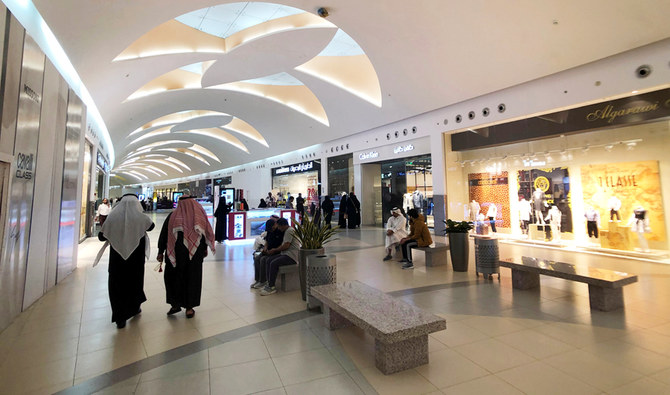
People are seen in the Mall of Dhahran, Saudi Arabia. (REUTERS file photo)
Short Url
Updated 11 May 2021
Follow

Eid shoppers urged to be wary of virus risk in Saudi Arabia

  • A Saudi ministry of Health spokesman noted that the fluctuating case numbers are a positive sign, but reiterated that the country is not in the clear just yet

JEDDAH: As the daily number of confirmed COVID-19 cases in Saudi Arabia continues to hover between 950 and 1,100, authorities are calling on residents to remain careful and vigilant as they prepare for Eid Al-Fitr.
With the holiday only a few days away, shoppers are urged to remain on high alert and choose online shopping rather than visiting packed malls. Warnings have been issued that store closures are imminent if commercial establishments fail to abide by the required health and safety precautions and ensure social distancing is maintained.
It comes after more than two weeks of rising numbers of infections during Ramadan to more than 1,000 a day, which authorities said is the result of people failing to follow rules on social distancing and gatherings.
On Monday, health authorities in the Kingdom recorded 986 new cases of the coronavirus disease (COVID-19), meaning 427,370 people in the country have contracted the disease.
The highest number of new infections was in the Riyadh region with 339, followed by the Makkah region with 283, and the Eastern Province with 131. Only two regions reported single-digit increases: The Northern Borders, with eight, and Jouf, with five.
An additional 1,076 people have recovered, according to health authorities, raising the total number of recoveries to 410,816. This means the recovery rate in the Kingdom has increased slightly to 96.1 percent.

HIGHLIGHTS

• Saudi Arabia recorded 986 new infections on Monday.

• 1,076 more people have recovered from the disease.

• The death toll rises to 7,085 with 13 new fatalities.

The number of active cases has been decreasing lately as recoveries increase. A Ministry of Health spokesman noted that the fluctuating case numbers are a positive sign, but reiterated that the country is not in the clear just yet. “The fluctuation could be an indicator that the cases are stabilizing,” he said on Sunday.
According to the figures announced on Monday, there are currently 9,469 active cases. Of these, 341 patients are in critical condition. Thirteen additional deaths related to COVID-19 were reported, raising the total to 7,085.
More than 10.6 million doses of COVID vaccines have been administered since vaccinations began in December. Nearly 31 percent of the Kingdom’s 34.8 million population have received at least one dose.

A total of 70,822 PCR tests for COVID-19 were carried out in the past 24 hours, raising the total number of tests in the Kingdom to nearly 17.6 million.
Saudi health clinics set up by the Ministry of Health as testing hubs or treatment centers have dealt with hundreds of thousands of people throughout the country since the start of the pandemic.

Taakad (make sure) centers provide COVID-19 tests for those who show no, or only mild, symptoms or believe they have been in contact with an infected individual. More than 9.7 million tests have been conducted at Taakad facilities.

Tetamman (rest-assured) clinics offer treatment and advice to those with more severe virus symptoms, such as breathing difficulties, fever, and loss of taste and smell. They have seen more than 2.5 million patients so far.

In addition, the Ministry of Health’s 937 call centers have received more than 35.2 million inquiries from people seeking medical advice.


Saudi Arabia, Estonia strengthen cyber defense cooperation

Updated 09 February 2026
Follow

Saudi Arabia, Estonia strengthen cyber defense cooperation

  • Renowned for its leadership in digital governance, Estonia sees cybersecurity as central to its partnership potential with Saudi Arabia, building on years of regional engagement through its technology firms

RIYADH: Estonia aims to deepen defense, cybersecurity, and artificial intelligence cooperation with Saudi Arabia as both nations look to advance technology‑driven defense and cybersecurity capabilities.

Hanno Pevkur, Estonia’s minister of defense, told Arab News at the World Defense Show in Riyadh on Monday that Estonia’s defense industry is eager to contribute to the Kingdom’s fast‑growing defense ecosystem.

“In the modern world, cooperation built on trust and technology is the best defense,” he said. “It is important for us to be here because we clearly see there is a possibility to increase cooperation, not only bilaterally between Saudi Arabia and Estonia, but across the region.”

At Estonia’s pavilion, a cooperation agreement was signed between an Estonian company and a Saudi firm during the show, he noted.

Pevkur also said Estonia’s defense sector has expanded rapidly in recent years, driven by technological innovation and partnership.

“Our defense industry is growing very rapidly, and we continue to see strong momentum,” he said.

He said Estonia’s strengths lie in digital and smart‑system integration rather than large‑scale weapons production.

“We will not build airplanes or tanks, but what we can do is integrate robotics, automation and drones to make existing systems smarter,” he said.

The minister said effective defense collaboration must link businesses and governments to achieve meaningful results.

“When we want to have real cooperation, we need it on all levels,” he said. “The biggest client for any defense company is the government, so we must treat this as one ecosystem where the public and private sectors work hand in hand.”

Renowned for its leadership in digital governance, Estonia sees cybersecurity as central to its partnership potential with Saudi Arabia, building on years of regional engagement through its technology firms.

Pevkur said several Estonian companies, including Nortal, have already assisted Gulf governments in developing open IT and digital‑service systems.

“As the most digitalized nation in the world, almost every service in Estonia can be done online, except getting married,” he said. “But with such digitalization, we also need strong cyberdefense.”

He said data protection and digital resilience are treated as matters of national sovereignty in Tallinn, the capital of Estonia.

“Data is what we own. When someone steals that data, it becomes a serious threat,” he added. “That is why cyberdefense is not just about technology, it is about trust, sovereignty and protection.”

Pevkur said Saudi Arabia’s advances in AI offer promising opportunities for collaboration.

“I know that Saudi Arabia is doing great work when it comes to AI,” he said. “For us, as a small country with limited human resources, AI is essential not just for defense but for everyday life.”

Pevkur added that Estonia has launched a national AI strategy to promote responsible development and closer coordination between government and industry. One Estonian company, he said, has developed a system that allows a single operator to control hundreds of drones through AI.

“It is quite easy to put a weapon into the hands of a robot, but we also need to define who is accountable for its actions,” he said.

“The big question for the future is whether we can allow a war to be fought entirely by AI, or if humans must always make the final ethical decisions.”

He said in his conclusion that governments must reach a common understanding on how AI will be used and regulated on the battlefield.