

Pakistan’s water bearers quench thirst in Ramadan, but fear for their trade 

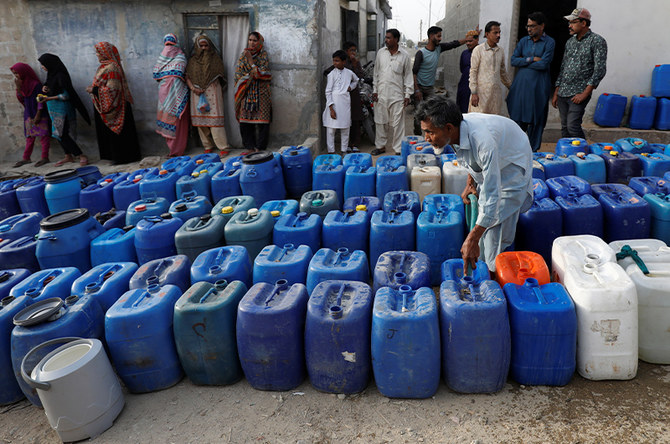
Residents gather as a worker fills containers at a free water distribution point in Orangi Town on the outskirts of Karachi, Pakistan, on March 19, 2021. (REUTERS)
Short Url
Updated 10 May 2021
Follow

Pakistan’s water bearers quench thirst in Ramadan, but fear for their trade 

  • Karachi needs about 1,200 million gallons of water a day to meet the demand of its estimated population of 20 million
  • Much of the city's water supplies are lost due to dilapidated infrastructure, water theft, and dams built upstream by India

KARACHI: Mohammad Ramzan pumps water into a large goat skin bag before carrying it down an alley and up several flights of stairs to deliver to a resident in Karachi, Pakistan’s largest city.
For more than four decades Ramzan has been a “mashki,” or water bearer, an age-old profession now in decline as water companies and tankers increasingly supply residents.
But his services are at least in high demand during the Islamic holy month of Ramadan, during which fasting can be a challenge when the weather is hot.
“In Ramadan, the poor mashkis have a very tough time delivering water to us inside buildings that are four or five storys high,” said resident Mohammad Imran, as Ramzan, 60, arrived with his load.
“The tanker people often do not even answer our calls; they also charge too much. We are really grateful to these mashkis.”
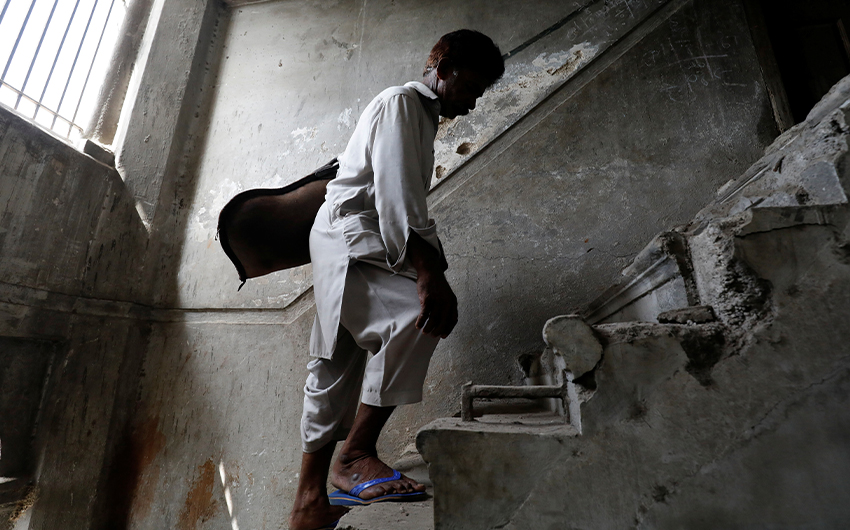


Mohammad Ramzan ascends a flight of stairs as he delivers water in a residential building during the fasting month of Ramadan in Karachi, Pakistan, on April 23, 2021. (REUTERS)

Karachi needs about 1,200 million gallons per day of water to meet the demand of its estimated population of 20 million people. But officials say its two main water sources only provide the city with about 580 million gallons per day.
Some of the water is lost due to dilapidated infrastructure and water theft, while experts say climate change and dams built upstream by India also reduce water supplies.
Ramzan stops to catch his breath as he climbs the narrow stairwell, carrying his leather “mashk” which can normally hold up to 35 liters of water.
“During the month of Ramadan, it becomes especially difficult for people to collect water from water points, so I bring water for them in the hope that Allah will bless me for it ... I also earn my living this way.”
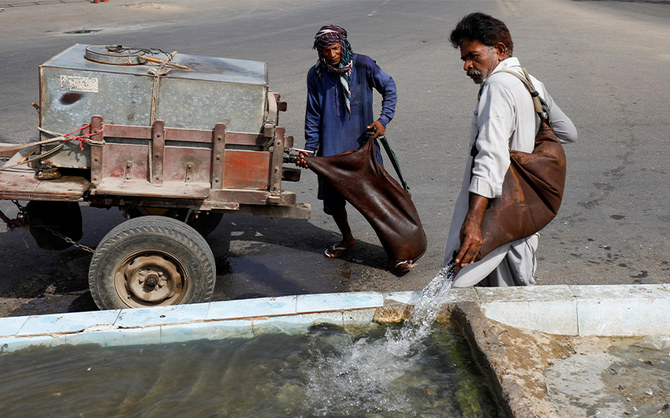


Mohammad Ramzan fills a water trough for pigeons along a road on a hot and humid day during the fasting month of Ramadan, as the outbreak of COVID-19 continues, in Karachi, Pakistan, on April 23, 2021. (REUTERS)

Water bearers have existed in South Asia for centuries, providing water to travelers and warriors during battles in ancient times.
But Ramzan worries that the days of the mashki are numbered.
“Tankers are delivering water everywhere; mineral water companies are supplying water from house to house,” he said.
“Because of this, the profession of the mashki looks like it will not last long.” 


Pakistan moves to digitize payments for 10 million women under flagship poverty initiative

Updated 5 sec ago
Follow

Pakistan moves to digitize payments for 10 million women under flagship poverty initiative

  • BISP Official says accounts will be linked to phones to boost financial inclusion and curb payment deductions
  • Over 1.9 million SIMs issued as the nationwide rollout continues across provinces ahead of the March deadline

ISLAMABAD: Pakistan’s flagship poverty alleviation initiative, the Benazir Income Support Program (BISP), plans to equip 10 million women with digital bank accounts linked to their phone numbers within four months in one of the largest such exercises in the world, one of its top officials said on Wednesday.

Launched in 2008, the initiative is named after the late former prime minister Benazir Bhutto and has a budget of Rs716 billion ($2.5 billion) during the current fiscal year. Through its Benazir Kafaalat — or financial assistance — program, BISP provides quarterly stipends of Rs13,500 ($48) to around 10 million women.

In an exclusive interview with Arab News, BISP Secretary Amir Ali Ahmed said the opening of digital bank accounts for the beneficiaries was part of Prime Minister Shehbaz Sharif’s initiative related to a cashless economy and digital transformation of the country.

“I’m glad to share that 10 million bank accounts, wallet accounts were created,” he said. “This is a follow-up of the same exercise whereby now 10 million SIMs are being distributed.

“It is significant to share that the entire beneficiary network that we have is female-centric,” he continued. “So these are 10 million female accounts that have been created.”

Ahmed said the process of issuing mobile phone SIM cards to BISP beneficiaries had started on November 17 and would be completed by March next year.

“Let me share that this is one of the largest such exercises to be conducted in the world which is female-centric, linked with financial inclusion and financial empowerment.”

The BISP official added that out of the more than 10 million beneficiaries, only five to 10 percent had bank accounts, but nearly 90 to 95 percent were excluded from the system.

He said they were being linked to the banking system with cellphone SIMs that are being distributed with the help of the IT ministry, Pakistan Telecommunication Authority, National Database and Registration Authority and telecom companies across the country.

“We feel that this initiative of the government of Pakistan will not only result in financial empowerment of our beneficiaries, it will also result in financial inclusion of a segment which was not part of the banking sector in Pakistan,” he said, adding that the move will also lead to transparency.

In the past, there have been complaints of women not getting their full payment from bank officials in the absence of their own accounts, but Ahmed said this was going to change.

“They will be free from any exploitation at the agent networks, the queues that one would witness, the complaints of corruption or deductions that would emerge,” he continued.

According to official data, more than 1.9 million SIMs have so far been issued for BISP beneficiaries across the country.

The province of Punjab leads the rollout with 810,597 SIMs, followed by Sindh with 523,629 and Khyber Pakhtunkhwa with 371,427 SIMs.

In other regions, Azad Jammu and Kashmir has received 59,617, Balochistan 82,826, Gilgit-Baltistan 45,184, and Islamabad 4,508 SIMs.