PM Khan returns home after three-day visit to Saudi Arabia

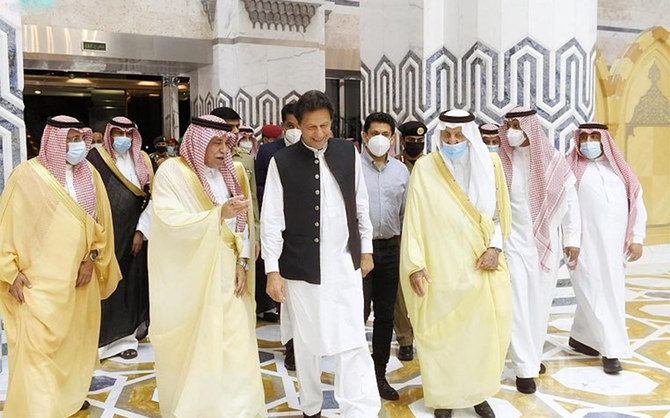
Pakistan PM Imran Khan (second right) departs from Jeddah, SaudiArabia, on May 09, 2021. (Photo courtesy: SPA)
Short Url
Updated 10 May 2021
Follow

PM Khan returns home after three-day visit to Saudi Arabia

  • Inks several agreements with top leadership in the Kingdom during the three-day trip
  • Agreements include the establishment of a Saudi-Pakistani Supreme Coordination Council

ISLAMABAD: Pakistani Prime Minister Imran Khan concluded his three-day official visit to Saudi Arabia on Sunday after signing several agreements with the top leadership in the kingdom to strengthen bilateral cooperation between the two countries.
Khan arrived in the Kingdom on Friday alongside high-ranking Pakistani officials at the invitation of Crown Prince Mohammed bin Salman and the two leaders held wide ranging bilateral and delegation level talks on Saturday in Jeddah.
On Saturday, PM Khan and Crown Prince Mohammed bin Salman signed an agreement to establish the Saudi-Pakistan Supreme Coordination Council in Jeddah before vowing to deepen Pakistan-Saudi ties in all fields.
“It was agreed to further strengthen, deepen and diversify the existing bilateral political, economic, trade, defense and security ties,” PM Khan’s office said in a statement on Saturday night.
“Special emphasis was laid on increasing Saudi investments in Pakistan, collaboration in the field of energy, and increased job opportunities for Pakistanis in Saudi Arabia,” it added.
In another joint statement issued on Saturday, the two leaders also discussed ways to strengthen and enhance economic and trade ties by exploring areas of investment and opportunities in line with the Kingdom’s Vision 2030 plan and Pakistan’s development priorities.
“Pakistan and Saudi Arabia agreed to continue supporting each other at multilateral fora. They agreed to further deepen coordination and cooperation to safeguard mutual interests and uphold the principles of fairness and justice,” it said.
Before leaving for Pakistan on Sunday, PM Khan addressed a gathering of overseas Pakistanis where over two million Pakistanis live and work in Saudi Arabia, which is the largest source of remittances to Pakistan.


Pakistan PM seeks review of new solar rules, orders protection of existing contracts

Updated 4 sec ago
Follow

Pakistan PM seeks review of new solar rules, orders protection of existing contracts

  • Shehbaz Sharif directs appeal to NEPRA to safeguard contracts of 466,000 rooftop solar users
  • He asks the government to ensure the cost does not shift to 37.6 million grid-only consumers

ISLAMABAD: Prime Minister Shehbaz Sharif on Wednesday ordered a review of new rooftop solar regulations issued by the power regulator, directing authorities to protect existing consumer contracts while ensuring the policy does not shift financial burden onto non-solar electricity users.

The move follows recent changes by the National Electric Power Regulatory Authority (NEPRA) that altered compensation rules for surplus electricity generated by rooftop solar users, part of broader power sector reforms aimed at easing pressure on state-run utilities.

Pakistan has been restructuring its energy sector under an International Monetary Fund-backed reform program to contain mounting circular debt and rationalize subsidies. Rapid growth in rooftop solar installations has reduced grid demand but also strained distribution companies’ revenues, prompting regulatory adjustments.

“The Power Division should immediately file a review petition before NEPRA to ensure maximum protection of existing contracts of solar consumers,” the prime minister instructed, according to a statement issued by his office.

He further instructed authorities to formulate a comprehensive plan to ensure that the cost burden of 466,000 solar beneficiaries does not fall on more than 37.6 million consumers who rely solely on the national grid.

Solar power grew from 4 percent of the energy mix in 2021 to over 14 percent–25 percent in 2024-2025, official figures show.

Driven by skyrocketing grid tariffs, Pakistan became one of the world’s top new solar adopters, importing roughly 22 gigawatts (GW) of solar panels in 2024 alone.

Industry data shows tens of thousands of new solar connections have been added annually, significantly reducing demand from the grid during daylight hours.

However, NEPRA’s new compensation rules have been designed so that consumers continue to pay full tariffs for electricity drawn from the grid while receiving a lower, market-linked rate for excess power they export.