

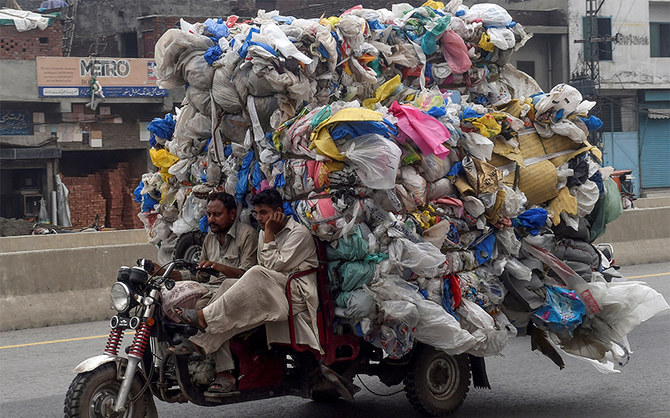

LAHORE: Nearly two months after a high court notice to the Punjab government, directing it to resolve the waste issue in its capital, Lahore, the Pakistani “city of gardens” continues to drown in its own trash, which experts warn may soon result in disease outbreaks.
Lahore produces over 5,500 tons of waste a day, but despite its inability to collect and process it all, Lahore Waste Management Company (LWMC) last year did not extend contracts with two Turkish contractors, Oz Pak and Albayrak, who had been cleaning up the city since 2012.
Days before the formal end of the contract, the LWMC, alongside police and district administration forcibly took control of six workshops — two in the occupation of Albayrak and four with Oz Pak. The move came despite a court’s stay order in place.
The situation has since worsened and health experts sound alarm that it could lead to infectious disease outbreaks at a time when the whole country is struggling with the coronavirus pandemic.
“Overflowing containers of garbage, unattended heaps of litter can contribute to the outbreak of dengue and if it happens, we won’t be able to handle the situation on the medical front,” Dr. Qaisar Sajjad, secretary general of the Pakistan Medical Association, told Arab News last week.
“The removal of waste in Lahore is outpacing its generation, which is a matter of grave concern,” he said, adding that many cases of dengue and malaria have been recently reported in Punjab, particularly in Lahore.
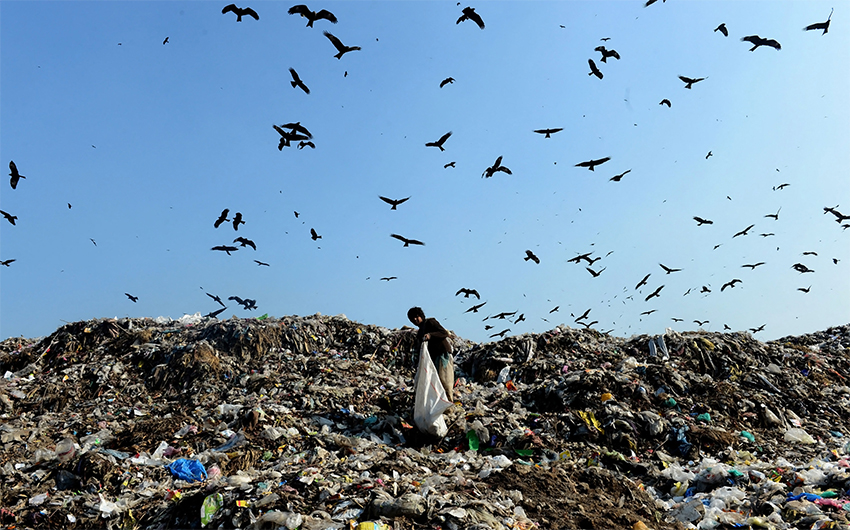
A scavenger searches for recyclable materials at a landfill site in Lahore, Pakistan, on January 22, 2013. (AFP)
Dr. Nasir Javaid, a waste management expert who in 2000 designed for Punjab and its capital city a strategy of treating solid wastes, believes that the removal of international contractors was one of the main factors contributing to Lahore’s current mess.
“If we want to clean our cities like Johannesburg and Kuala Lumpur, then we have to allow international companies to come in the country so that local contractors can compete with them and build their capacity while working with them,” he said, adding that the LWMC’s claim that millions of dollars would be saved annually by employing only local contractors was not helping resolve the problem.
“In the absence of intellectual and competitive environment, we can’t produce desirable results,” he said, adding that relying on local contractors whose capacity was less would only worsen the situation.
But LWMC is not planning to re-engage foreigners.
“The LWMC will do the garbage collection while the local contractors will transport the garbage to the landfill site,” LWMC spokesperson Jameel Khawar told Arab News.
He said that no foreigners had been invited to the bidding process as the government wants to save annually Rs5 billion ($32.8 million) which the previous administration had used on foreign contractors.
While LWMC intends to promote local workforce and expertise, both appear to be insufficient.
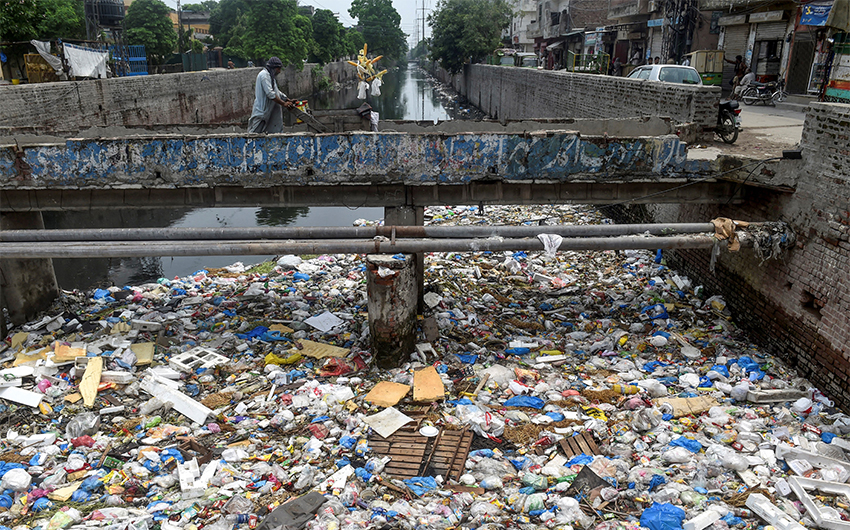
A vendor pushes his corn cart over a stream full of plastic bags and garbage in Lahore, Pakistan, on July 31, 2019. (AFP)
“In the last, two and half years, LWMC could not come up with a viable waste management plan which would have been followed by other local waste management companies,” a source at the LWMC told Arab News on condition of anonymity. “Currently, we have no vehicles, no manpower and no infrastructure for sweeping and mechanical sweeping of the province.”
He added: “The current government did not chalk out any roadmap before the expiration of contract with two Turkish companies in Lahore, Albayrak and Oz Pak, rather it got into legal fight which could have invited potential international arbitration and brought further bad name to the country.”
Former Lahore Mayor Mubasher Javed, who governed the city before the ruling Pakistan Tehreek-e-Insaf (PTI) party took charge in 2018, said that in the past three years everything has gone upside-down.
“The city where mechanical transportation system for waste management was being conducted, is now managed with bull and donkey carts,” he said. “The vehicles that used to transport garbage have become rotten garbage under the current administration.”
Local authorities, however, believe that the current crisis is temporary.
Punjab Local Government and Community Development secretary Noorul Amin Mengal, who two month ago took charge of waste management, said that while “financial mismanagement” and “deficient municipal infrastructure” have led to the current situation, it is going to change.
“We are in the process of hiring 1,000 vehicles for mechanical cleaning of the metropolitan area which is producing 5,500 tons of waste,” he told Arab News.
“Other waste management companies working in six districts have also been directed to come up with a plan to revive the system,” he said, adding that soon Lahore and Punjab will be an “example for the whole country.”




