China propels BMW to strong profits, Germany lags

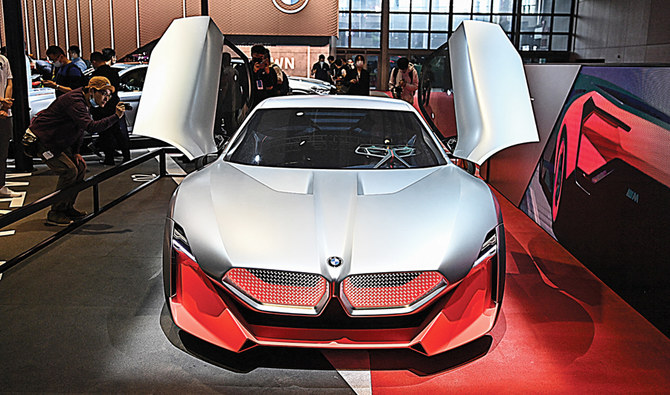
A BMW Vision Next car is seen during the 19th Shanghai International Automobile Industry Exhibition in Shanghai. (AFP)
Short Url
Updated 08 May 2021
Follow

China propels BMW to strong profits, Germany lags

  • BMW net profit rose to €2.83 billion ($3.42 billion) from €574 million in the year-earlier period

FRANKFURT: Booming sales in China helped propel German luxury carmaker BMW to stronger profits in the first three months of the year even as its home market Germany trailed the ongoing recovery in global car markets from the worst of the pandemic shutdowns.
BMW said that its sales in China nearly doubled in the quarter to 230,120 vehicles, partly reflecting the shutdowns in early 2020 as China was hit first by the pandemic. Sales in the overall Asia region however exceeded even pre-pandemic levels.
Sales were up by double-digit percentages in most of Europe and in the US. An exception was the company’s home market in Germany, where sales dropped 5 percent. The earnings underscored the German auto industry’s strong connections with China; competitor Volkswagen said Wednesday that it recorded a 61 percent increase in first-quarter unit sales there, helping it sharply increase profits.
The company said higher sales volume across key global markets as they rebound from the pandemic recession was accompanied by improved prices. Earnings were also supported by better used car prices in the US, which increases revenues from the sales of cars that have been leased to customers.

NUMBER

BMW revenues rose 15 percent to €26.78 billion.

BMW CEO Oliver Zipse said that the quarter showed “our business model is a successful one, even in times of crisis.” He said the company’s focus is on developing digitally connected, electric cars. The company more than doubled its sales of battery and electric vehicles in the quarter over the year earlier, to 70,200.
Zipse said that the fall in sales in Germany was less than that for the total market, meaning market share had increased, and said that sales in April, the first month of the new quarter, had been “significantly better.”
BMW net profit rose to €2.83 billion ($3.42 billion) from €574 million in the year-earlier period. Revenues rose 15 percent to €26.78 billion. Per-vehicle profitability, defined as operating result on sales, reached 9.8 percent, a big increase from 1.3 percent in the year-earlier quarter and within the company’s long-term target range.
Chief Financial Officer Nicolas Peter said that the company had not lost any production due to the shortage of semiconductors — the silicon chips that enable many of the electronic functions in today’s vehicles — that has affected the auto industry worldwide.


Saudi Arabia’s FMF concludes with over $26.6bn in agreements  

Updated 4 sec ago
Follow

Saudi Arabia’s FMF concludes with over $26.6bn in agreements  

RIYADH: Saudi Arabia said it secured more than SR100 billion ($26.6 billion) in agreements and memorandums of understanding at the fifth edition of the Future Minerals Forum, underscoring the Kingdom’s push to position mining as a key pillar of its economic diversification strategy. 

The forum, held in Riyadh under the patronage of King Salman bin Abdulaziz Al Saud, drew representatives from around 100 countries and attracted about 21,500 participants, according to the Ministry of Industry and Mineral Resources.  

The government has identified mining as a priority sector as it seeks to reduce reliance on oil and strengthen global supply chains for critical minerals. 

The agreements signed during the forum span the full mining value chain, including exploration, extraction, and mineral processing, as well as manufacturing, research and development, innovation, and sustainability.  

The ministry said the breadth of the deals highlights efforts to accelerate sector development while attracting long-term domestic and foreign investment.   

Participants included ministers, senior government officials, executives from major global mining companies, and investors, as well as academics and technical experts. More than 450 speakers took part in ministerial roundtables, panel discussions and technical sessions.  

An international exhibition formed a key part of the event, featuring 274 exhibitors from 13 countries, including Australia, the US, and the UK, as well as France, Germany, and several emerging mining markets.   

The exhibition was organized across four main zones covering exploration and mining, processing and manufacturing, advanced technologies and innovation, and investment and partnerships.  

Forum discussions focused on strengthening cross-border cooperation across mineral supply chains, accelerating exploration activity, and improving access to financing, as well as promoting sustainable and responsible mining practices.   

Sessions also examined the growing role of digital tools, automation and artificial intelligence in enhancing operational efficiency and decision-making in the sector.  

The ministry said the scale of agreements announced at the forum provides a foundation for sustained growth and supports the Kingdom’s long-term objective of becoming a global hub for mining and mineral processing, at a time of rising international demand for critical and strategic minerals.  

The ministry also highlighted the rapid evolution of the Future Minerals Forum over its five editions, describing it as a platform that has transitioned from a regional gathering into a global convening point for policymakers and industry leaders.