VIENNA: World powers held a fourth round of high-level talks Friday in Austria aimed at bringing the US back into the nuclear deal with Iran.
Both sides have signaled willingness to work out the major stumbling blocks.
The talks began in early April and Russian delegate Mikhail Ulyanov tweeted following Friday’s meeting that “the participants agreed on the need to intensify the process.”
“The delegations seem to be ready to stay in Vienna as long as necessary to achieve the goal,” he wrote.
The US pulled out of the landmark 2015 deal in 2018 after then-President Donald Trump said the pact needed to be renegotiated. The deal had promised Iran economic incentives in exchange for curbs on its nuclear program, and the Trump administration reimposed heavy sanctions on the Islamic republic in an unsuccessful attempt to bring Tehran into new talks.
Iran reacted by steadily increasing its violations of the deal, which is intended to prevent the country from obtaining nuclear weapons. Iran began enriching uranium to a greater purity, stockpiling more than allowed and beginning to use more advanced centrifuges, among other things, in an attempt to pressure the world powers remaining in the deal — Germany, France, Britain, Russia and China — for economic relief.
US President Joe Biden says he wants to rejoin the deal, known as the Joint Comprehensive Plan of Action, or JCPOA, but that Iran needs to return to compliance.
Iran, which insists it does not want to produce a nuclear bomb, has said it is prepared to reverse all of its violations but that Washington must remove all sanctions imposed under Trump.
On the other side is the question of what Iran’s return to compliance would look like. Delegates to the Vienna talks concede, for example, that Iranian nuclear scientists cannot unlearn the knowledge they acquired in the last three years, but it is not clear whether Iran’s new centrifuges would need to be destroyed, mothballed and locked away, or simply taken offline.
Because the US is currently out of the deal, there was no American representation at the talks. Diplomats involved are shuttling between the Iranian side and a delegation from Washington elsewhere in Vienna.
Between the high-level meetings, expert groups have been meeting to try and come up with solutions to the outstanding issues.
Alain Matton, a spokesperson for the EU delegation in Vienna, which is chairing the meetings, said the expert discussions will continue in the days ahead.
“And the EU as a coordinator and facilitator of the JCPOA talks will continue with separate talks with all participants and with the US,” Matton told reporters. “The participants are continuing with discussions, which are held on various levels and which have as their objective the full and effective implementation of the deal by all sides and the US return to the JCPOA.”
Ahead of the talks, a senior US official, speaking on condition of anonymity to discuss the US position, said Washington has laid out the concessions it’s prepared to make and that success or failure now depends on Iran making the political decision to accept those concessions and to return to compliance with the accord.
The official said it remains possible to reach an agreement before Iran’s June presidential election, which some believe are a complicating factor in the discussions.
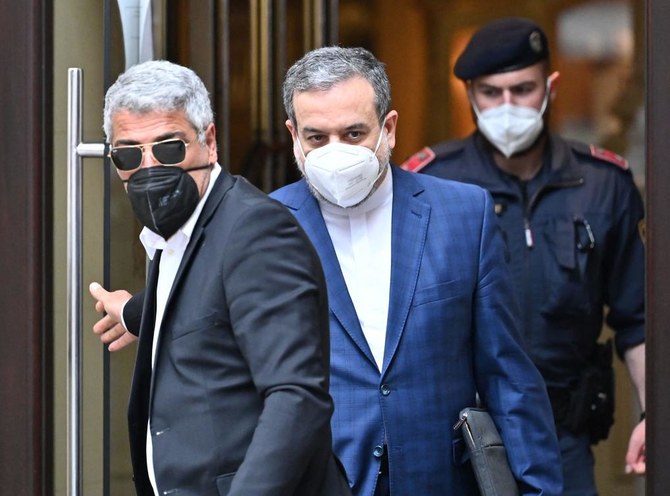
Iran’s delegate to the talks, Deputy Foreign Minister Abbas Araghchi, told his country’s state-run IRNA news agency late Thursday that his team was trying to reach an agreement as soon as possible but would not act in haste and would act in Iran’s national interests.
“We are on a specified path about which there are, fortunately, agreements, but there are serious obstacles in the way as well,” Araghchi said.
Heading into the talks, Ulyanov tweeted that he saw positive signs from the Iranian minister’s statements.
“The head of the Iranian delegation is cautious in his assessment of the current state of affairs at the Vienna talks (very similar to assessments of the US colleagues),” he tweeted. “But both #Iran and #US refrain from pessimistic conclusions. This seems to be not a bad sign.”


![]()

Talks ‘intensify’ on bringing US back to Iran nuclear deal
Short Url
https://arab.news/nyn2w
Talks ‘intensify’ on bringing US back to Iran nuclear deal
- U.S. and Iran have signaled willingness to work out the major stumbling blocks
- Russian delegate tweeted following Friday's meeting that “the participants agreed on the need to intensify the process”


Latest updates


Recommended


© 2026 SAUDI RESEARCH & PUBLISHING COMPANY, All Rights Reserved And subject to Terms of Use Agreement.