Yemeni conjoined twins arrive safely in Saudi Arabia

1 / 9
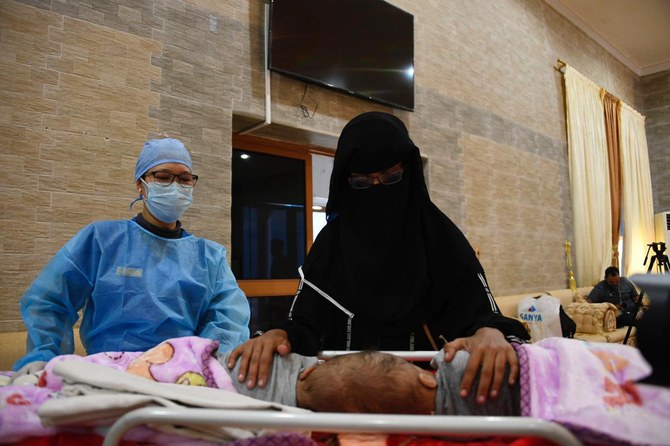
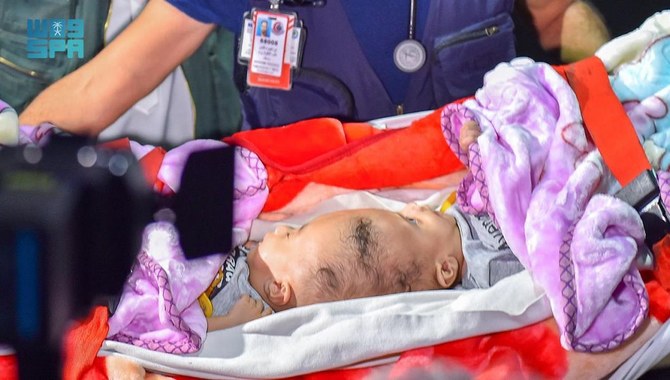
Yemeni conjoined twins “Yousuf and Yassin” arrived in Riyadh via an air medical evacuation plane from Al-Mukalla. (Twitter/@KSRelief)
2 / 9
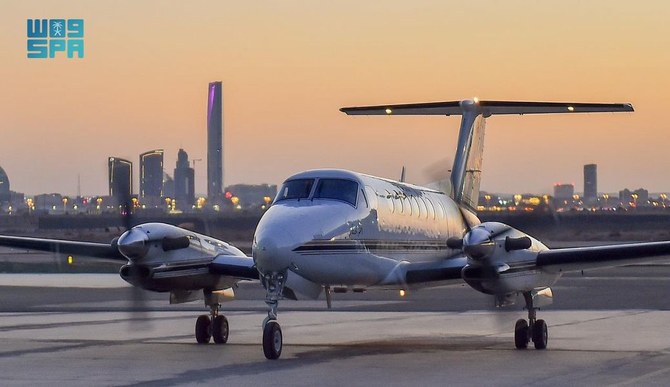
Yemeni conjoined twins “Yousuf and Yassin” arrived in Riyadh via an air medical evacuation plane from Al-Mukalla. (Twitter/@KSRelief)
3 / 9
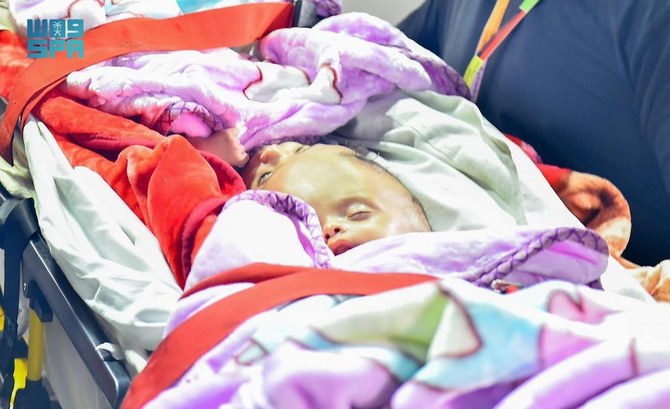
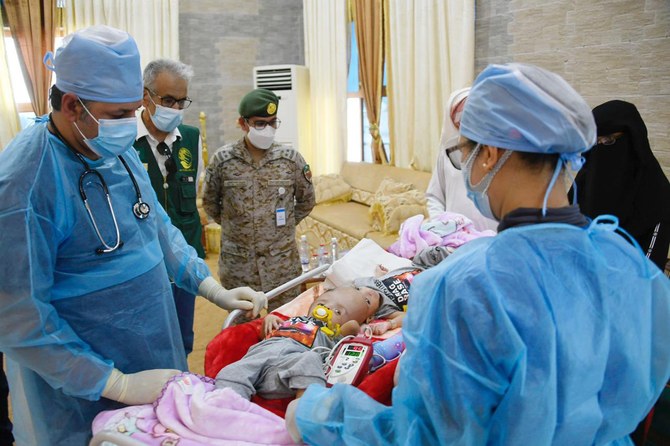
Yemeni conjoined twins “Yousuf and Yassin” arrived in Riyadh via an air medical evacuation plane from Al-Mukalla. (SPA)
4 / 9
Yemeni conjoined twins “Yousuf and Yassin” arrived in Riyadh via an air medical evacuation plane from Al-Mukalla. (SPA)
5 / 9
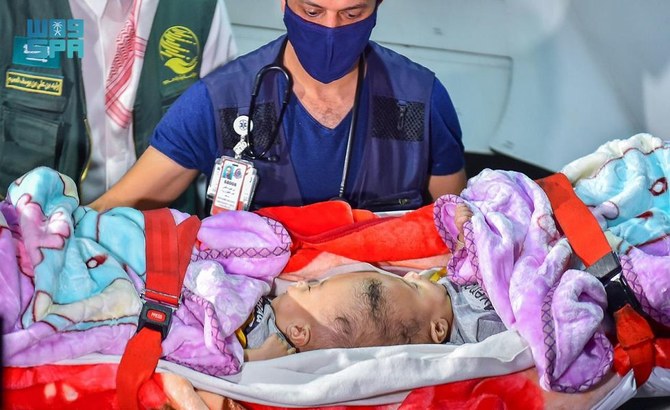
Yemeni conjoined twins “Yousuf and Yassin” arrived in Riyadh via an air medical evacuation plane from Al-Mukalla. (SPA)
6 / 9
Yemeni conjoined twins “Yousuf and Yassin” arrived in Riyadh via an air medical evacuation plane from Al-Mukalla. (SPA)
7 / 9
Yemeni conjoined twins “Yousuf and Yassin” arrived in Riyadh via an air medical evacuation plane from Al-Mukalla. (Twitter/@KSRelief)
8 / 9
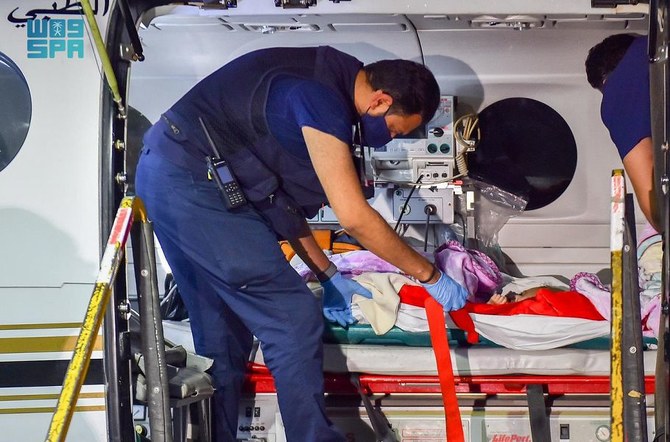
Yemeni conjoined twins “Yousuf and Yassin” arrived in Riyadh via an air medical evacuation plane from Al-Mukalla. (SPA)
9 / 9
Yemeni conjoined twins “Yousuf and Yassin” arrived in Riyadh via an air medical evacuation plane from Al-Mukalla. (Twitter/@KSRelief)
Short Url
Updated 06 May 2021
Follow

Yemeni conjoined twins arrive safely in Saudi Arabia

  • King Salman ordered the speedy transfer of the twins and their parents to the Kingdom for a medical examination
  • This is the 116th case to be examined and assessed by the Saudi National Program for Separating Conjoined Twins since it started in 1990

RIYADH: Yemeni conjoined twins “Yousuf and Yassin” arrived safely with their parents at King Salman Air Base in Riyadh on Wednesday via an air medical evacuation plane from the city of Al-Mukalla.
King Salman ordered the speedy transfer of the twins and their parents to the Kingdom for a medical examination, Dr. Abdullah Al-Rabeeah, the general supervisor of the King Salman Humanitarian Aid and Relief Center (KSrelief) and a renowned pediatric surgeon, said.
According to the Journal of Neurosurgery, craniopagus twins represent a rare phenomenon where twins, joined at the top or side of the head, share a portion of the skull. Cases of conjoined twins are rare — only one per 200,000 births — as most are female, according to various studies.
After their arrival, the twins were transferred to the King Abdullah Specialist Children’s Hospital at the Ministry of National Guard so they could be examined as doctors will consider the possibility of separating them.
Mohammed Abdulrahman, the twins’ father, extended his thanks and gratitude to King Salman and Crown Prince Mohammed bin Salman for transporting the twins and examining their condition. He also praised the warm reception his family received and the Kingdom for its generous humanitarian work.
Al-Rabeeah also thanked the king, the crown prince, and the coalition forces abroad for their “noble humanitarian initiative that comes in recognition of the difficult conditions facing Yemen,” the Saudi Press Agency reported.
This is the 116th case to be examined and assessed by the Saudi National Program for Separating Conjoined Twins since the program started in 1990. Patients from 21 countries have been examined while more than 50 operations have been performed to separate such twins.
Cases of conjoined twins usually occur in Central African, South East Asian and Latin American populations due to an increased rate of identical twins; a determining factor in the birth rate of conjoined twins.


Airbus seeks to strengthen Saudi defense ties

Updated 10 sec ago
Follow

Airbus seeks to strengthen Saudi defense ties

MALHAM: Airbus is aiming to deepen its strategic relationship with Saudi Arabia, a “core customer” in the region, according to Head of Air Power, Airbus Defense and Space Jean-Brice Dumont.

“Saudi Arabia is one of our customers in the region that we have a very strong link with,” Dumont told Arab News on the sidelines of the World Defense Show in Riyadh.

“We have a very strong link with decades of history of Airbus in the country, be it for helicopters, but in my case for military aircraft.

He said the Kingdom was “sort of a hometown for us for these flying platforms and for the maintenance, repair, and overhaul of these platforms.”

Airbus has a longstanding partnership with Saudi Arabia in both commercial and defense aircraft that dates back nearly 50 years.

“We have already invested quite significantly in the region,” Dumont said. “Notably, we have a JV (joint venture) with SAMI (Saudi Arabia Military Industries) in Saudi Arabia and that, I believe is the beginning of a longer journey. But so far, when we see what’s happening in the region, it’s already quite good.”

In 2021 SAMI, a wholly owned subsidiary of the Public Investment Fund and the National Champion of Military Industries Localization, and Airbus signed an agreement to form a joint venture on military aviation services and maintenance, repair and overhaul capabilities.

During the interview Dumont also looked ahead, detailing the strategic roadmap for 2026–2030 that moves beyond traditional hardware toward a digitally-dominant battlefield.

“I think we are reaching the end or the limits of the ‘fighter goes alone’ kind of model,” he said. “Now, the fighters need to communicate, to command drones, to be themselves receiving information by a mass, high-throughput data link so that they can play their role — their new role — in the battlefield.”

He also spoke about how the A330 aircraft was moving beyond its basic reputation as a “flying gas station” to become a high-tech “command center” in the sky.

“The A330 can be first much more automated. The air-to-air refueling can be automatic, and we have developed that capability,” he explained.

“On the other hand, it’s a big platform flying high, which can act as a command-and-control node in the system of systems that the air forces are all aspiring to.”

On the Eurofighter, he said it was “a bit symmetrical,” while speaking about the “buzz” around artificial intelligence he said that while neural networks have been embedded in Airbus platforms for nearly 20 years, the next decade would see AI move to the forefront of decision-making.

From mission preparation to real-time command, he said, the goal is to process vast amounts of data to act faster than the adversary.

“The one who gets that right has won,” he said.