

Robots, AI could double size of Saudi economy to $1.6 trillion: Special report

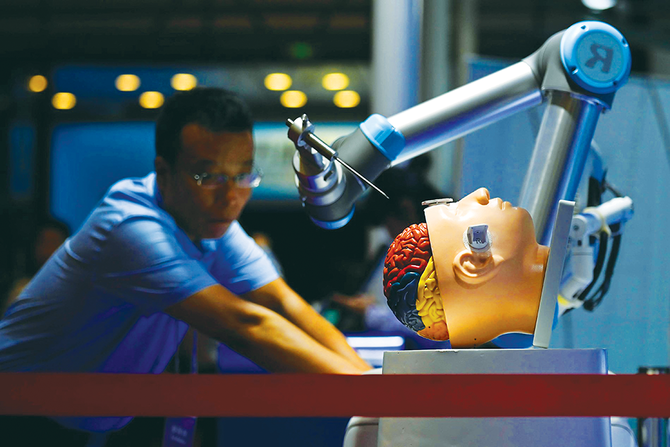
The buoyant outlook for the Kingdom came from research commissioned by Automation Anywhere, a global specialist in robotic process automation. (AFP/File)
Short Url
Updated 03 May 2021
Follow

Robots, AI could double size of Saudi economy to $1.6 trillion: Special report

  • Silicon Valley firm Automation Anywhere to set up in Riyadh, press ahead with major Middle East expansion plans

RIYADH: Saudi Arabia had the potential to double the size of its economy to $1.6 trillion and add an extra $293 billion by 2030 if it fully adopted intelligently automated systems in all sectors, a report has revealed.

The buoyant outlook for the Kingdom came from research commissioned by Automation Anywhere, a global specialist in robotic process automation (RPA).

The study by professional services giant Ernst and Young computed the impact of incremental automation adoption – a combination of RPA and artificial intelligence (AI) – across all sectors in the country, using three possible scenarios.

The first, an optimistic scenario, conveying a 50 percent incremental intelligent automation adoption by organizations throughout the region, was predicted to add $293 billion to the nominal gross domestic product (GDP) by 2030.

A moderate scenario with a 30 percent adoption rate would provide a $184 billion boost to GDP, while a more conservative 15 percent uptake would be expected to generate an additional $103 billion.

Dinesh Chandra, Automation Anywhere’s regional vice president for the Middle East and Turkey, told Arab News that the coronavirus disease (COVID-19) pandemic had emphasized the need to build a strong business infrastructure based on cloud technology and one that was scalable and efficient, allowing organizations to function under most adverse circumstances.

“The Middle East as a region has a strong appetite toward technology adoption, as it is also a government-driven agenda. We are witnessing a strong uptake of automation adoption in the region, especially among customers from the government, banking and insurance, tourism, energy, and metals segments,” Chandra said.

The report identified three critical enablers to accelerate intelligent automation: The need to speed up the digital transformation of government entities and private enterprises by increasing fast and secure services through the cloud; increased training and development in digital skills; and support for a stronger ecosystem of startups, enterprises, government, and academia to drive innovation.

Milan Sheth, executive vice president for India, the Middle East, and Africa at Automation Anywhere, told Arab News that the Silicon Valley-based company – which has more than 3,000 employees and has been operating for nearly 20 years – had secured $550 million in Series A funding, one of the largest in history, backed by the SoftBank Vision Fund, which itself was supported by the Saudi Public Investment Fund (PIF).

“The SoftBank Vision Fund was our biggest investor. And then within three months of that, two more companies invested in us. Last year, we also had Salesforce (an American cloud-based software firm) investing in our company.

“So, in summary, we raised capital close to $1 billion in the last three years. At the last valuation, we were valued at $7 billion, which was a year back. Probably the valuation would be twice that if we went public in the near future,” he said.

Automation Anywhere operates in 90 countries through partner organizations and has a physical presence in 35 nations.

“In the Middle East, we started our operations in the last quarter of 2018 and the beginning of 2019. The indirect investment we have is from the PIF and the (UAE’s) Mubadala Ventures. The SoftBank Vision Fund is the second-largest investor in the company after the founders. So, we clearly have a very strong connection with the Middle East and want to make sure that we are there,” Sheth added.

Saudi Arabia has laid strong foundations by actively promoting private and public partnerships for its Vision 2030 reform plan, a strategic framework to reduce the Kingdom’s dependence on oil, diversify its economy, and develop public service sectors such as health, education, infrastructure, recreation, and tourism.

The company set up an office in Dubai in 2018 and plans to open another in Riyadh. “We are now in the process of getting the tax structuring finalized with the finance team, and hopefully, we will have a physical presence on the ground in the Kingdom very soon,” he said.

The company has ambitious targets in the region having signed up around 50 clients in the last two years. “We believe that five years from now, we will have somewhere between 800 and 1,000 enterprise customers in the region,” Sheth added.


How lifestyle-led real estate is reshaping Saudi Arabia’s urban future

Updated 59 min 10 sec ago
Follow

How lifestyle-led real estate is reshaping Saudi Arabia’s urban future

  • Government spending, regulatory changes, and incentives for foreign investors are fueling development

RIYADH: Saudi Arabia’s real estate sector is entering a new phase, one defined by lifestyle, experience, and quality of life rather than sheer housing volume.

Driven by Vision 2030, lifestyle-focused developments are set to outperform traditional residential projects, reshaping how people live, work, and connect across the Kingdom.
Government spending, regulatory changes, and incentives for foreign investors are also fueling development. Rising demand across residential, commercial, and logistics sectors, along with the push for smart cities and sustainability, is reshaping the market.
Saudi Arabia’s real estate market was valued at $77.2 billion in 2025 and is projected to grow to $137.8 billion by 2034, with a compound annual growth rate of 6.7 percent from 2026 to 2034, according to IMARC Group.

Lifestyle-focused real estate market 
Saudi Arabia’s real estate landscape has evolved beyond conventional housing. Guided by Vision 2030, it now plays a key role in enhancing quality of life, boosting tourism, and driving economic diversification.
According to Sally Menassa, partner at Arthur D. Little, what stands out today is a clear shift from volume-driven residential supply to lifestyle-led, experience-based development.
“As a result, the lifestyle-focused segment is expected to outperform conventional residential real estate, growing at around 8 percent annually over the next five years. This growth is being driven by changing consumer expectations, population growth, rising incomes, and the scale of public investment shaping new urban environments,” Menassa said.
She added that demand in the Kingdom’s real estate is rising across four key segments: mixed-use districts near urban hubs such as King Salman Park; wellness-focused communities prioritizing walkability and services; coastal living along the Red Sea with branded residences; and heritage-driven districts like Diriyah and Al Balad that blend culture, hospitality, and long-term value.
“Overall, this marks a fundamental shift in the Kingdom. Real estate is no longer an end in itself and about delivering buildings; it is becoming a platform for place-making, economic diversification, and sustained value creation,” the ADL partner explained.
From another perspective, Houssem Jemili, senior partner at Bain and Co. Middle East said: “Saudi’s real estate market is forecast at roughly 7–8 percent CAGR to 2030; ‘lifestyle’ demand is being pulled most by amenity-led mixed-use communities plus higher-spec, greener and wellness-leaning homes.”
A report from PwC Middle East released in 2025 focused on the future of sustainable real estate in Saudi Arabia, and  showed that the sector is shifting toward livability-focused, high-quality urban developments. Giga-projects are driving demand for mixed-use, wellness-focused, and socially connected communities that enhance quality of life.
Imad Shahrouri, cities sector lead partner, consulting, in Riyadh at PwC Middle East said: “By placing livability and human experience at the foundation of its urban agenda, Saudi Arabia is shaping a market where lifestyle-led developments will play an increasingly influential role in driving demand and investment.”

Core lifestyle elements developers are prioritizing  
Saudi developers are shifting from the traditional “build and sell” model to creating integrated lifestyle communities focused on long-term value and everyday living.
Menassa from ADL highlighted that the shift centers on enhancing public spaces — with walkable areas, parks, and wellness facilities — to promote healthier, more social lifestyles, especially for a younger, health-focused population.
“Convenience is also playing a bigger role in shaping residential districts. Schools, childcare centers, clinics, co-working spaces and a wide range of food and beverage options are increasingly located within walking distance of homes, reducing commuting time and making everyday life more efficient and connected,” she said.
The partner added: “Equally important is the role of culture and social activity. Many developments now incorporate cultural venues, entertainment spaces and destination dining, ensuring that neighborhoods remain active throughout the day and week rather than becoming dormant outside working hours.”
Menassa went on to stress that real estate in Saudi Arabia is evolving into a strategic tool for quality of life, tourism, and talent attraction. Driven by Vision 2030, developments now integrate smart infrastructure and global lifestyle standards, while staying rooted in local culture to meet the needs of a young, urban population.

FASTFACT

Driven by Vision 2030, lifestyle-focused developments are set to outperform traditional residential projects, reshaping how people live, work, and connect across the Kingdom.

From Bain’s lens, Jemili said: “Developers are prioritizing livable neighborhoods. Walkability, parks and sport, culture and entertainment access, and everyday convenience, shaped by Vision 2030’s Quality of Life agenda and the 70 percent homeownership-by-2030 push.”
Shahrouri from PwC shed light on how developers in the Kingdom prioritizing livability, wellbeing, and inclusive, community-focused spaces are, aligning with Vision 2030’s push to enhance daily life and promote social integration while reflecting local identity.
“As a result, lifestyle-led elements such as walkable neighborhoods, activated public spaces and integrated community facilities are becoming central to new destinations, ensuring future developments foster more connected, resilient and experience-rich ways of living,” he said.

Regions, cities key hubs for experiential development 
Several Saudi cities are emerging as prominent centers for lifestyle-focused, experiential development, each defined by its unique urban and economic character.
From ADL’s perspective, Riyadh is leading this shift as it positions itself as a global capital. The city is seeing strong demand for integrated, mixed-use districts that support live-work-play lifestyles.
“Developments such as KAFD, Diriyah, and areas surrounding King Salman Park reflect a growing preference for urban living that combines employment, culture, green space, and entertainment in close proximity,” Menassa said.
“Jeddah’s appeal is different, but equally compelling. Its strength lies in its coastal character, historic fabric, and more relaxed urban rhythm. Waterfront regeneration and heritage-led districts, particularly around Al Balad, are driving interest in developments that blend walkability, culture, and sea-facing lifestyles — attracting residents, investors, and tourists alike,” she added.
The partner continued to underline that destination developments along the Red Sea coast focus on sustainable, low-density communities blending hospitality, nature, and residential living, promoting wellness and eco-tourism.
Menassa noted that secondary cities like Abha and AlUla are emerging as hubs for outdoor living, culture, and heritage, supported by government policies and investments. 
These lifestyle-driven districts appeal to residents for livability and job access, and to investors for scale and stability, offering resilience through everyday services and cultural experiences.
From Bain’s side, Jemili explained that Riyadh and Jeddah stand out as the main hubs because they combine jobs, population growth, liquidity and are where “integrated community” formats scale fastest.
“We’re seeing the same in Makkah and Madinah; the focus is shifting from delivering more units to delivering higher-quality development and standards,” he said.
From PwC’s perspective, Shahrouri noted that regions across Saudi Arabia are becoming hubs for lifestyle-driven development, with large-scale regeneration creating sustainable, well-designed environments that enhance urban living and attract global investment.
“Flagship projects are reshaping their surroundings by focusing on the character and feel of place, bringing together community elements, environmental responsibility, and integrated urban design.”

 Their growing appeal comes from the balance they strike between modern infrastructure and a human-centered approach to planning, creating destinations where daily life feels more seamless and connected,” he said.

Next phase of Saudi real estate evolution
The next phase of Saudi Arabia’s real estate evolution is likely to be defined by integration, intelligence, and regeneration.
From ADL’s lens, Menassa explained that  Riyadh is set to feature highly vertical, dense urban environments designed for land efficiency and sustainability, with fully integrated live-work-play ecosystems that reduce commuting, boost productivity, and enhance social cohesion.
“The real shift, however, is toward AI-enabled and data-driven communities, where energy, mobility, and services are actively managed rather than passively consumed. Real estate will increasingly be judged not by how much is sold, but by how well places perform — in terms of livability, productivity, and environmental outcomes,” she said.
The partner noted that Saudi Arabia is boosting private sector involvement, public-private partnerships, and institutional investments to develop public spaces and social infrastructure. The focus is shifting from just constructing cities to designing lifestyles, using real estate as a key driver for economic growth and social transformation.
Jemili from Bain said: “The next phase is more about operating districts like platforms, digital twins, and real-time data to optimize energy, maintenance, mobility, and resident experience, creating tighter live-work-play loops. Rather than ‘building more.’”
From PwC’s side, Saudi Arabia is building a strong foundation for future cities by focusing on resilient, resource-efficient developments and adaptable infrastructure, paving the way for smart, connected urban models like vertical districts and digital neighborhoods.
“These emerging environments are set to respond more naturally to the needs of their communities. As the quality and experience of urban life continue to rise, our cities are poised to become more intelligent, enriching and future ready, evolving with their residents and reflecting the ambition of a nation transforming at pace,” Shahrouri concluded.