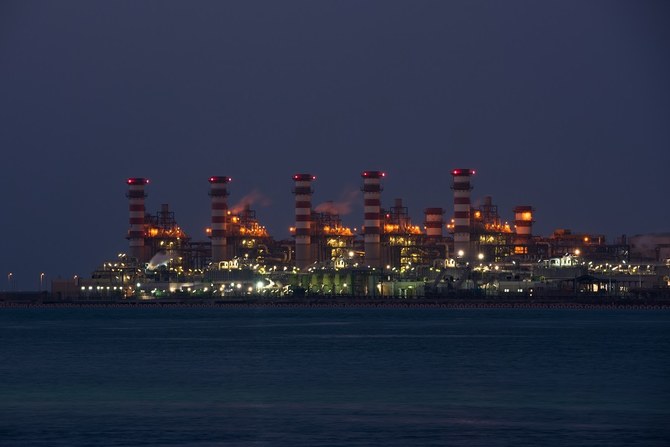
DUBAI: Abu Dhabi energy giant TAQA said it completed a $1.5 billion bond sale that will help repay outstanding debt.
The company also known as Abu Dhabi National Energy Company, said the placement comprised seven-year and 30-year dual-tranche senior unsecured notes, in a stock exchange filing on Sunday.
The seven-year notes, sized at $750 million and maturing April 2028, were issued at a coupon rate of 2 percent. The 30-year notes, also sized at $750 million and maturing April 2051, were issued at a coupon rate of 3.4 percent, it said.
“The strong demand from global credit markets and investors from around the world is a strong vote of confidence in TAQA’s strengthened financial profile as well as the company’s strategy to become a low carbon power and water champion in the UAE and beyond,” said Jasim Husain Thabet, TAQA’s group CEO.
The 30-year tranche was TAQA’s first Formosa issuance dual-listed in Taipei and London to tap into Taiwanese demand.
The order book was four times oversubscribed with strong demand from Asian investors setting the stage for further orders from MENA, Europe and the US, it said.
The issuance was arranged and offered through a syndicate of joint lead managers and bookrunners comprising Bank of China, Citi, First Abu Dhabi Bank, HSBC, Mashreq, Mizuho Securities and MUFG.
In addition to the bond issuance, TAQA offered to buy back all the $1.5 billion of outstanding corporate bonds maturing in 2021 and up to $250 million of the bonds maturing in January 2023.


TAQA completes $1.5bn bond sale
https://arab.news/zb8ub
TAQA completes $1.5bn bond sale

- The seven-year notes, sized at $750 million and maturing April 2028, were issued at a coupon rate of 2 percent
- The 30-year notes, also sized at $750 million and maturing April 2051, were issued at a coupon rate of 3.4 percent


Egypt–Saudi power link set to boost regional energy integration, minister says
RIYADH: Electricity interconnection projects between Egypt and Saudi Arabia will strengthen regional energy cooperation and economic integration, Egypt’s minister of electricity and renewable energy said during a visit to a key cross-border power facility.
Mahmoud Esmat made the remarks while inspecting the Egypt–Saudi electricity interconnection station linking the two countries’ power grids, where he reviewed construction progress and equipment testing ahead of trial operations expected in the coming weeks, according to a statement from the Egyptian State Information Service.
The project is described as the first of its kind in the Middle East in terms of scale, manufacturing technology, operation, and application in grid interconnection lines.
The initiative supports the state’s broader vision to implement sustainable solutions aimed at ensuring the stability of the national unified grid and enhancing the reliability and quality of electricity supply.
It also aligns with Egypt’s allocation of 136.3 billion Egyptian pounds ($2.8 billion) to the electricity and renewable energy sector in its 2025–26 development plan, nearly double the 72.6 billion pounds set aside the previous year.
The plan focuses on diversifying energy sources, expanding renewable capacity, and strengthening the national grid to meet rising demand.
The statement said: “The minister toured the station’s departments and control and operation center, following up on the completion of testing for all equipment and components in preparation for launching operations and synchronizing the project with the unified power grids of Egypt and Saudi Arabia in the coming weeks.”
It added: “Esmat reviewed the implementation rate of the project and testing works, as well as the project’s timeline. He highlighted finalization of operational tests at the Badr transformer station and the Sakakin Taba 2 station, as well as the 500 kilovolts overhead transmission line extending approximately 320 km.”
The minister said the project forms part of broader efforts to build an integrated power network connecting the two countries, facilitating efficient and flexible electricity exchange and laying the groundwork for a unified Arab electricity market.
He added that the initiative reflects a clear vision and comprehensive strategy to strengthen the efficiency of the energy system while delivering both immediate and long-term solutions to safeguard grid stability and enhance service quality.