DUBAI: To be located in AlUla amid the ruins of the ancient North Arabian Kingdom of Dadan and as if to bring back to life the dazzling past of this still enigmatic civilization, the recently announced Kingdom’s Institute, established under the auspices of the Royal Commission for AlUla (RCU), is marked to become AlUla’s global hub for archaeological and conservation research.
Its most prominent buildings are destined to be carved themselves into the mountains opposite the archaeological site of Dadan while the design of the remaining edifices will be inspired by the archaeological structures uncovered pertaining to the Dadan civilization.
“Inspired by the crown prince’s vision for AlUla to protect 200,000 years of history, AlUla’s cultural legacy continues with the Kingdom’s Institute,” Prince Badr bin Abdullah, the Saudi minister of culture and RCU governor, told Arab News.
“It will be a global hub for knowledge, research and collaboration, exploring the frontiers of archaeology and unlocking new careers for our community. The Institute will be a place for discovery and celebration as we unfold Arabia’s contribution to humanity.”
Dadan, a civilization that dates back more than 2,700 years and pre-dates the Nabataean civilization as well as the Roman presence in the Arabian Peninsula, was once the capital for the Dadan and Lihyan Kingdoms and is considered to be one of the most developed 1st-millennium BCE cities of the Arabian Peninsula.
“The ‘era of the kingdoms’ — the time of the Dadan, Lihyan and Nabataean Kingdoms circa 1000 BCE to 106 CE — will be an area of special emphasis for the institute and indeed gives it its name,” said Munirah Almushawh, the archaeology survey lead of the Kingdom’s Institute.
Almushawh is also the first female archaeologist to co-direct an archaeological project in Saudi Arabia. She is working on the Khaybar Long-Duree Archaeological Project, a major archaeological project southwest of AlUla, which is being developed with the French National Centre for Scientific Research.
“In deference to the architectural style of the district, the institute’s permanent home will be a red sandstone structure echoing the monumental works of the Dadan civilization,” Almushawh said.
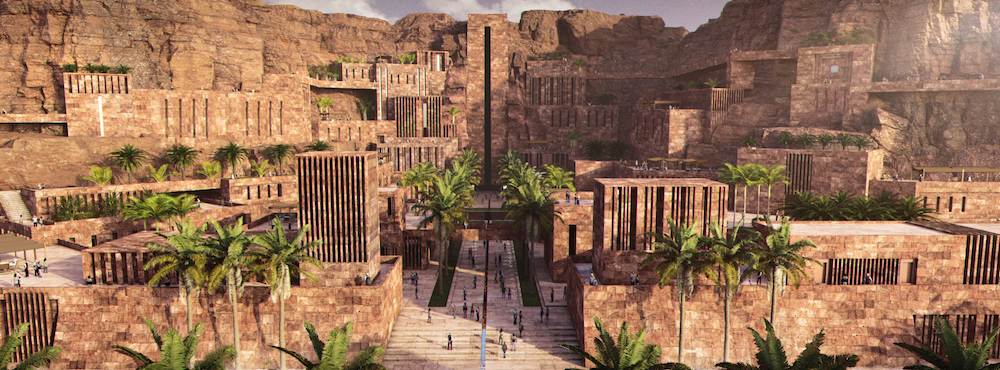
The design of the Kingdoms Institute will be inspired by the works of the Dadan civilisation with the most prominent buildings carved into the mountains opposite the archaeological site of Dadan. (Supplied)
The institute, which is part of AlUla’s recently announced “The Journey Through Time: a masterplan for preserving and sustainably developing Saudi Arabia’s ancient AlUla,” is expected to complete its first phase of construction by 2023 and open to visitors by 2030, which is also the year of the Saudi Vision 2030. It forecasts a visitation of 838,000 people by 2035.
“In a spirit of co-construction and co-development of research with its partner French Agency for Alula Development (AFALULA), specialized and original research programs have been set up with the best experts in the region in order to write the history from the Neolithic to today of this unique heritage jewel in the world,” Ingrid Perisse, AFALULA’s head of archaeological and cultural heritage projects, told Arab News.
“The interdisciplinary research teams that take turns on the different sites have made AlUla the most important archaeological hub in the Arabian Peninsula.”
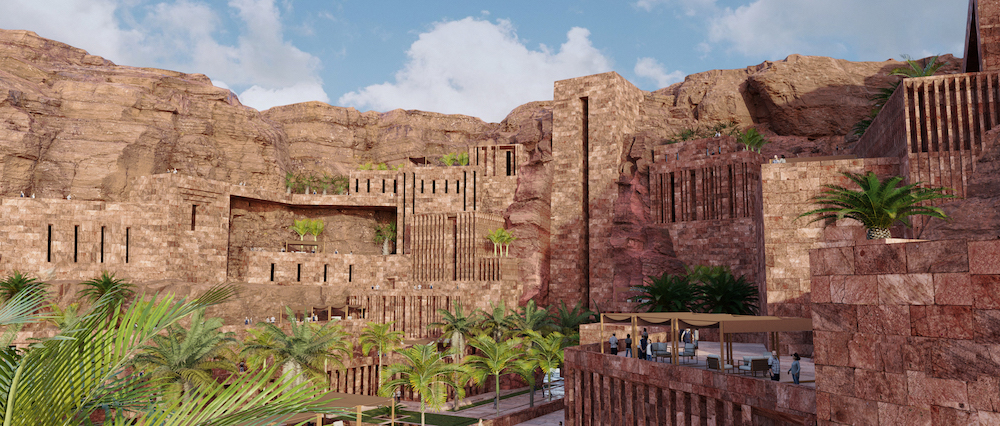
The design of the Kingdoms Institute will be inspired by the works of the Dadan civilisation with the most prominent buildings carved into the mountains opposite the archaeological site of Dadan. (Supplied)
Perisse said the scientific community will come together for this project.
“Historians, geo-archaeologists, ceramologists, numismatists and other specialists of this scientific community bring their knowledge and know-how to participate in the training of the next generation of Saudi archaeologists,” she said.
History and heritage are at the heart of the Dadan district and its upcoming Kingdom’s Institute. With its enduring sense of mystery, perpetuated by its magnetic red rocks, the institute intends to pay homage to Saudi Arabia’s past as well as the role AlUla will play in the future of the Kingdom.
The Kingdom’s Institute will be built on a 28,857 square-meter site. Inside will be a multidisciplinary and innovative scientific center where visitors and residents can study from seven core archaeological programs, including rock art conservation and preservation, inscriptions and languages, prehistoric and historic agriculture and sustainability, connectivity and the archaeological record, in addition to seven major disciplines, from research to fieldwork, publishing and exhibition management.
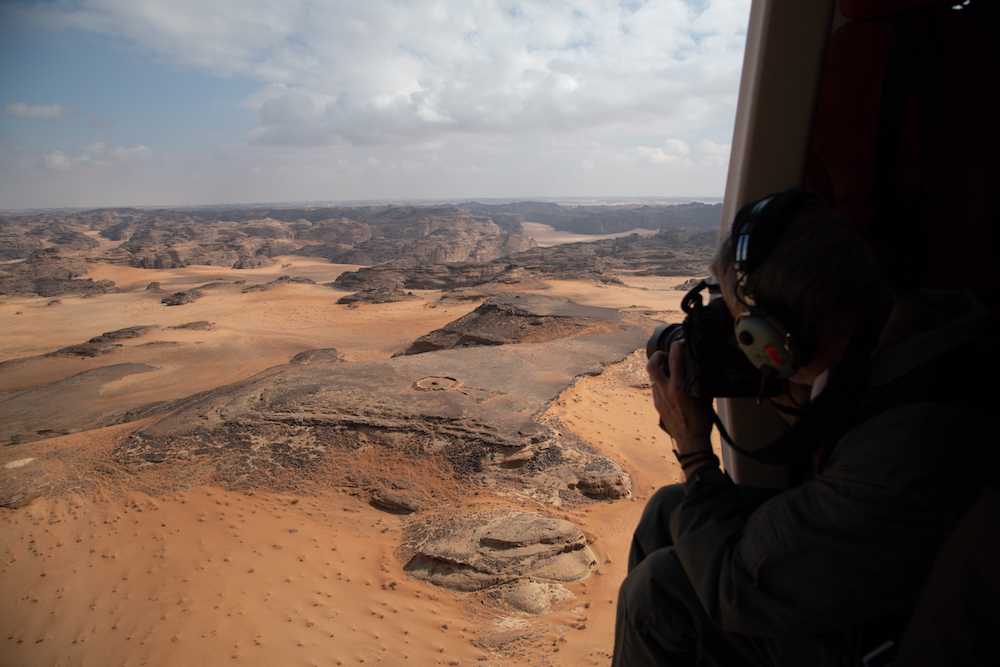
Extensive aerial surveys of AlUla, conducted by a University of Western Australia team, are providing a fuller picture of its rich archaeological heritage, including this tomb in Sharaan. (Supplied)
The Institute will provide access to the study of 200,000 years of history and prehistory amid a survey of 22,675 square meters. Already, the Institute has begun preparing 15 research and conservation missions.
One example is the recent discovery of mustatils, fence-like structures built by people thousands of years ago in what is now Saudi Arabia by piling rocks to form low walls that were then formed in the shape of rectangles.
While the existence of the mustatils was previously known, the more than 1,000 mustatils that the RCU-commissioned team recently recorded, are approximately twice as many as were previously identified and constituted the largest study of mustatils to date.
“We have only begun to tell the hidden story of the ancient kingdoms of North Arabia,” RCU Archaeology, Heritage Research and Conservation Executive Director José Ignacio Gallego Revilla told Arab News.
“There is much more to come as we reveal the depth and breadth of the area’s archaeological heritage, which for decades has been underrepresented, but which will finally have the showcase it deserves in the Kingdom’s Institute.”