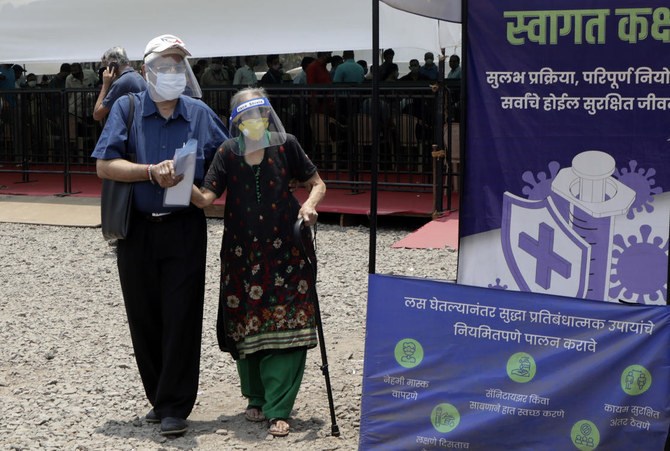
BENGALURU: All vaccination centers in India’s financial capital of Mumbai were shut for three days starting Friday due to a shortage of vaccines, said authorities, as the country posted another record daily rise in coronavirus cases.
India reported 386,452 news cases on Friday, while deaths from COVID-19 jumped by 3,498 over the last 24 hours, according to health ministry data.
However, medical experts believe actual COVID-19 numbers in the world’s second-most populous nation may be five to 10 times greater than the official tally.
India has added about 7.7 million cases since the end of February, when its second wave picked up steam, according to a Reuters tally. In contrast, it took India nearly six months to add the previous 7.7 million cases.
The country is in deep crisis, with hospitals and morgues overwhelmed, medicines and oxygen in short supply and strict curbs on movement in its biggest cities.
India is the world’s biggest producer of vaccines but does not have enough stockpiles to keep up with the second deadly COVID-19 wave, despite Prime Minister Narendra Modi’s government planning to vaccinate all adults starting May 1. Only about 9 percent of India’s 1.4 billion people have received a vaccine dose since January.
Several states have said they will be unable to immunize people aged 18-45 immediately.
Modi is scheduled to meet cabinet of ministers on Friday as the wave of infections cripples the nation’s health system and threatens to impact major businesses as absenteeism grows with staff falling sick or taking leave to tend to sick relatives.
World aid has started arriving in India as it struggles to combat what has been described as a humanitarian disaster.
The first US flight carrying oxygen cylinders, regulators, rapid diagnostic kits, N95 masks and pulse oximeters arrived in the Indian capital Delhi on Friday.
“Just as India came to our aid early in the pandemic, the US is committed to working urgently to provide assistance to India in its time of need,” US Secretary of State Antony Blinken said on Twitter.
“Today we are proud to deliver our first shipment of critical oxygen equipment, therapeutics and raw materials for vaccine production.”

COVID-19 vaccination centers close in Mumbai as India posts another record rise in cases
Short Url
https://arab.news/yeq69
COVID-19 vaccination centers close in Mumbai as India posts another record rise in cases
- India reported 386,452 news cases on Friday, while deaths from COVID-19 jumped by 3,498 over the last 24 hours
- The country is in deep crisis, with hospitals and morgues overwhelmed, medicines and oxygen in short supply
China’s top diplomat to visit Somalia on Africa tour
- Stop in Mogadishu provides diplomatic boost after Israel became the first country to formally recognize breakaway Somaliland
- Tour focusses on Beijing's strategic trade access across eastern and southern Africa
BEIJING: China’s top diplomat began his annual New Year tour of Africa on Wednesday, focusing on strategic trade access across eastern and southern Africa as Beijing seeks to secure key shipping routes and resource supply lines.
Foreign Minister Wang Yi will travel to Ethiopia, Africa’s fastest-growing large economy; Somalia, a Horn of Africa state offering access to key global shipping lanes; Tanzania, a logistics hub linking minerals-rich central Africa to the Indian Ocean; and Lesotho, a small southern African economy squeezed by US trade measures. His trip this year runs until January 12.
Beijing aims to highlight countries it views as model partners of President Xi Jinping’s flagship “Belt and Road” infrastructure program and to expand export markets, particularly in young, increasingly affluent economies such as Ethiopia, where the IMF forecasts growth of 7.2 percent this year.
China, the world’s largest bilateral lender, faces growing competition from the European Union to finance African infrastructure, as countries hit by pandemic-era debt strains now seek investment over loans.
“The real litmus test for 2026 isn’t just the arrival of Chinese investment, but the ‘Africanization’ of that investment. As Wang Yi visits hubs like Ethiopia and Tanzania, the conversation must move beyond just building roads to building factories,” said Judith Mwai, policy analyst at Development Reimagined, an Africa-focussed consultancy.
“For African leaders, this tour is an opportunity to demand that China’s ‘small yet beautiful’ projects specifically target our industrial gaps, turning African raw materials into finished products on African soil, rather than just facilitating their exit,” she added.
On his start-of-year trip in 2025, Wang visited Namibia, the Republic of Congo, Chad and Nigeria.
His visit to Somalia will be the first by a Chinese foreign minister since the 1980s and is expected to provide Mogadishu with a diplomatic boost after Israel became the first country to formally recognize the breakaway Republic of Somaliland, a northern region that declared itself independent in 1991.
Beijing, which reiterated its support for Somalia after the Israeli announcement in December, is keen to reinforce its influence around the Gulf of Aden, the entrance to the Red Sea and a vital corridor for Chinese trade transiting the Suez Canal to Europe.
Further south, Tanzania is central to Beijing’s plan to secure access to Africa’s vast copper deposits. Chinese firms are refurbishing the Tazara Railway that runs through the country into Zambia. Li Qiang made a landmark trip to Zambia in November, the first visit by a Chinese premier in 28 years.
The railway is widely seen as a counterweight to the US and European Union-backed Lobito Corridor, which connects Zambia to Atlantic ports via Angola and the Democratic Republic of the Congo.
By visiting the southern African kingdom of Lesotho, Wang aims to highlight Beijing’s push to position itself as a champion of free trade. Last year, China offered tariff-free market access to its $19 trillion economy for the world’s poorest nations, fulfilling a pledge by Chinese President Xi Jinping at the 2024 China-Africa Cooperation summit in Beijing.
Lesotho, one of the world’s poorest nations with a gross domestic product of just over $2 billion, was among the countries hardest hit by US President Donald Trump’s sweeping tariffs last year, facing duties of up to 50 percent on its exports to the United States.
Foreign Minister Wang Yi will travel to Ethiopia, Africa’s fastest-growing large economy; Somalia, a Horn of Africa state offering access to key global shipping lanes; Tanzania, a logistics hub linking minerals-rich central Africa to the Indian Ocean; and Lesotho, a small southern African economy squeezed by US trade measures. His trip this year runs until January 12.
Beijing aims to highlight countries it views as model partners of President Xi Jinping’s flagship “Belt and Road” infrastructure program and to expand export markets, particularly in young, increasingly affluent economies such as Ethiopia, where the IMF forecasts growth of 7.2 percent this year.
China, the world’s largest bilateral lender, faces growing competition from the European Union to finance African infrastructure, as countries hit by pandemic-era debt strains now seek investment over loans.
“The real litmus test for 2026 isn’t just the arrival of Chinese investment, but the ‘Africanization’ of that investment. As Wang Yi visits hubs like Ethiopia and Tanzania, the conversation must move beyond just building roads to building factories,” said Judith Mwai, policy analyst at Development Reimagined, an Africa-focussed consultancy.
“For African leaders, this tour is an opportunity to demand that China’s ‘small yet beautiful’ projects specifically target our industrial gaps, turning African raw materials into finished products on African soil, rather than just facilitating their exit,” she added.
On his start-of-year trip in 2025, Wang visited Namibia, the Republic of Congo, Chad and Nigeria.
His visit to Somalia will be the first by a Chinese foreign minister since the 1980s and is expected to provide Mogadishu with a diplomatic boost after Israel became the first country to formally recognize the breakaway Republic of Somaliland, a northern region that declared itself independent in 1991.
Beijing, which reiterated its support for Somalia after the Israeli announcement in December, is keen to reinforce its influence around the Gulf of Aden, the entrance to the Red Sea and a vital corridor for Chinese trade transiting the Suez Canal to Europe.
Further south, Tanzania is central to Beijing’s plan to secure access to Africa’s vast copper deposits. Chinese firms are refurbishing the Tazara Railway that runs through the country into Zambia. Li Qiang made a landmark trip to Zambia in November, the first visit by a Chinese premier in 28 years.
The railway is widely seen as a counterweight to the US and European Union-backed Lobito Corridor, which connects Zambia to Atlantic ports via Angola and the Democratic Republic of the Congo.
By visiting the southern African kingdom of Lesotho, Wang aims to highlight Beijing’s push to position itself as a champion of free trade. Last year, China offered tariff-free market access to its $19 trillion economy for the world’s poorest nations, fulfilling a pledge by Chinese President Xi Jinping at the 2024 China-Africa Cooperation summit in Beijing.
Lesotho, one of the world’s poorest nations with a gross domestic product of just over $2 billion, was among the countries hardest hit by US President Donald Trump’s sweeping tariffs last year, facing duties of up to 50 percent on its exports to the United States.
© 2026 SAUDI RESEARCH & PUBLISHING COMPANY, All Rights Reserved And subject to Terms of Use Agreement.


