Malaysians throng popular Ramadan bazaars

1 / 3
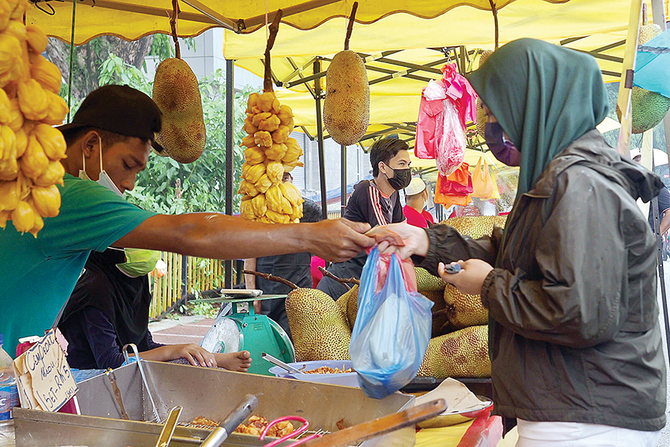
Ramadan bazaars are a staple among Malaysians, with several visiting the highly popular markets after breaking their fasts at sunset. (AN photo by Hadi Azmi)
2 / 3
Ramadan bazaars are a staple among Malaysians, with several visiting the highly popular markets after breaking their fasts at sunset. (AN photo by Hadi Azmi)
3 / 3
Ramadan bazaars are a staple among Malaysians, with several visiting the highly popular markets after breaking their fasts at sunset. (AN photo by Hadi Azmi)
Short Url
Updated 27 April 2021
Follow

Malaysians throng popular Ramadan bazaars

  • Most are excited to go to the markets but worry about a spike in infections

KUALA LUMPUR: Two weeks into the holy month of Ramadan, and despite supporting the government’s decision to reopen traditional food bazaars, several Malaysians say they now fear a spike in coronavirus disease (COVID-19) infections, citing poor implementation of health protocols at the highly popular markets. 

Unlike last year, when the government had canceled the famous bazaars in the early days of the pandemic to limit the spread of the outbreak, the markets are now allowed to operate, provided traders and visitors adhere to strict standard operating procedures (SOP) and checks. 

Earlier this month, the Kuala Lumpur City Council said that 65 bazaars would be allowed to operate from 3 p.m. to 8 p.m. during Ramadan, before reiterating that compliance with SOPs was of utmost importance, especially those set by the National Security Council, such as mandatory face masks, body temperature scans and checking in with a dedicated mobile application. 

Malaysia’s Ramadan bazaars date back to the 1980s. Eddin Khoo, a cultural activist focusing on Malay cultures, said that the concept gained popularity for its “food sharing culture.”

“In the 1970s, it was a smaller-scale home industry based on the idea of communal eating,” Khoo told Arab News. 

He added that the bazaars’ unique selling point is that they cater to both Muslims and non-Muslims in Malaysia. 

The bazaars are usually attended by thousands of people, who go out for late-night meals after breaking their fast at sunset or iftar time. 

They feature hundreds of stalls with hawkers and street vendors selling local delicacies and hot food.

FASTFACT

Unlike last year, when the government had canceled the famous bazaars in the early days of the pandemic to limit the spread of the outbreak, the markets are now allowed to operate.

“Last year, everyone sorely missed the bazaars when they were canceled due to the pandemic. That was when we realized how important they are to the Malaysian community,” he said. 

Adit Rahim, 44, told Arab News that the bazaars were smaller compared to those of the past few years. 

Still, he has “adapted to the situation,” hoping for things to improve in the country. 

On Monday, Malaysia had registered 395,718 COVID-19 cases and 1,449 deaths, while 369,556 people had recovered from the disease since the start of the pandemic last year. 

Rahim said that while the SOPs are in place, they are not “well-explained, documented and disseminated” at the bazaars. 

“When I arrived at the check-in counter, I had to remind the enforcement officer to enforce physical distancing, especially with children present,” he explained. 

Nurul Syazwani Yahi, 29, said she was “excited to visit a bazaar” but “genuinely concerned” about the spike in infections as well. 

“I believe basic hygiene needs to be emphasized more at the bazaar because it is still very poor,” she told Arab News. 

Meanwhile, City Mayor Mahadi Che Ngah told Arab News that health protocols are necessary for the bazaars to run smoothly. To control the crowds at the bazaars, the mayor said an enforcement team comprising officials from various departments within the council had been deployed at the bazaars. 

“We are also working closely with the police and immigration departments throughout the period,” he added. 

Authorities in Malaysia are aiming to more strictly enforce the SOPs, while one bazaar in the state of Selangor has already been ordered to shut down due to compliance failures.


Only 4% women on ballot as Bangladesh prepares for post-Hasina vote

Updated 5 sec ago
Follow

Only 4% women on ballot as Bangladesh prepares for post-Hasina vote

  • Women PMs have ruled Bangladesh for over half of its independent history
  • For 2026 vote, only 20 out of 51 political parties nominated female candidates

DHAKA: As Bangladesh prepares for the first election since the ouster of its long-serving ex-prime minister Sheikh Hasina, only 4 percent of the registered candidates are women, as more than half of the political parties did not field female candidates.

The vote on Feb. 12 will bring in new leadership after an 18-month rule of the caretaker administration that took control following the student-led uprising that ended 15 years in power of Hasina’s Awami League party.

Nearly 128 million Bangladeshis will head to the polls, but while more than 62 million of them are women, the percentage of female candidates in the race is incomparably lower, despite last year’s consensus reached by political parties to have at least 5 percent women on their lists.

According to the Election Commission, among 1,981 candidates only 81 are women, in a country that in its 54 years of independence had for 32 years been led by women prime ministers — Hasina and her late rival Khaleda Zia.

According to Dr. Rasheda Rawnak Khan from the Department of Anthropology at Dhaka University, women’s political participation was neither reflected by the rule of Hasina nor Zia.

“Bangladesh has had women rulers, not women’s rule,” Khan told Arab News. “The structure of party politics in Bangladesh is deeply patriarchal.”

Only 20 out of 51 political parties nominated female candidates for the 2026 vote. Percentage-wise, the Bangladesh Socialist Party was leading with nine women, or 34 percent of its candidates.

The election’s main contender, the Bangladesh Nationalist Party, whose former leader Zia in 1991 became the second woman prime minister of a predominantly Muslim nation — after Pakistan’s Benazir Bhutto — was the party that last year put forward the 5 percent quota for women.

For the upcoming vote, however, it ended up nominating only 10 women, or 3.5 percent of its 288 candidates.

The second-largest party, Jamaat-e-Islami, has not nominated a single woman.

The 4 percent participation is lower than in the previous election in 2024, when it was slightly above 5 percent, but there was no decreasing trend. In 2019, the rate was 5.9 percent, and 4 percent in 2014.

“We have not seen any independent women’s political movement or institutional activities earlier, from where women could now participate in the election independently,” Khan said.

“Real political participation is different and difficult as well in this patriarchal society, where we need to establish internal party democracy, protection from political violence, ensure direct election, and cultural shifts around female leadership.”

While the 2024 student-led uprising featured a prominent presence of women activists, Election Commission data shows that this has not translated into their political participation, with very few women contesting the upcoming polls.

“In the student movement, women were recruited because they were useful, presentable for rallies and protests both on campus and in the field of political legitimacy. Women were kept at the forefront for exhibiting some sort of ‘inclusive’ images to the media and the people,” Khan said.

“To become a candidate in the general election, one needs to have a powerful mentor, money, muscle power, control over party people, activists, and locals. Within the male-dominated networks, it’s very difficult for women to get all these things.”