NEW DELHI: India’s new coronavirus infections hit a record peak for a fifth day on Monday as countries including Britain, Germany and the United States pledged to send urgent medical aid to help battle the crisis overwhelming its hospitals.
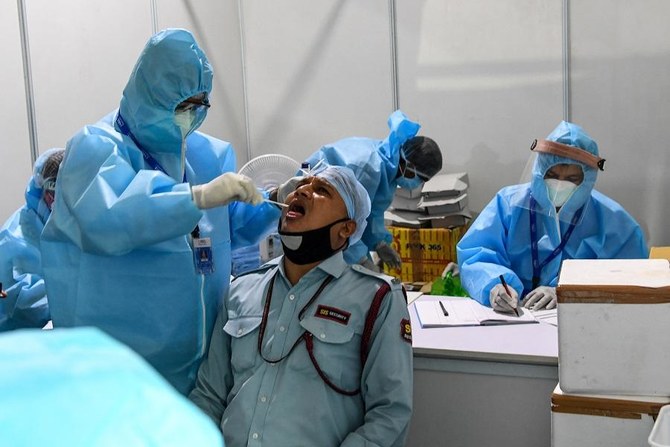
Infections in the last 24 hours rose to 352,991, with overcrowded hospitals in Delhi and elsewhere turning away patients after running out of supplies of medical oxygen and beds.
“Currently the hospital is in beg-and-borrow mode and it is an extreme crisis situation,” said a spokesman for the Sir Ganga Ram Hospital in the capital, New Delhi.
On Sunday, Prime Minister Narendra Modi urged all citizens to get vaccinated and exercise caution, while hospitals and doctors have put out urgent notices saying they were unable to cope with the rush of patients.
In some of the worst-hit cities, including New Delhi, bodies were being burnt in makeshift facilities offering mass services.
Television channel NDTV broadcast images of three health workers in the eastern state of Bihar pulling a body along the ground on its way to cremation, as stretchers ran short.
“If you’ve never been to a cremation, the smell of death never leaves you,” Vipin Narang, a political science professor at Massachusetts Institute of Technology (MIT) in the United States, said on Twitter.
“My heart breaks for all my friends and family in Delhi and India going through this hell.”
On Sunday, President Joe Biden said the United States would send raw materials for vaccines, medical equipment and protective gear to India. Germany joined a growing list of countries pledging to send supplies.
India, with a population of 1.3 billion, has a tally of 17.31 million infections and 195,123 deaths, after 2,812 deaths overnight, health ministry data showed, although health experts say the death count is probably far higher.
The scale of the second wave knocked oil prices on Monday, as traders worried about a fall in fuel demand in the world’s third-biggest oil importer.
RALLY BACKLASH
Politicians, especially Modi, have faced criticism for holding rallies attended by thousands of people, packed close together in stadiums and grounds, despite the brutal second wave of infections.
Several cities have ordered curfews, while police have been deployed to enforce social distancing and mask-wearing.
Still, about 8.6 million voters were expected to cast ballots on Monday in the eastern state of West Bengal, in the penultimate part of an eight-phase election that will wrap up this week.
Voting for local elections in other parts of India included the most populous state of Uttar Pradesh, which has been reporting an average of 30,000 infections a day.
Modi’s plea on vaccinations came after inoculations peaked at 4.5 million doses on April 5, but have since averaged about 2.7 million a day, government figures show.
Several states, including Maharashtra, the richest, halted vaccinations in some places on Sunday, saying supplies were not available.
Supply has fallen short of demand as the inoculation campaign was widened this month, while companies struggle to boost output, partly because of a shortage of raw material and a fire at a facility making the AstraZeneca dose.
Hospitals in Modi’s home state of Gujarat are among those facing an acute shortage of oxygen, doctors said.
Just seven ICU beds of a total of 1,277 were available in 166 private hospitals designated to treat the virus in the western state’s largest city of Ahmedabad, data showed.
“The problem is grim everywhere, especially in smaller hospitals, which do not have central oxygen lines and use cylinders,” said Mona Desai, former president of the Ahmedabad Medical Association.


![]()

India’s coronavirus crisis deepens as countries promise aid
Short Url
https://arab.news/znty2
India’s coronavirus crisis deepens as countries promise aid
- Prime Minister Narendra Modi urged all citizens to get vaccinated and exercise caution
- President Joe Biden said the US would send raw materials for vaccines, medical equipment and protective gear to India


Latest updates





© 2026 SAUDI RESEARCH & PUBLISHING COMPANY, All Rights Reserved And subject to Terms of Use Agreement.